
Handwriting Analysis Will Contest Florida | Trust Counsel
By Leslie V. Marenco · Published November 6, 2026
In a handwriting analysis will contest Florida matter, an examiner can help show that a signature was not made by the person who died. A trained examiner compares the disputed signature with known genuine samples and reports the differences and similarities. The examiner’s report is evidence, not the final ruling. This page explains how a handwriting analysis will contest Florida cases usually works, what evidence is compared, and the short deadline that applies.
When a Signature on a Florida Will Is Challenged as Forged
A forged signature challenge says the will was signed by someone other than the person who died. If that is true, the document does not carry that person’s real intent. Forgery is one of several grounds people raise in a will contest. The others include undue influence, lack of testamentary capacity (the mental ability to make a will) and improper signing.
Florida law says a will is void if its execution is procured by fraud, duress, mistake, or undue influence (§ 732.5165). Whether a signature is genuine is a factual question. Handwriting evidence is one way to address it. Improper signing is a separate issue. A will must be signed and witnessed the way the statute requires (§ 732.502).
Who can contest? The personal representative must promptly serve a notice of administration on certain known persons, such as the decedent’s surviving spouse (§ 733.212). No one can start a contest before the person who made the will has died (§ 732.518). A contest usually comes after the will is offered for probate in a Florida court.

Not sure what your next step is?
Talk it through with our team — the first discovery call is free, confidential, and carries no obligation.
How a Handwriting Analysis Will Contest Florida Wills: The Examiner’s Role
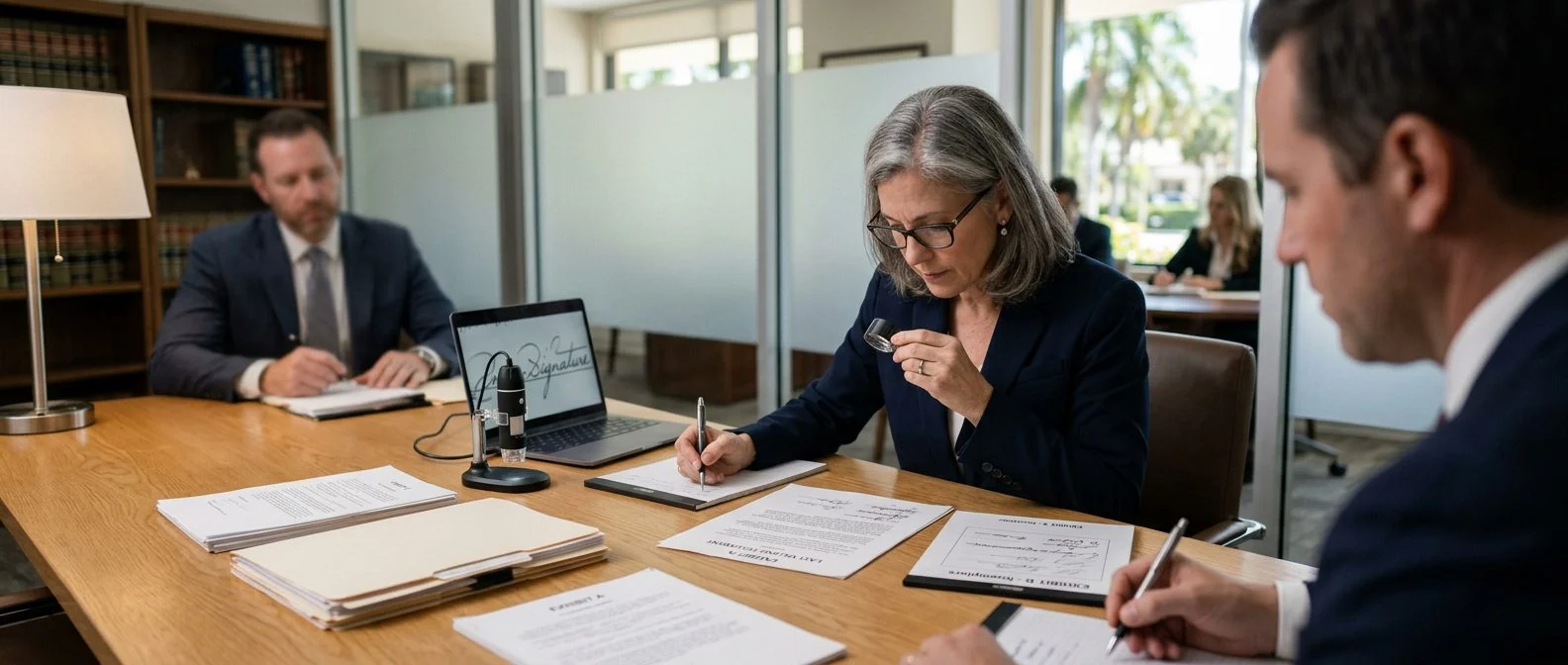
A handwriting examiner is a third-party witness who compares writing and reports what they find. In a handwriting analysis will contest Florida matter, the examiner works the way a forensic document examiner does. That means a side-by-side comparison, documented features and a stated opinion with its limits.
One side often hires the examiner. The other side can challenge the work, the method and the samples used. The examiner does not decide the case. The examiner reports observations and an opinion. The judge decides the contest and how much weight the testimony deserves.
Trust Counsel’s attorneys play a different role. They advise and represent the parties. They decide how the examiner’s report fits the overall case. The examiner does the comparison. The attorneys build the case around it.
The Evidence a Handwriting Examiner Compares
The examiner compares the questioned signature with known exemplars. Known exemplars are genuine writing from the person who died. They often come from dated checks, letters, deeds or earlier estate papers. Samples written close in time to the will are often easier to compare, because handwriting changes with age and health.
The questioned document is the will or codicil itself. The original matters more than a copy. Pen pressure, line quality and ink are hard to judge on a photocopy. A scan can hide the small stops, pen lifts and tremor that an examiner looks for.
The examiner studies letter formation, spacing, slant, tremor, stops and pen lifts. Each feature is compared across the samples to see what matches and what does not.
The result depends on the quality and number of exemplars. It also depends on whether the original is available. The examiner’s conclusion may be qualified when samples are limited. Some opinions come with stated limits rather than a firm answer.
When a Handwriting Analysis Matters Most in a Florida Contest
Handwriting analysis matters most when the signature itself is the central dispute. It can also carry weight when the person’s health or hand was impaired at the time of signing. It can matter when attesting witnesses cannot clearly recall the signing.
A review of the relevant documents is often the first step. In all proceedings contesting the validity of a will, the proponent of the will has the burden of establishing prima facie its formal execution and attestation. After that, the contestant has the burden of establishing the grounds on which probate of the will is opposed or revocation is sought (§ 733.107). After that, the contestant carries the burden on the grounds for opposing probate (§ 733.107).
A self-proving affidavit executed in accordance with s. 732.503 is admissible and establishes prima facie the formal execution and attestation of the will (§ 733.107). Handwriting evidence usually sits alongside other proof. That proof includes how the will was signed, the drafting history and the relationships among the people involved.
Have questions about what happened?
Ask our team directly. The first conversation is free, confidential, and there is no obligation to continue.
Timing, Procedure and Preserving the Original Will
The window to object is short. You must file an objection within 3 months after the notice of administration is served on you, or the objection is forever barred (§ 733.212). That rule covers objections to the will’s validity, the venue, or the court’s jurisdiction. The 3-month period can be extended only for estoppel based on a misstatement by the personal representative about the deadline. It cannot be extended for other reasons, such as failure to disclose information.
The outside limit is the earlier of a final discharge order or 1 year after service of the notice. Under Fla. Stat. § 733.212, persons who may be entitled to exempt property under s. 732.402 are deemed to have waived that right unless a petition for determination of exempt property is filed by them or on their behalf. Persons entitled to exempt property are deemed to have waived their rights to claim that property as exempt property unless a petition for determination of exempt property is filed by such persons or on their behalf on or before the later of the date that is 4 months after the date of service of a copy of the notice of administration on such persons or the date that is 40 days after the date of termination of any proceeding involving the construction, admission to probate, or validity of the will or involving any other matter affecting any part of the exempt property (§ 733.212). The deadline is the later of 4 months after service of a copy of the notice of administration on them or 40 days after the termination of any proceeding involving the construction, admission to probate, or validity of the will, or involving any other matter affecting any part of the exempt property. This exempt-property deadline is separate from the deadline for objecting to the will’s validity, venue, or the court’s jurisdiction.
Preserve the evidence early. Keep the original will in a safe place and do not mark or alter it. Gather known exemplars while documents and people are still available. Early steps can affect what evidence remains.
A common sequence runs in order. The will is offered for probate. The notice of administration is served. A petition or objection is filed. Then handwriting analysis is requested as the case moves forward. Florida’s civil rules of evidence apply in these proceedings unless the Probate Code changes them (§ 731.1035).
Limits and Risks of Relying on Handwriting Analysis
A handwriting analysis is one piece of evidence. It cannot promise how the court will rule. The answer depends on the facts.
The opinion can be challenged. The other side can question the examiner’s method, the samples chosen and the conclusions drawn. Cross-examination is a normal part of that process. After the proponent makes a prima facie showing of formal execution and attestation, the contestant bears the burden of establishing the grounds on which probate of the will is opposed or revocation is sought (§ 733.107).
Retaining an examiner and gathering known samples takes time and effort. Those steps are easier when planning starts early. Delay also has costs. Witnesses may move or forget details, documents may be lost, and the original may become harder to locate.
A contest can include other grounds too. The examiner’s findings are one part of the evidence. The signing circumstances, the witnesses and the history of the will matter as well.

Talking Through a Disputed Signature With Trust Counsel
Trust Counsel, PL is a trusts and estates law firm with its only office in Coral Gables, Florida. Leslie V. Marenco is the responsible lawyer for this page. We serve clients in Florida. In probate and trust disputes, the firm advises and represents trustees, personal representatives and beneficiaries. Trust Counsel’s attorneys can serve individually as trustee or personal representative.
If a family member’s signature on a will looks wrong, and the will has already been offered for probate, the timing may already be running. A discovery call is a good time to review the original document and the dates that may apply to you. The first discovery call is free, confidential and without obligation to continue. Call (305) 707-7126 or schedule your discovery call online.
Common questions
Can a handwriting examiner prove a will was forged?
An examiner gives an opinion about the signature. The court decides whether the will is valid.
Is a photocopy of the will enough?
A copy can be used, but the original lets an examiner study pen pressure and ink more closely.
How long do I have to contest a will in Florida?
You must object to the will’s validity, the venue, or the court’s jurisdiction by filing a petition or other pleading within 3 months after the notice of administration is served on you, or the objection is forever barred. The 3-month period may only be extended for estoppel based upon a misstatement by the personal representative regarding the time period, under § 733.212.
Ready to take the next step?
Want to know where you stand?
Tell us what happened and our team will walk you through the options available to you, at no cost.