
Probate Litigation | Coral Gables, Florida
Questioning a Signature on a Florida Will?
Learn how a forensic document examiner fits into a Florida will contest, and talk with Leslie V. Marenco about your options. Your first consultation is free, confidential and comes with no obligation to continue.
By Leslie V. Marenco · Published October 27, 2026
A handwriting examiner compares a questioned signature on a will with writing the decedent is known to have made. The examiner gives an opinion on whether the writing matches. The judge decides what that opinion means in the case. In a Florida will contest, this evidence is one tool among several.
What a Handwriting Examiner Does in a Florida Will Contest
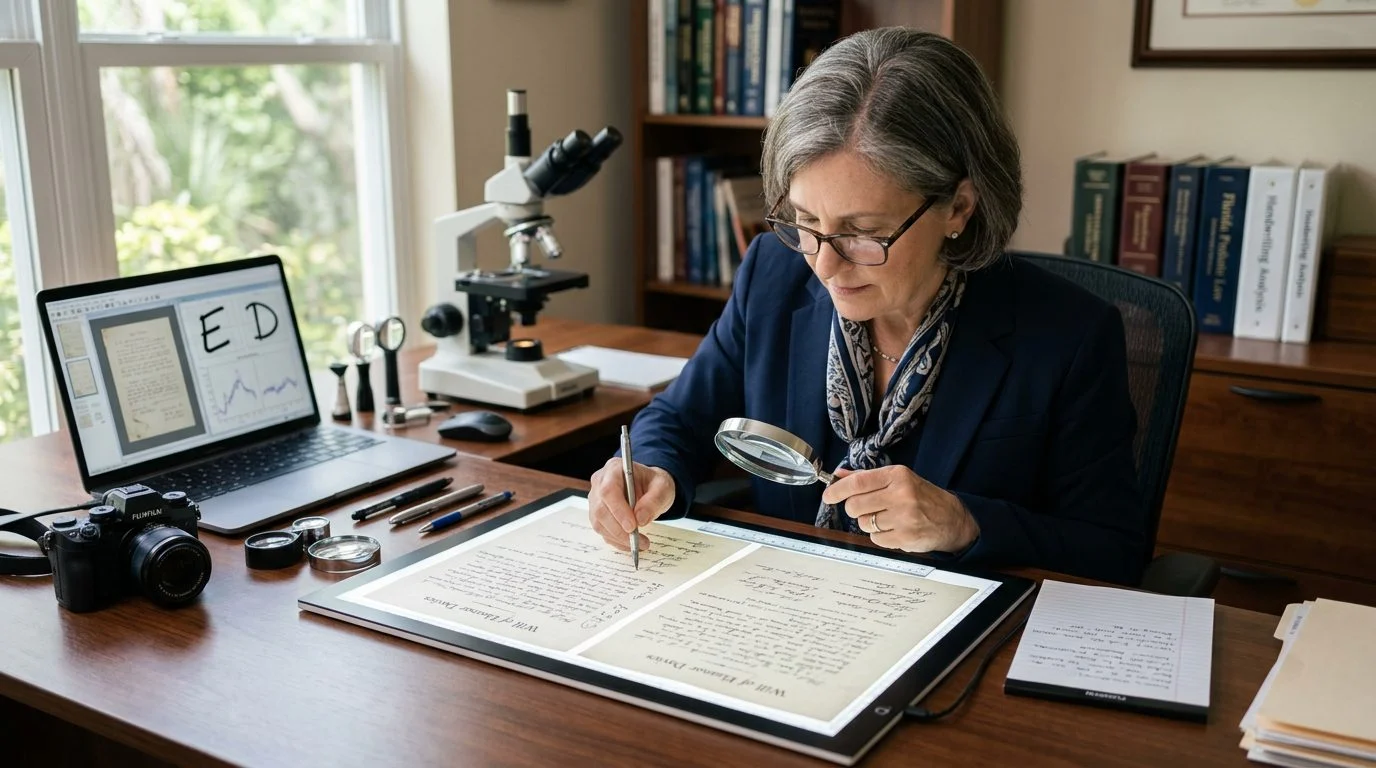
A handwriting examiner, also called a forensic document examiner, studies handwriting and signatures for a living. In a will dispute, the examiner looks at a disputed signature and compares it with known samples. The examiner then gives an opinion on whether the same person likely wrote both.
The examiner doesn’t decide who wins. That job belongs to the court. The opinion is one piece of evidence the judge weighs with witness testimony and the other facts.
Usually the examiner’s work starts after a lawyer has pinned down the exact document and the exact signature in question. A vague feeling that something looks off gives the examiner little to test. A clear question gives the examiner something to measure. For example: does the signature on the last page match the decedent’s signature on a bank card?
If you doubt that a parent's signature on a will is genuine, you may have a claim worth reviewing, and we can talk it through with you. Talk it through with Trust Counsel, PL — the first consultation is free, confidential, and carries no obligation.
Where a Signature Challenge Fits Among Florida Will Contest Grounds
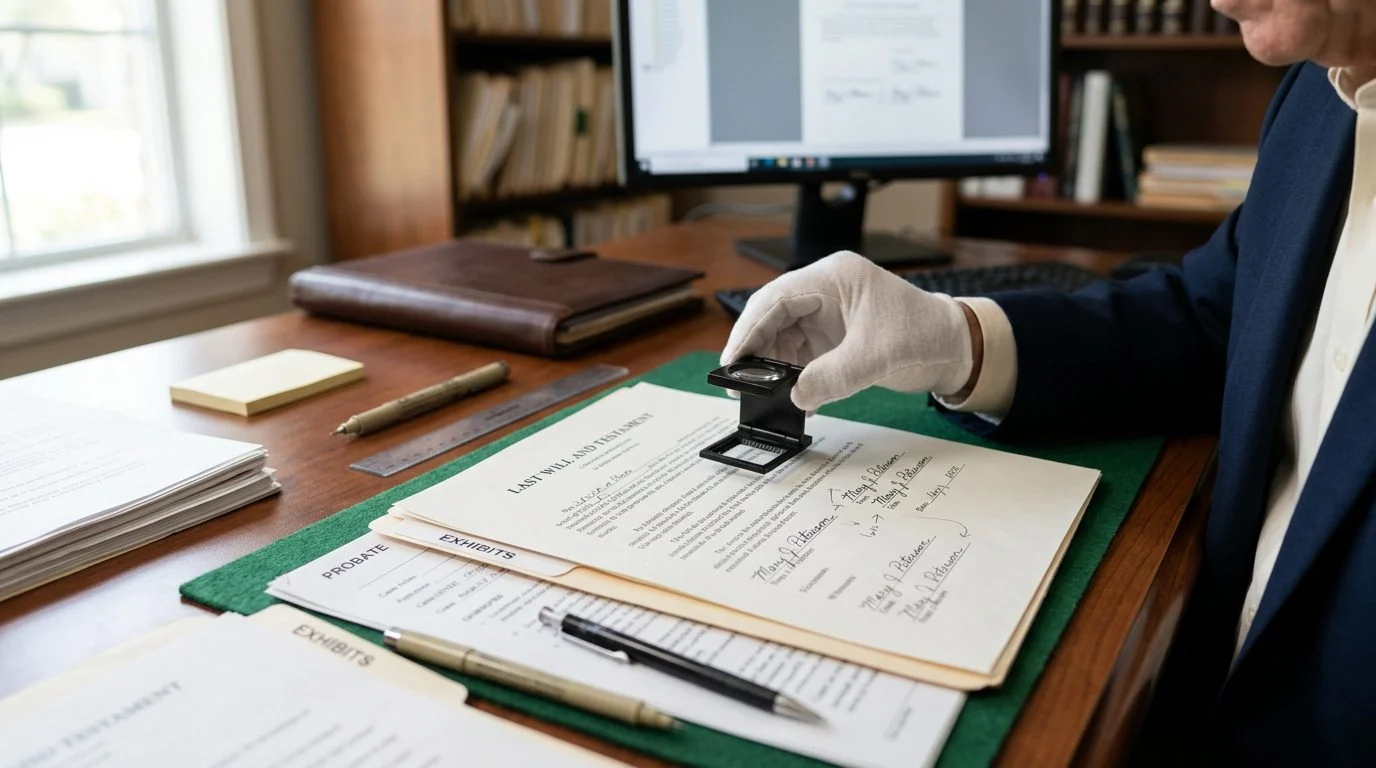
A signature challenge is usually one part of a larger case. Common grounds include forgery or fraud, improper execution, lack of capacity, and undue influence.
Florida law sets the basic formalities. A will must be in writing. The testator must sign it at the end, or another person must sign the testator’s name in the testator’s presence and by the testator’s direction. At least two attesting witnesses must see the signing or acknowledgment. They must sign in the presence of the testator and of each other, under Fla. Stat. § 732.502. If those steps were missed, the signature is only one of several possible defects.
Under Fla. Stat. § 732.502, every will must be in writing and executed as follows; fraud, duress, mistake, or undue influence can also void a will under Fla. Stat. § 732.5165. Under Fla. Stat. § 732.5165, a will is void if its execution was procured that way. Any part procured that way is void, but the rest stays valid if it isn’t invalid for other reasons.
Forgery and undue influence often grow from the same facts. Someone who controlled a parent’s money may also have had access to the parent’s pen and papers. Florida also has a special rule for undue influence. Where the presumption of undue influence applies, it implements public policy against abuse of fiduciary or confidential relationships and is a presumption shifting the burden of proof under ss. 90.301-90.304.
How Handwriting Comparisons Are Built
A comparison starts with known samples, called known exemplars. These are writings the decedent made in the ordinary course of life. Checks, letters, cards, bills, and earlier legal documents are common examples.
The quality and age of those samples matter. A signature from ten years ago may look different from one written during an illness. Samples written close in time to the disputed signature usually help more. A large, varied set gives the examiner a better picture of how the person normally wrote.
The original will is generally needed too. A copy can lose pen pressure, ink flow, and fine line detail. Those details help an examiner judge whether a signature flowed naturally or was traced. NIST’s forensic handwriting research describes general standards and limits that apply to this kind of work.
What an Examiner’s Report Can and Cannot Establish
A report can support a claim that a signature was not written by the decedent. It can weaken that claim. It can also leave the question open. The result depends on the facts of each case, including the samples available.
Examiners look for natural variation in handwriting. They also watch for signatures that are unusually identical, which can suggest tracing or copying. The American Academy of Forensic Sciences discusses these general methods for detecting forged signatures.
Examiners also make errors. A peer-reviewed study on handwriting comparisons examines how examiners compare questioned writing with known samples and reports on their accuracy and error rates.
The court still considers the whole record. Witness testimony, the circumstances of signing, and the estate planning history all matter. Under Fla. Prob. R. 5.275, in a proceeding contesting a will, the proponent must first establish prima facie the will’s formal execution and attestation. After that, the contestant must establish the grounds for opposing probate.
Timing and Preserving the Evidence
Florida sets a short window to object to a will. Under Fla. Stat. § 733.212, an interested person served with a notice of administration must object to the will’s validity on or before 3 months after service. Otherwise those objections are forever barred. The statute also sets an outer limit: objections must be filed no later than the earlier of the entry of an order of final discharge of the personal representative or 1 year after service of the notice of administration. Under Fla. Stat. § 733.212(2)(d), persons who may be entitled to exempt property under s. 732.402 are deemed to have waived their right to claim that property as exempt unless a petition for determination of exempt property is filed by them or on their behalf on or before the later of 4 months after the date of service of a copy of the notice of administration on them or 40 days after the date of termination of any proceeding involving the construction, admission to probate, or validity of the will, or involving any other matter affecting any part of the exempt property. The 3-month period may only be extended for estoppel based on a misstatement by the personal representative about the deadline.
Timing also works in another direction. Under Fla. Stat. § 732.518, an action to contest a will may not be started before the testator dies.
Preserve evidence right away. Keep the original will, any envelopes, drafts, and the decedent’s known writing samples. Don’t mark, copy over, or handle the originals more than necessary. Delay can narrow the evidence available for a comparison, and some records are harder to recover later.
When the Circumstances of Signing Matter
Signing circumstances often matter as much as the signature itself. A will signed in a hospital bed raises questions about capacity, who was in the room, and whether the witnesses actually saw the signing. Our trust litigation attorney page covers the broader picture of contesting a will.
Some wills are self-proved. Under Fla. Stat. § 733.201, self-proved wills executed in accordance with this code may be admitted to probate without further proof, but a purportedly self-proved electronic will with a substantial failure to comply with the online notarization procedures may be admitted only as subsections (2) and (3) provide. A self-proving affidavit made under Fla. Stat. § 732.503 involves the testator’s acknowledgment and the witnesses’ sworn statements before an officer. Under Fla. Stat. § 733.107, that affidavit establishes prima facie the formal execution. A self-proved will can still be challenged on other grounds.
Handwriting evidence and signing-circumstance evidence are often reviewed together. A signature that matches the decedent’s known writing may still raise questions if the signing setting was irregular. The reverse is also true.
Not sure what your next step is?
Talk it through with Trust Counsel, PL — the first consultation is free, confidential, and carries no obligation.
Talking With a Trust Litigation Attorney in Coral Gables
You may be reading this because a parent or relative left a will you didn’t expect. You may have received a notice of administration and want to understand your options before deadlines pass. That’s a stressful position, and you don’t have to sort it out alone.
Trust Counsel, PL focuses on probate and trust litigation for beneficiaries, heirs, and fiduciaries. The firm advises and represents trustees, personal representatives, and beneficiaries. Its only office is in Coral Gables, Florida. Leslie V. Marenco is the responsible lawyer for this page. Trust Counsel’s attorneys can serve individually as trustee or personal representative.
Your first consultation is free, confidential, and carries no obligation to continue. Bring the will, any notice you received, and the documents you think show the decedent’s real handwriting. Call (305) 707-7126 or schedule a consultation online to review the document and the questioned signature.

Frequently Asked Questions
What does a handwriting examiner do in a Florida will contest?
A handwriting examiner, also called a forensic document examiner, compares a disputed signature or handwritten text with known samples to offer an opinion about who wrote it. In a Florida will contest, that opinion can be one piece of evidence the court considers when a signature or handwritten will is questioned.
How long do you have to file a will contest in Florida?
Under Florida Statute 733.212(3), any interested person on whom a copy of the notice of administration is served must file an objection to the validity of the will, the venue, or the jurisdiction of the court on or before the date that is 3 months after the date of service of the notice of administration on that person, and in all cases no later than the earlier of the entry of an order of final discharge of the personal representative or 1 year after service of the notice of administration. Because deadlines depend on the facts, speak with an attorney promptly if you have concerns.
Can a handwriting opinion alone decide whether a Florida will is valid?
No. A handwriting opinion is not automatically decisive, and the court weighs it together with other evidence, such as the circumstances of signing, witness testimony, and the person’s mental capacity at the time.
What should I do if I think a handwritten will or signature was forged?
Keep the original documents safe, avoid altering them, and write down what you know about when and how they were created. Trust Counsel, PL offers a free first consultation that is confidential and carries no obligation to continue.
How a Handwriting Question Is Handled
Gather the Original Documents
Originals, known signature samples and the circumstances of signing often matter. Preserving them early helps keep the evidence intact.
Evaluate the Handwriting Evidence
A forensic document examiner compares the disputed writing with known samples and gives an opinion on the comparison. Whether that opinion is useful depends on the full record.
Plan the Litigation Strategy
Probate litigation attorneys weigh the handwriting evidence alongside the other facts, the governing Florida law and the goals of the people involved.
Advise Every Interested Party
Beneficiaries, heirs and personal representatives each have different interests. Trust Counsel, PL focuses on representing beneficiaries, heirs and fiduciaries in probate and trust disputes.
Act Promptly to Protect the Evidence
Timing matters in a will contest. If you question a signature or handwritten will, speak with an attorney as soon as possible.
Common Questions About Handwriting in Will Contests
What does a handwriting examiner do?
A forensic document examiner compares a disputed signature or handwritten text with known samples and offers an opinion about authorship.
Can a handwritten will be challenged?
A handwritten will can be questioned in court, just as a typed will can. Handwriting evidence is often central, so it helps to review the documents with an attorney early.
Who can serve as a fiduciary in these matters?
Trust Counsel's attorneys can serve individually as trustee or personal representative. The firm advises and represents trustees, personal representatives and beneficiaries.
Where is the firm located?
Trust Counsel, PL has its office in Coral Gables, Florida. We serve clients in Fort Lauderdale, Boca Raton, West Palm Beach, Doral, Kendall, Pinecrest, Key Biscayne, Aventura and throughout Florida.