
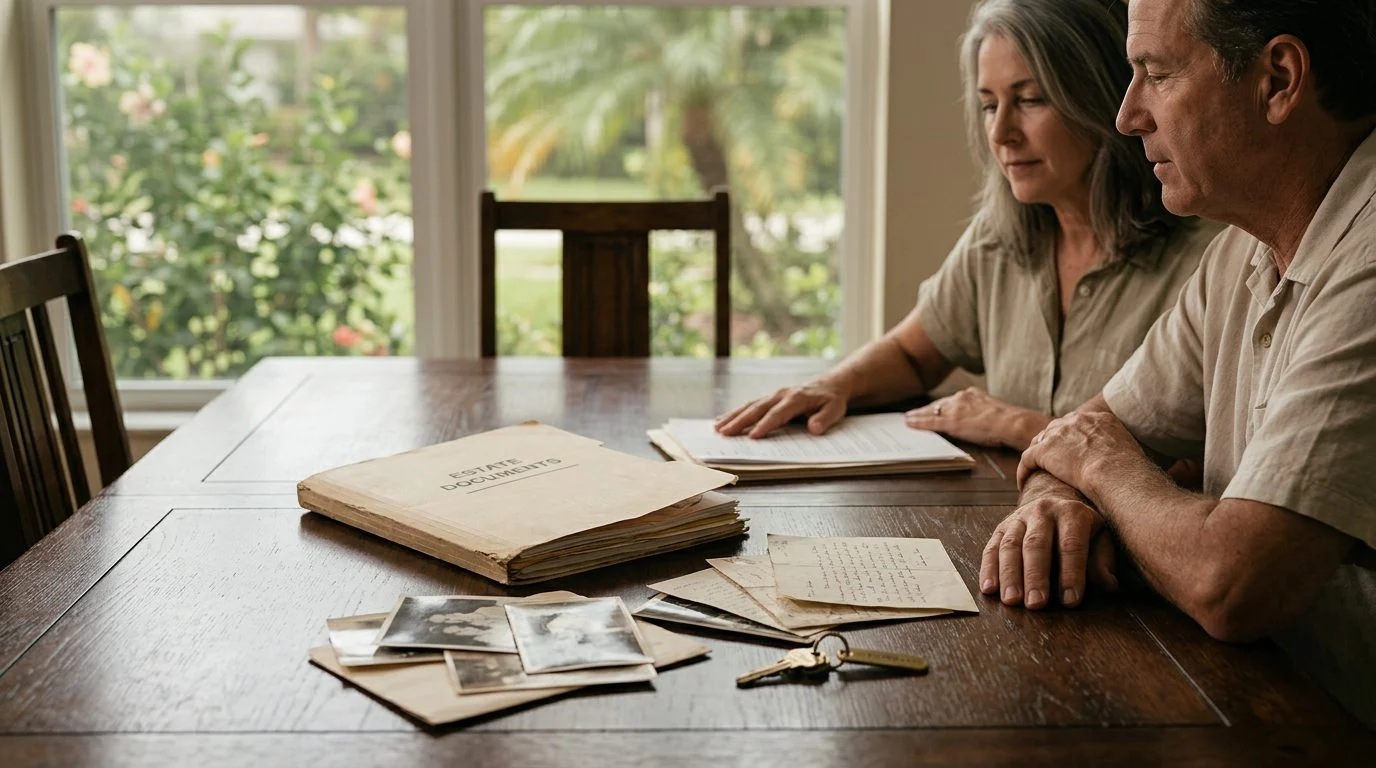
Heirship disputes | Coral Gables, Florida
Heirs Without a Will: Get Clear Answers on Florida Heirship
Whether you are a family member questioning who qualifies as an heir or a fiduciary facing competing claims, Trust Counsel's Coral Gables attorneys can review the facts with you early.
By Leslie V. Marenco · Published November 9, 2026
A family member has died without a will, and now relatives are arguing about who gets a share. That is the core of an heirship dispute in Florida.
An heirship dispute starts when people disagree about who the legal heirs are. Florida’s probate statutes set an order for heirs, and a court decides any relationship that is in doubt.
What a heirship dispute is and who it affects
An heirship dispute is a disagreement about who the legal heirs of a person are when that person left no valid will. Heirs are the people who take property under the statutes, so their status controls who receives property.
These fights usually begin with a family relationship, not with how property is split. One person says they are a child or spouse. Another person says they are not.
The people most often involved include:
- Surviving spouses
- Children, including children born outside marriage or adopted children
- Parents, siblings and their children
- Stepchildren who believe they are entitled to a share
- The personal representative (often called an executor), who manages the estate
- Beneficiaries or heirs who object to the family tree

Not sure what your next step is?
Talk it through with our team — the first discovery call is free, confidential, and carries no obligation.
Who inherits when there is no will in Florida
A surviving spouse and the decedent’s descendants usually come first. More distant relatives take only when no closer heir exists.
Property that a will does not effectively dispose of passes to the heirs. The death itself vests that right (Fla. Stat. § 732.101).
The spouse’s share depends on who else survives (§ 732.102):
- If there are no surviving descendants, the spouse takes the entire intestate estate.
- If some descendants are not the spouse’s lineal descendants, the spouse takes one-half. If all the descendants are also the spouse’s, the spouse takes the entire estate when the spouse has no other descendant, and one-half when the spouse has descendants who are not the decedent’s (§ 732.102).
The part not going to the spouse goes first to the decedent’s descendants.
Florida uses per stirpes distribution (§ 732.104). In plain terms, a share that would have gone to a relative who died first passes to that relative’s own children.
Stepchildren often assume they inherit by relationship alone. Florida’s rules turn on descent and adoption, so a stepchild’s claim must fit those rules.
Heirs, next of kin and the affidavit of heirship
An heir is someone the intestate statutes entitle to property. Next of kin is a broader, everyday term for close family, and people often mix up the two.
An affidavit of heirship (also called an affidavit of heirs) is a sworn statement about a decedent’s family. It usually names the spouse and children and lists marriages, divorces and deaths. It is often used when real property must be transferred or title must be cleared.
The affidavit is only as accurate as the records behind it. Missing birth, marriage or divorce papers can cause errors, and an error can start a dispute.
An affidavit does not end a disagreement.
Common causes of heirship disputes
Most heirship disputes trace back to one family fact that the paper trail does not clearly show.
- Children born outside marriage. The child is a descendant of the mother. The child is a descendant of the father if the parents had a marriage ceremony, even a void one, if paternity is established by adjudication, or if the father acknowledges paternity in writing (§ 732.108).
- For intestate succession, an adopted person is generally treated as the adopting parent’s descendant, not the natural parent’s. The statute includes exceptions, such as adoption by a natural parent’s spouse.
- Terminated parental rights. For intestate succession, a parent whose rights were terminated under chapter 39 before the child’s death is barred from inheriting from or through that child (§ 732.1081).
- Disputed marriages. Questions about whether the decedent was legally married, or whether a divorce was final, can change who the spouse is.
- Competing requests to serve. In an intestate estate, the surviving spouse has first preference, then the person chosen by a majority of heirs, then the heir nearest in degree (§ 733.301).
How heirs contest heirship in Florida court
An heir who disagrees with the family tree can ask the court to decide. The usual tool is a petition to determine beneficiaries.
When property passes by intestate succession, or the will is unclear, and there is doubt about who is entitled to it, any interested person may petition the court to determine beneficiaries or their shares (§ 733.105). The petition must list everyone who may have an interest, except the decedent’s creditors, who are known to the petitioner or ascertainable by diligent search and inquiry, and describe each person’s interest (Fla. Prob. R. 5.385).
After formal notice and hearing, the court must enter an order determining the beneficiaries, their shares, or both (Fla. Prob. R. 5.385).
Objections to a will’s validity, the venue or the court’s jurisdiction run on a separate clock. Under § 733.212, an interested person served with a notice of administration must file an objection to the validity of the will, the venue, or the jurisdiction of the court within 3 months after service, or the objection is forever barred; the period can be extended only for estoppel based on the personal representative’s misstatement of the deadline.
Evidence usually comes from birth, marriage and divorce records, court orders and adoption papers. The court weighs what those records show.
Some families settle. Florida’s court ADR handbook notes that mediation confidentiality provisions may apply.
Have questions about what happened?
Ask our team directly. The first conversation is free, confidential, and there is no obligation to continue.
What to expect: the process step by step
Expect the process to move from records, to notice, to objections, and then to settlement or a hearing.
- Gather the records. An authenticated copy of a death certificate from the place of death is prima facie proof of the death, its place, date and time, and the decedent’s identity (§ 731.103). Add birth, marriage, divorce and adoption papers, and build a family chart that matches them.
- Decide who petitions to serve. The priority rules in § 733.301 shape every later step.
- Give and check notice. Under § 731.301, persons given proper notice are bound by all orders entered in that proceeding. Review every notice carefully.
- File objections or a petition. Use a petition to determine beneficiaries, and track the 3-month objection window for any objection that challenges the validity of the will, the venue, or the jurisdiction of the court in § 733.212.
- Settle or get a ruling. Parties may settle through mediation or move toward a hearing. After formal notice and hearing, the court enters an order on the beneficiaries and their shares.
The timeline varies with how many relationships are disputed, what records exist, and when the court can hear the matter.
Why Trust Counsel for heirship disputes
Trust Counsel, PL focuses on probate litigation, trust litigation and trust and estate administration. The firm’s only office is in Coral Gables, Florida, and it serves clients across Florida.
Leslie V. Marenco is the lawyer responsible for this page. The firm’s lawyers include Leslie V. Marenco and Tanya Vega. The firm also has support staff.
Trust Counsel’s attorneys can serve individually as trustee or personal representative. The firm advises and represents trustees, personal representatives and beneficiaries, including heirs who object to a family tree.
Related topics include tortious interference with an expected inheritance, and trust situations where no successor trustee is named.
Common questions about heirship disputes in Florida
These short answers cover common questions about heirship in Florida.
Can a stepchild inherit in Florida without a will?
A stepchild’s claim turns on Florida’s descent and adoption rules, not on the relationship alone.
Can an heir challenge an affidavit of heirship?
Yes. Questions about the facts stated in an affidavit can be discussed with an attorney.
Who gets priority to serve as personal representative?
In an intestate estate, the surviving spouse comes first. The person chosen by a majority of heirs comes next, then the heir nearest in degree (§ 733.301).
Do I need a lawyer to raise an objection?
Objections are filed in court and involve notice, deadlines and evidence. A lawyer can explain how those rules apply to your family’s facts.
Does every heirship dispute go to court?
Not always. Some families settle through mediation, which may be faster than litigation.

Talk with Trust Counsel about your family’s situation
If a relative died without a will and your place in the family is now in question, you don’t have to sort through the records alone.
Trust Counsel, PL offers a free discovery call, which is confidential and carries no obligation to continue. Call (305) 707-7126 or schedule online.
Want to know where you stand?
Tell us what happened and our team will walk you through the options available to you, at no cost.
How Trust Counsel approaches heirship matters
Review the family facts
We look at the decedent's relationships, prior marriages, adoptions and any documents already filed before anyone relies on them.
Protect your position
We help heirs and beneficiaries understand what to ask for and what to avoid signing while a question is open.
Plain-language guidance
We explain the options in clear terms so you can make informed decisions about your family's next steps.
Before you sign anything
Do not sign an affidavit of heirship, accept property or agree to a family arrangement until an attorney has reviewed the facts. Assumptions about who is family can be incorrect.
Matters we handle in heirship disputes
Probate litigation
Contested estates where heirs disagree about who should receive property or serve as personal representative.
Trust litigation
Disputes involving trust property, beneficiary claims and the duties owed by a trustee.
Trust administration
Guidance for trustees and beneficiaries as a trust is administered while an heirship question is pending.
Guardianship
Support for families when a minor or incapacitated person's interests must be protected during a dispute.