
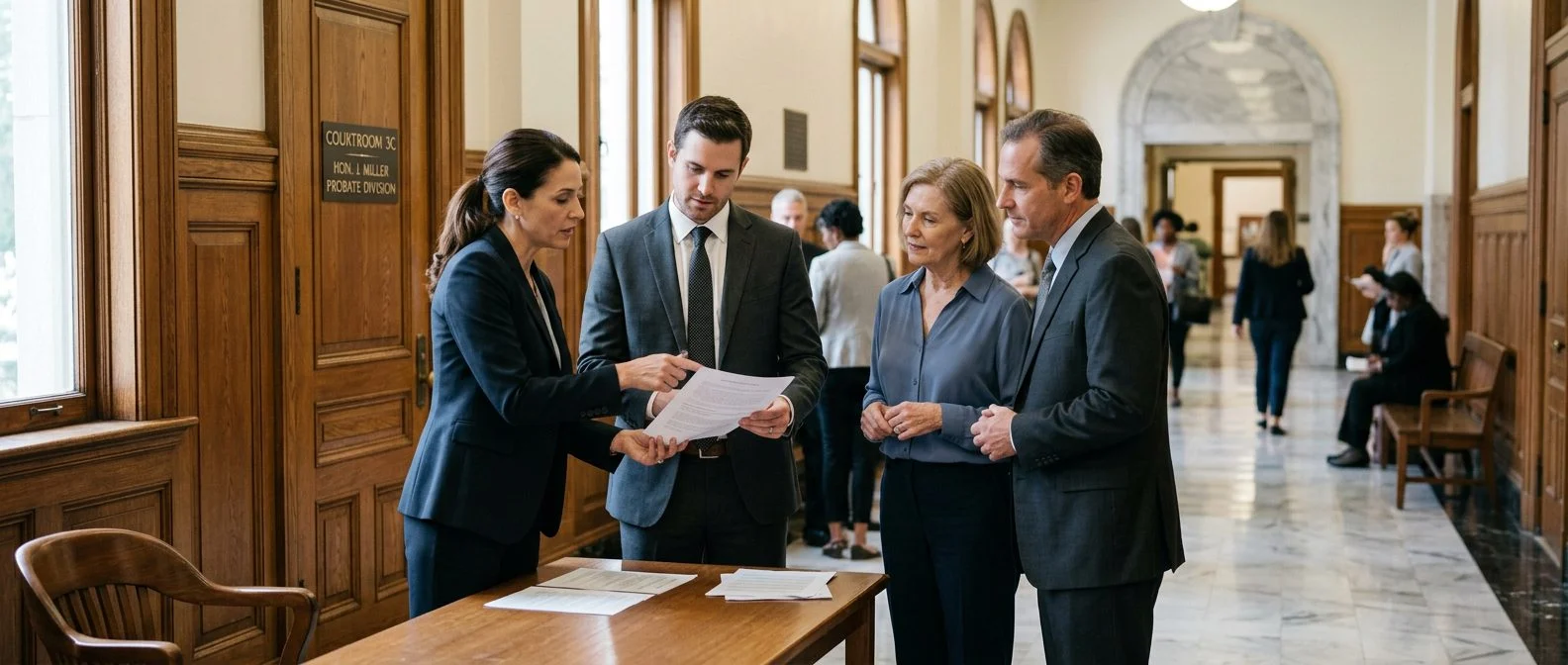
Intestate Estates & Heir Disputes | Coral Gables, Florida
Heir Disputes in a Florida Intestate Estate
When someone dies without a will, questions about who inherits can divide families. Leslie V. Marenco and the attorneys at Trust Counsel, PL focus on probate and trust litigation for heirs, beneficiaries and fiduciaries in Coral Gables and across South Florida. Your first discovery call is free, confidential and carries no obligation to continue.
By Leslie V. Marenco · Published November 5, 2026
An heir dispute intestate estate Florida matter starts when a person dies without a valid will and relatives disagree about who inherits or how much each one gets. Florida law, not the family, sets the order. This page offers general information about how probate and trust matters in Florida can involve heirs, competing claims and court proceedings. It is written for adult children, spouses, siblings, stepchildren and other relatives, and for personal representatives who must sort out competing claims.
What an Heir Dispute in an Intestate Estate Is
An heir dispute happens when people disagree about who inherits from someone who died without a valid will.
When a person dies without a will, the estate is called intestate. Fla. Stat. § 732.101 says property not effectively disposed of by will passes to the decedent’s heirs. It also says the death itself gives heirs their right to that property.
Most disputes fall into three groups:
- Who qualifies as an heir.
- What share each heir takes.
- Whether a person who claims to be an heir is entitled at all.
Adult children from different relationships, stepchildren, siblings who had little contact with the decedent, and creditors can all raise these questions. Personal representatives often must sort through competing claims before they can distribute property.
Claims tend to grow when the estate holds valuable property or the family is blended. More money and more relationships give more people a reason to question the paperwork.
If you're facing an heir dispute intestate estate Florida situation, you don't have to sort out the statute alone. Talk it through with our team — the first discovery call is free, confidential, and carries no obligation.
How Florida Distributes an Estate With No Will
Florida gives the surviving spouse the first share, and descendants, parents and siblings follow in order.
Under § 732.102, a surviving spouse takes the entire intestate estate when the decedent left no descendants. The spouse also takes it all when every descendant is also the spouse’s own descendant and the spouse has no other descendants.
When some of the decedent’s descendants are not lineal descendants of the spouse, the spouse takes one-half. The spouse also takes one-half when all the decedent’s descendants are the spouse’s too, but the spouse has children who are not the decedent’s.
The spouse’s intestate share is set by § 732.102, and the part that does not go to the spouse passes under § 732.103, first to the decedent’s descendants. Under § 732.103, if there are none, it goes to the decedent’s father and mother equally, or to the survivor of them. Next come brothers and sisters and the descendants of deceased brothers and sisters.
Under § 732.104, descent is per stirpes (by family branch). That means shares follow the family line, so a deceased heir’s children take that heir’s place.
If no qualifying heir exists, § 732.107 says the estate escheats to the state.
Special Situations That Commonly Trigger Heir Claims
Adoption, parentage and parental rights decide many heir claims, so the records matter.
Under § 732.108, an adopted person is treated as a descendant of the adopting parent for intestate succession. Fla. Stat. § 732.108 reads: “(1) For the purpose of intestate succession by or from an adopted person, the adopted person is a descendant of the adopting parent and is one of the natural kindred of all members of the adopting parent’s family, and is not a descendant of his or her natural parents, nor is he or she one of the kindred of any member of the natural parent’s family or any prior adoptive parent’s family, except that: (a) Adoption of a child by the spouse of a natural parent has no effect on the relationship between the child and the natural parent or the natural parent’s family.” There are exceptions. Adoption by a natural parent’s spouse keeps the child’s tie to that natural parent and family, and adoption by a close relative keeps the tie to the families of the deceased natural parents.
The same section covers a child born outside marriage. That child is a descendant of the mother. The child is also a descendant of the father if paternity is established by court adjudication or the father acknowledges it in writing. A marriage ceremony between the parents also counts, even one later found void.
Under § 732.1081, a parent cannot inherit from or through a child if the parent’s rights were terminated under chapter 39 before the child died.
Stepchildren need care. The statutes covered here tie intestate inheritance to parentage and adoption, so a stepchild who was never adopted needs one of those links.
Debts matter as well. Under § 732.109, a debt owed to the decedent is charged only against the debtor’s own share, and if the debtor does not survive the decedent, the debt is not taken into account in computing the debtor’s heirs’ shares.
Each family’s facts differ, so the answer depends on the facts and the records available.
How Heirs Are Determined in Probate
An interested person asks the court to decide who the heirs are by filing a petition.
Under § 733.105, when property passes by intestate succession, or the will is unclear and there is doubt about who is entitled to any part of the property or about the shares and amounts any person is entitled to receive, any interested person may petition the court to determine beneficiaries or their shares. A separate civil action can also be brought when an estate has not been administered.
A petition usually relies on proof of family links. Useful records include birth certificates, marriage and divorce records, adoption decrees and death certificates.
Notice comes next. Under § 731.301, people given proper notice are bound by all orders entered in that proceeding. Giving notice to everyone who may have an interest matters.
Under § 733.105, a personal representative who acts under that order is fully protected.
Common Claims Heirs Raise and How They Are Handled
Heir claims move through objections, negotiation and, when needed, a court hearing.
Common claims say a person was left out of a petition, a relationship was misstated, or distributions were wrong. Each one needs its own proof and its own record.
Will challenges have a short clock. Under § 733.212, an interested person served with a notice of administration has 3 months to object to the will’s validity, venue or the court’s jurisdiction. After that, those objections are forever barred. The window can be extended only for estoppel based on a misstatement by the personal representative.
A surviving spouse’s elective share has its own deadline. The right itself comes from § 732.201.
Heirs and beneficiaries can raise concerns about a personal representative’s accounting. If talks fail, the matter can go to court.
When a trust is involved, the dispute may move into trust litigation, which the firm also handles.
Not sure what your next step is?
Talk it through with our team — the first discovery call is free, confidential, and carries no obligation.
What to Expect: Steps and Timeline
An heir dispute usually moves through five steps, from gathering records to a court order.
- Gather records. Collect the death certificate, any known will or prior estate papers, and family records.
- List every possible heir. Note the family link and the proof for each person.
- Decide who will act. Trust Counsel’s attorneys can serve individually as trustee or personal representative. The firm advises and represents trustees, personal representatives and beneficiaries. A personal representative (often called an executor) manages the estate.
- File or respond. File the petition or answer one, and give notice to interested persons.
- Resolve objections. Work toward agreement where possible, or ask the court to decide. Then obtain the order determining heirs.
Timing varies with the number of objections and the court’s calendar.
Why Work With Trust Counsel on an Heir Dispute
Trust Counsel is a Coral Gables, Florida firm that focuses on trusts and estates matters.
The firm concentrates in probate litigation, trust litigation, trust administration and estate planning. Its only office is in Coral Gables.
We serve clients in Fort Lauderdale, Boca Raton, West Palm Beach, Doral, Kendall, Pinecrest, Key Biscayne and Aventura.
Leslie V. Marenco is responsible for this page. The firm’s lawyers include Leslie V. Marenco and Tanya Vega.
The firm advises heirs, beneficiaries and fiduciaries on both sides of estate and trust disputes.
The firm offers a free first discovery call, which is confidential and carries no obligation to continue.
Frequently Asked Questions
Can an heir be left out of an intestate estate in Florida?
Yes.
Does a stepchild inherit when a parent dies without a will?
Not automatically. A stepchild needs a parentage or adoption link that fits the statute.
What is a petition for determination of heirs, and who can file it?
It asks the court to decide who the heirs are and what each one receives. Under § 733.105, when property passes by intestate succession or the will is unclear and there is doubt about who is entitled or the shares, any interested person may file a petition asking the court to determine beneficiaries or their shares.
Is a surviving spouse always the first to inherit?
The spouse takes a share first, under § 732.102. The amount depends on whether the decedent left descendants who are or are not the spouse’s.
What happens if an heir disagrees with the personal representative’s accounting?
The heir can raise the concern with the personal representative first. If that fails, the issue can be taken to court.

Talk With a Florida Trust Litigation Attorney About Your Heir Question
Losing someone without a will can leave a family unsure who is entitled to what, all while still grieving. If you’re facing an heir dispute intestate estate Florida situation, you don’t have to sort out the statute alone. Our Coral Gables office can review the facts with you. Call (305) 707-7126 or schedule online to book a discovery call.
Have questions about what happened?
Ask our team directly. The first conversation is free, confidential, and there is no obligation to continue.
How we approach intestate heir disputes
Reviewing the estate record
We look at the decedent's family history, the estate's assets and any filings so the questions in dispute are clear.
Examining family relationships
Parentage, adoption and marriage facts can bear on who may be an heir under Florida law. We review them carefully.
Protecting your position
We advise heirs, beneficiaries and fiduciaries on steps to take while questions remain open.
Plain-language advice
We explain your options clearly so you can decide what to do next.
Do not assume who inherits
Relatives often assume a particular person will inherit when there is no will, but the answer depends on the facts and the statute. Get advice early, before property is distributed or a family agreement is signed.
Common questions in intestate heir disputes
Stepchildren and other relatives
Whether a relative inherits depends on the facts and on Florida law.
Petition to determine heirs
A petition for determination of heirs asks the court to decide who the heirs are. Contact us to discuss whether it fits your situation.
Disputes with the personal representative
Disagreements often involve the personal representative (often called an executor), who manages the estate. Our attorneys advise heirs and beneficiaries on these concerns.
Free first discovery call
Your first discovery call is free, confidential and carries no obligation to continue.