
Probate and Trust Administration | Coral Gables, Florida
Someone Has Died. Here Is What to Do First.
A short, practical guide for families and fiduciaries who need to know where to begin.
By Leslie V. Marenco · Published November 10, 2026
When a parent, spouse, or other close family member dies, paperwork starts arriving fast. You may not know who has authority to act. Facing the days after a loved one’s death in Florida, start by securing their property, locating any will and trust, and confirming who has legal authority to act. Nothing should be moved or distributed until that is settled.
The first weeks are mostly about order. Each step has a rule or deadline attached, and early mistakes are hard to reverse. Here is the general sequence of steps.
Start With the Immediate Practical Steps
In the first days, get certified copies of the death certificate, secure the property, and hold off on moving anything until someone confirms who can act.
Order several certified copies of the death certificate. Banks, insurers, and agencies will each ask for one, and ordering extras now is easier than going back later.
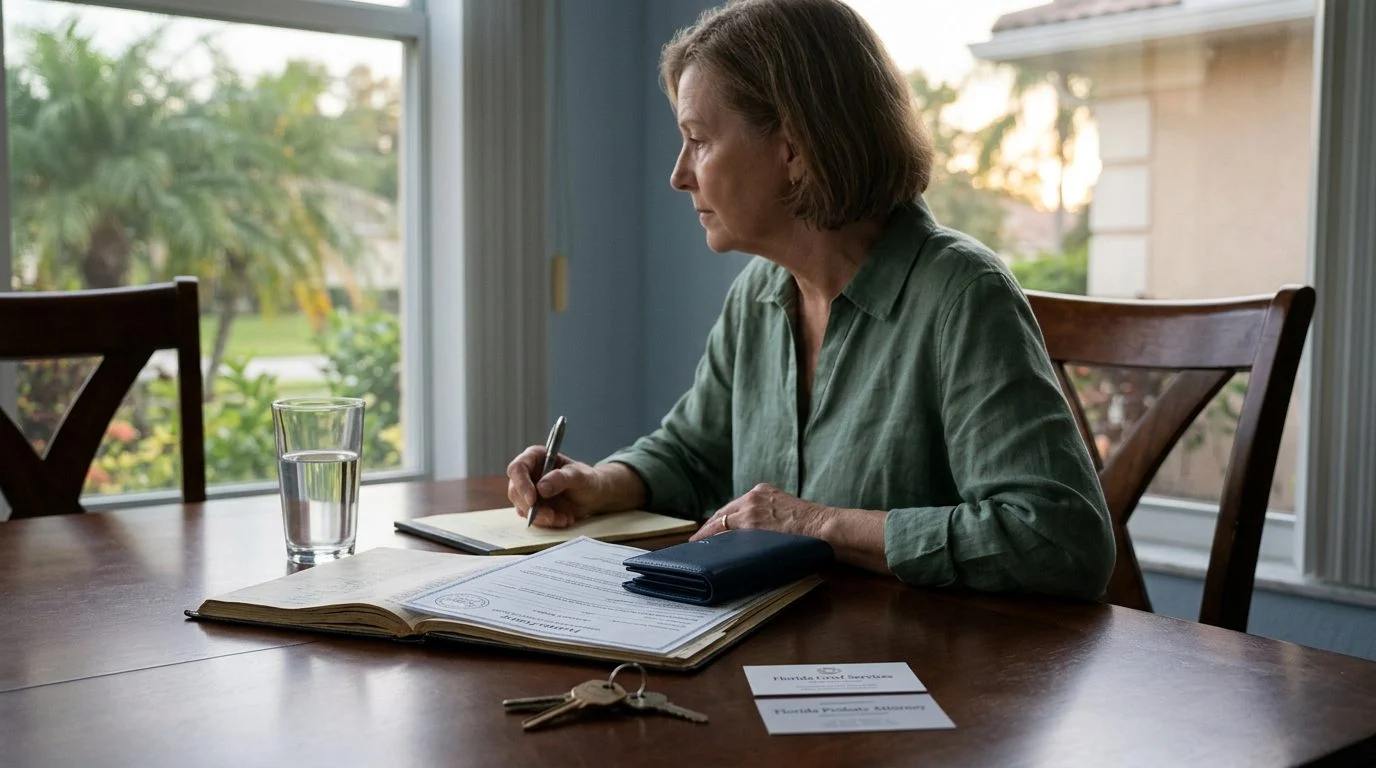
Secure the home, vehicles, and valuables. Lock up, collect the keys, and write a dated list of what is inside, with photos if you can. That record protects everyone who later has to account for those items.
Pause automatic payments where you can. Tell the employer, insurers, and Social Security office, where relevant. Keep a folder for every letter and bill that arrives, because those papers become the start of the estate or trust file.
The most common early mistake is giving items away, selling a car, or cashing out an account before anyone has confirmed legal authority. Those moves are hard to undo and often start disputes.
Not sure what your next step is?
Talk it through with our team — the first discovery call is free, confidential, and carries no obligation.
Find the Will, Any Trust, and Important Papers
Start by finding an original signed will and making sure it reaches the clerk of court. Florida sets a short deadline for this step.
The custodian of a will must deposit it with the clerk of court within 10 days after learning the person has died. Fla. Stat. § 732.901 The custodian must also give the clerk the date of death or the last four digits of the Social Security number.
Then look beyond the will. Check for a revocable living trust, trust amendments, beneficiary designations, deeds, and account statements. Ask the bank or insurer whether a named beneficiary is on file for each account.
A will and a trust can both matter, and they can govern different assets. Having a will does not by itself mean the estate must go through probate. Read how each asset is titled before deciding anything.
Missing one document can change which process applies. Make a written list of every paper you find, and note where the originals are kept.
Probate or Trust Administration: Which Applies
Which process applies depends on how each asset is titled and what documents exist.
Property in a person’s own name alone generally goes through formal probate. A court opens the estate, and a personal representative manages it under the court’s supervision.
A successor trustee steps in under that document’s terms.
Sorting this out early shows you which assets need a court filing, which need a trustee, and which pass directly to a named person. Florida also has a simpler route for very small personal estates, covered below.
Who Can Serve as Personal Representative or Successor Trustee
In a will-based estate, the person the will nominates has first priority to serve as the personal representative (often called an executor).
Florida sets a statutory order of preference for appointment in both kinds of estate. If the person died without a will, the surviving spouse comes first, then a person chosen by a majority of the heirs, then the heir nearest in degree. Fla. Stat. § 733.301
Under Florida law, a person who is sui juris (legally competent to act for themselves) and was a Florida resident when the decedent died can qualify to serve as personal representative, subject to the limitations in that part of the code. Fla. Stat. § 733.302
A successor trustee takes over under the trust document’s terms. Florida’s definition of trustee, in Fla. Stat. § 731.201, includes a successor trustee, whether or not a court confirmed the appointment; Fla. Stat. § 733.302 separately addresses who is qualified to act as personal representative. Fla. Stat. § 731.201
The firm does not serve as trustee or personal representative. Trust Counsel’s attorneys can serve individually as trustee or personal representative, and the firm advises and represents trustees, personal representatives and beneficiaries.
Unless the will provides otherwise, the personal representative has the right to take possession or control of the decedent’s property (other than protected homestead), must take the steps reasonably necessary to manage, protect and preserve the estate until distribution, and may bring an action to recover possession of estate property or to determine title to it. Fla. Stat. § 733.607 Except as otherwise provided by a decedent’s will, every personal representative has a right to, and shall take possession or control of, the decedent’s property, except the protected homestead and a surviving spouse’s one-half share of property to which the Florida Uniform Disposition of Community Property Rights at Death Act as described in ss. 732.216-732.228, applies, though real or tangible personal property may be left with the person presumptively entitled to it unless possession is necessary for administration. Fla. Stat. § 733.607
Have questions about what happened?
Ask our team directly. The first conversation is free, confidential, and there is no obligation to continue.
Deadlines, Notices, and Creditor Claims
Creditors have a limited time to file claims, and the deadline is the later of 3 months after first publication of the notice to creditors or, for a creditor required to be served with a copy of the notice, 30 days after service on that creditor.
The personal representative must promptly publish a notice to creditors. Publication runs once a week for 2 consecutive weeks in a newspaper published in the county where the estate is administered or, if there is no newspaper published in the county, in a newspaper of general circulation in that county. Fla. Stat. § 733.2121
Under Fla. Stat. § 733.702, a claim against the decedent’s estate that arose before death is not binding on the estate, the personal representative, or any beneficiary unless it is filed in the probate proceeding on or before the later of 3 months after the time of the first publication of the notice to creditors or, for a creditor required to be served with a copy of that notice, 30 days after the date of service on that creditor. This is subject to s. 733.710, and the court may extend the time only on grounds of fraud, estoppel, or insufficient notice of the claims period. Fla. Stat. § 733.702
A claim filed late is barred even if no one objects. Fla. Stat. § 733.702 reads: “unless filed in the probate proceeding on or before the later of the date that is 3 months after the time of the first publication of the notice to creditors or, as to any creditor required to be served with a copy of the notice to creditors, 30 days after the date of service on the creditor, even though the personal representative has recognized the claim or demand by paying a part of it or interest on it or otherwise.” A court can extend the time only on grounds of fraud, estoppel, or insufficient notice of the claims period. Fla. Stat. § 733.702 reads: “No independent action or declaratory action may be brought upon a claim which was not timely filed unless an extension has been granted by the court.”
For a trust, the trustee must give qualified beneficiaries notice within 60 days after accepting the trust. The notice must include the trustee’s full name and address. Fla. Stat. § 736.0813
Small estates may not need full administration. No administration is required when the decedent left only exempt personal property, plus nonexempt personal property worth no more than preferred funeral expenses and medical and hospital costs from the last 60 days of the last illness. Fla. Stat. § 735.301
Missing a claims deadline can bar a claim, so map out the timeline early.
When Family Disagreements or Trust Problems Arise
A dispute usually starts when a will, a trust amendment, or a trustee’s handling of assets is questioned.
Florida does not allow an action to contest a will to start before the person who wrote the will dies. Fla. Stat. § 732.518
Beneficiaries can ask for information. On reasonable request, a trustee must give a qualified beneficiary a complete copy of the trust document, plus relevant information about the trust’s assets, liabilities, and administration. Fla. Stat. § 736.0813
Common disputes include a challenged will, a trust amendment one family member questions, a question about how a trustee handled trust property, and an heir left out when there is no will.
The firm’s trust litigation attorney and probate litigation attorney pages cover these situations in more detail.
How the Firm Can Help You Decide the Next Step
Trust Counsel, PL is a Coral Gables, Florida trusts and estates law firm, and it can help you decide which step comes first.
The firm represents beneficiaries, heirs and fiduciaries in probate and trust matters. Its only office is in Coral Gables, Florida. Leslie V. Marenco is the responsible lawyer for this page.
Frequently Asked Questions
What should I do first when someone dies in Florida?
Get certified copies of the death certificate, secure the property, and find the original will. Hold off on moving or giving away property until someone confirms who has legal authority.
How long do creditors have to file claims in Florida?
A claim must be filed by the later of 3 months after first publication of the notice to creditors or 30 days after service on a creditor who must be served. Fla. Stat. § 733.702
Who can serve as personal representative in Florida?
In a will-based estate, the person the will nominates has first priority. Any Florida resident who is legally competent at the time of death can qualify, subject to the code’s limits.
If a relative’s death is recent, the paperwork is piling up, and the next step is unclear, you don’t have to sort it out alone. A free discovery call is confidential and comes with no obligation to continue. Call (305) 707-7126 or schedule online at https://trustcounsel.com/contact/.
Four first steps to take
Get certified copies of the death certificate
Many banks, insurers and agencies will ask for certified copies before they act on an account or policy.
Secure the property
Protect the home, vehicles, valuables and important papers so nothing is lost, damaged or removed.
Find the original will
Locate the original document and any trust, beneficiary designations or account records the person left behind.
Confirm who has legal authority
Identify who can act for the estate or trust before making decisions about assets or accounts.
Pause before moving property
Hold off on moving, selling or giving away property until someone confirms who has legal authority over it.
How Trust Counsel, PL can help
Probate and trust matters
Trust Counsel, PL focuses on probate litigation, trust litigation and trust administration in Florida.
Advice for every party
The firm advises and represents trustees, personal representatives and beneficiaries.
Fiduciary roles
Trust Counsel's attorneys can serve individually as trustee or personal representative.
Coral Gables office
Our only office is in Coral Gables. We serve clients in Fort Lauderdale, Boca Raton and West Palm Beach.
Not sure what comes next? Speak with Leslie V. Marenco.
Want to know where you stand?
Tell us what happened and our team will walk you through the options available to you, at no cost.