

Probate & Trust Litigation | Coral Gables, Florida
Who Inherits When a Florida Resident Dies Without a Will?
Heirs are identified by family relationship and Florida's intestacy statutes, not by who was named in a document. Trust Counsel, PL helps heirs, beneficiaries and fiduciaries understand their position from the start. Our only office is in Coral Gables, and we serve clients in Fort Lauderdale, Boca Raton, West Palm Beach, Doral, Kendall, Pinecrest, Key Biscayne and Aventura.
By Leslie V. Marenco · Published October 31, 2026
The legal heirs of a deceased person are the relatives Florida law names to inherit property that a valid will does not dispose of. Who are the legal heirs of a deceased person? In Florida, the answer turns on family relationship and the order the statute sets. This guide explains those rules in plain words. Leslie V. Marenco is the lawyer responsible for this page. Trust Counsel, PL has its only office in Coral Gables, Florida.
What a legal heir is under Florida law
A legal heir is a person who inherits by statute, not because a document names them. Under Fla. Stat. § 732.101, property not effectively disposed of by will passes to the decedent’s heirs as the Florida Probate Code prescribes. The death itself gives the heirs their right to that property.
A beneficiary is different. A beneficiary is someone named in a will or trust. An heir is someone the law identifies through family relationship. The same person can be both. A sibling, for example, may be an heir but receive nothing under a will that leaves everything to a friend.
When relatives disagree about who qualifies, the probate court can decide. Fla. Stat. § 733.105 lets any interested person petition the court to determine beneficiaries or their shares when property passes by intestate succession or a will is unclear and there is doubt about who is entitled to receive the property or what shares they receive.
If you're sorting out a death in the family without a will, we can talk through who may have a legal claim and what steps to consider next. Talk it through with Trust Counsel, PL — the first consultation is free, confidential, and carries no obligation.
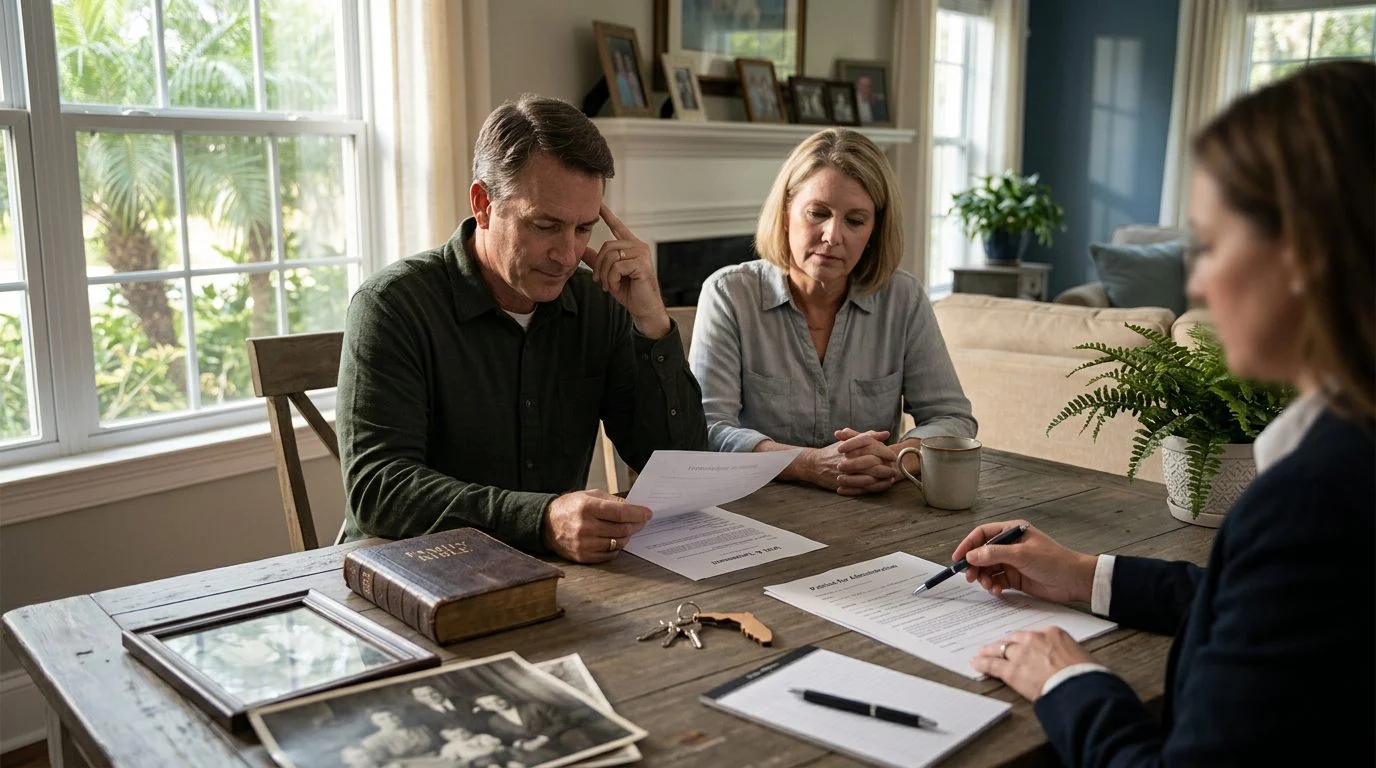
Who inherits when there is no will
Florida’s intestacy rules set the line of inheritance when a person dies without a valid will. Intestate means the estate is not controlled by a will. Under § 733.105, a court can determine beneficiaries when property passes by intestate succession or the will is unclear and there is doubt; the order of inheritance is set by § 732.103, not the family’s agreement.
The surviving spouse’s share comes first. The rest passes to the decedent’s descendants, such as children and grandchildren. If there are no descendants, parents come next. Then siblings and their descendants take. More distant relatives follow only if the closer groups are empty.
Fla. Stat. § 732.103 sets this order for the part of the estate that does not go to the spouse. Each step applies only when the step above it is empty. Florida does not use one fixed fraction for the spouse. The spouse’s share depends on who else survived, as the next section explains.
Surviving spouse and children
A surviving spouse’s share depends on whether every child is also the spouse’s child. Fla. Stat. § 732.102 sets the outcomes.
If there are no surviving descendants, the spouse takes the entire intestate estate. The spouse also takes everything if all descendants are the spouse’s children and the spouse has no other children. If some descendants are not the spouse’s children, the spouse takes one-half. The same one-half rule applies when the spouse has children the decedent did not have.
Children from another relationship change the math. They can reduce the spouse’s share to one-half. Adoption and birth outside marriage also count. Fla. Stat. § 732.108 treats an adopted person as a descendant of the adopting parent. Under Fla. Stat. § 732.108, an adopted person is treated as a descendant of the adopting parent for purposes of intestate succession, and is not treated as a descendant of the natural parents, except in listed situations. One exception is adoption of a child by the spouse of a natural parent, which has no effect on the relationship between the child and the natural parent or the natural parent’s family. Fla. Stat. § 732.108 reads: “(1) For the purpose of intestate succession by or from an adopted person, the adopted person is a descendant of the adopting parent and is one of the natural kindred of all members of the adopting parent’s family, and is not a descendant of his or her natural parents, nor is he or she one of the kindred of any member of the natural parent’s family or any prior adoptive parent’s family, except that: (a) Adoption of a child by the spouse of a natural parent has no effect on the relationship between the child and the natural parent or the natural parent’s family.”
A child born outside marriage is a descendant of the mother. The child is also a descendant of the father if paternity is adjudicated, if the father acknowledges paternity in writing, or if the parents went through a marriage ceremony, even a void one. Birth and adoption records often decide these points.
No spouse and no children
When there is no surviving spouse or descendant, the parents inherit first. If there is no descendant, the estate goes to the father and mother equally, or to the survivor of them, under § 732.103.
If neither parent is living, brothers and sisters inherit. So do the descendants of any brother or sister who has died. Half-siblings count too, but with a limit. Fla. Stat. § 732.105 says that when property descends to collateral kindred, such as siblings, relatives of the half blood inherit only half as much as relatives of the whole blood. If all are of the half blood, they take whole shares.
Florida also uses per stirpes descent. Fla. Stat. § 732.104 says descent is per stirpes, so a relative who has died passes a share to that relative’s own descendants.
If no one qualifies, the estate goes to the state. Florida law calls this escheat (passing to the state). Fla. Stat. § 732.107 says the property is sold and the proceeds go to the State School Fund. A person claiming entitlement may reopen the administration within 10 years after payment.
When heirship must be proven in court
A court may need to decide who the heirs are before property can move. Under § 733.105, a separate civil action to determine beneficiaries can be brought when an estate has not been administered.
Proof of heirship usually centers on family records. These include birth records, marriage records, adoption records, and evidence that ties each claimant to the deceased. Gathering these papers early can save time.
A personal representative is appointed by the court to administer the estate. Under the same statute, a personal representative who distributes property under an order determining beneficiaries is fully protected. That protection is a good reason to get the order before distribution.
Trust Counsel’s attorneys can serve individually as trustee or personal representative. The firm advises and represents trustees, personal representatives and beneficiaries in these proceedings. The firm itself does not serve in those roles.
Can an heir lose the inheritance?
Yes, an heir can lose an inheritance in several ways. A valid will can replace the intestate shares. A relative who would have been an heir may then receive nothing.
Florida’s slayer rule is another route. Fla. Stat. § 732.802 says a surviving person who unlawfully and intentionally kills, or helps procure the death, is not entitled to benefits under the will or the Probate Code. The estate passes as if that person died first. A final judgment of conviction of murder in any degree settles the question. Without one, the court may decide by the greater weight of the evidence.
Omitted children can also take a share. Fla. Stat. § 732.302 says a child born or adopted after the will was made, and left out of it, generally takes the intestate share, unless the child already received a part of the testator’s property equal to a child’s part by way of advancement. The share does not apply if the omission appears from the will to have been intentional, or if the testator had one or more children when the will was executed and devised substantially all the estate to the other parent of the pretermitted child, and that other parent survived the testator and is entitled to take under the will.
These rules turn on the actual will and the family facts. Read the document and gather the records before drawing conclusions.
Not sure what your next step is?
Talk it through with Trust Counsel, PL — the first consultation is free, confidential, and carries no obligation.
What to do when heirs disagree
Disagreements among heirs can be complicated, and how they are resolved depends on the facts of each estate. Common disputes involve three questions. Who counts as an heir? Can a family link be proven? Does a later will or trust change the result?
A caveat is a written objection placed on file with the court. The Miami-Dade Clerk’s probate court page describes how caveats are used.
Some family disputes can be mediated. The Florida State Courts System ADR resource handbook sets out court alternative dispute resolution rules, including mediation confidentiality provisions that may apply when a dispute is mediated.
If your concern is how an estate is run, rather than who inherits, that is a different question. The same goes for trust disputes, such as neutral trustees during litigation or lawsuits to modify a trust.
Who inherits in Florida if there is no will?
The spouse, descendants, parents, siblings and more distant relatives take in the order Florida’s intestacy statutes set. The spouse’s share depends on whether the children are shared.
Is an heir the same as a beneficiary?
No. An heir is identified by family relationship and statute. A beneficiary is named in a will or trust. Some people are both.
Does a child from another relationship inherit without a will?
Yes. A child of the decedent takes as a descendant. That child can also reduce the surviving spouse’s share to one-half.
Talk with a Coral Gables trust litigation attorney about your situation
If you are handling a death in the family and trying to work out who has a legal claim, you may be doing it without a will to guide you. That is a hard place to start, and you don’t have to sort it out alone. Share the family facts and documents with Trust Counsel, PL at our Coral Gables office by calling (305) 707-7126 or through our contact form. The first consultation is free, confidential and carries no obligation to continue. For broader context, read our trust litigation attorney overview.
How We Help Heirs and Families
Reviewing the family facts
We look at the decedent's family history, any prior marriages, children and other relatives to help identify who may qualify as an heir under Florida law.
Probate and trust disputes
When heirs, beneficiaries or fiduciaries disagree about an estate or trust, our probate and trust litigation attorneys focus on resolving the dispute through the appropriate court process.
Guidance for fiduciaries
The firm advises and represents trustees, personal representatives and beneficiaries. Trust Counsel's attorneys can serve individually as trustee or personal representative.
Clear next steps
We explain the options in plain language so you can decide how to proceed with confidence.
Do not assume your share
Being a relative of the deceased does not by itself settle who receives property or how much. Consider speaking with an attorney before you sign any estate paperwork, accept property or make decisions for the estate.
Matters We Handle for Florida Families
Probate litigation
Representation for heirs, beneficiaries and fiduciaries in contested probate matters in Florida.
Trust litigation
Representation in disputes over trust terms, administration and the conduct of trustees.
Trust administration
Guidance for trustees and beneficiaries through the administration of a trust.
Guardianship
Legal help for families addressing guardianship needs in Florida.