
Florida Trust and Estate Litigation | Coral Gables
Which Court Handles Trust Disputes in Florida?
Florida circuit courts hear trust disputes. Here is how the court process works, and how Trust Counsel, PL helps beneficiaries, heirs and fiduciaries in Coral Gables and across South Florida.
By Leslie V. Marenco · Published October 26, 2026
The Short Answer: Florida Circuit Court
Most Florida trust disputes are heard in the circuit court, the trial court with general authority over these cases. Many circuit courts assign trust matters to a probate division. Fla. Stat. § 736.0203 says the circuit court has original jurisdiction over all proceedings arising under the Florida Trust Code.
Which county and which division apply depends on the facts. This page walks through each layer. It was written by Leslie V. Marenco, the responsible lawyer for Trust Counsel, PL, whose only office is in Coral Gables, Florida.
If a trust you didn't create, or a trustee's accounting, has you asking which court to use, you don't have to sort it out alone. We can talk through your facts. Talk it through with Trust Counsel, PL — the first consultation is free, confidential, and carries no obligation.

Why Florida Circuit Courts Hear Trust Disputes
Circuit courts hear trust disputes because the Florida Trust Code, Chapter 736 of the Florida Statutes, places them there. The code governs how trusts are run and when a court gets involved. Under Fla. Stat. § 736.0201, a court may step in when an interested person asks it to, or as the law provides. A trust isn’t under ongoing court supervision unless a judge orders it.
A trust case starts the way most civil suits do. Under s. 736.0206, the court may review the propriety of a trustee’s employment of any person and the reasonableness of compensation paid; the general rule that trust proceedings are commenced by filing a complaint under the Florida Rules of Civil Procedure is in s. 736.0201.
Most disputes that reach court involve a few common problems. A beneficiary may want a trustee removed. Another may demand an accounting. Someone may question whether the trust is valid at all. A serious breach of trust is one ground for removal (Fla. Stat. § 736.0706). To remedy a breach of trust that has occurred or may occur, a court can also order a trustee to pay money back or restore property (Fla. Stat. § 736.1001).
The Probate Division Within Circuit Court
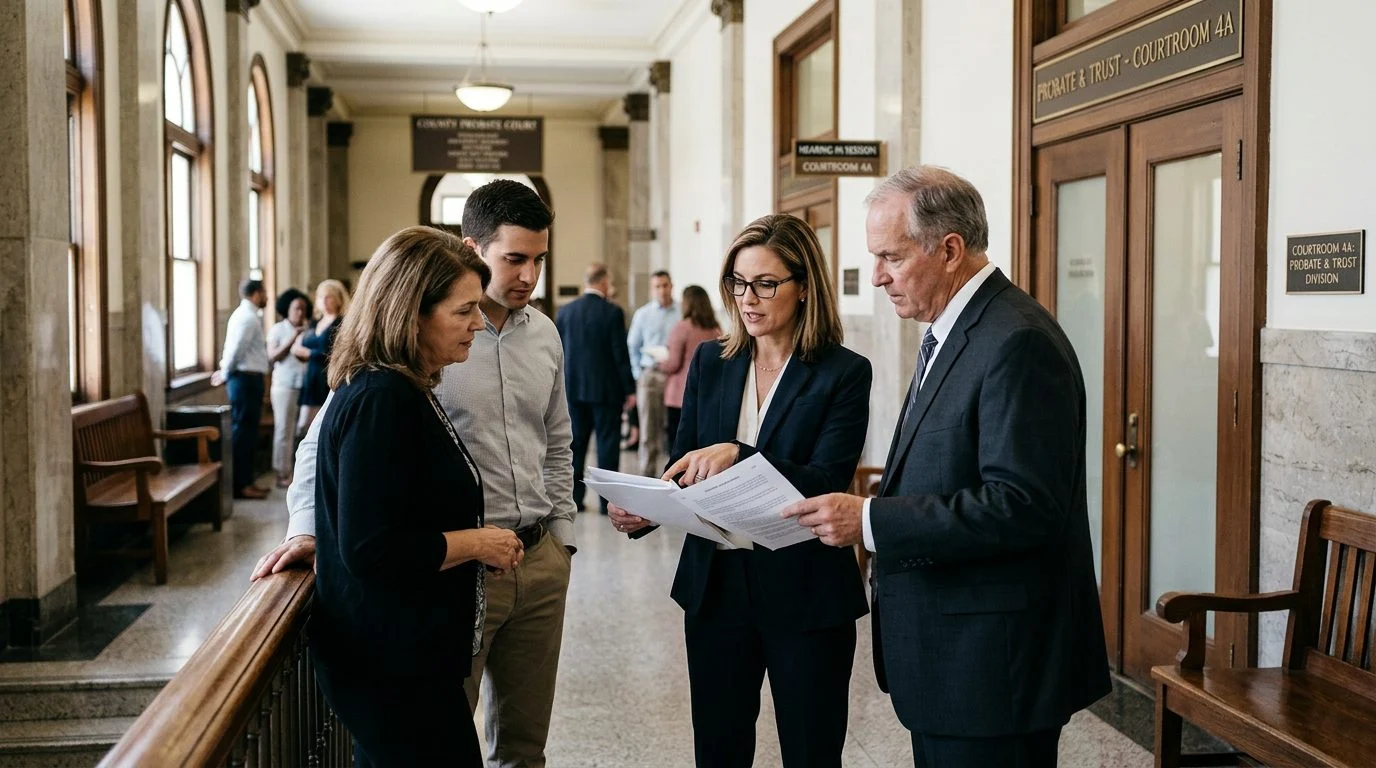
Many circuit courts place probate matters, and often trust disputes, in a probate division. Assignment practice varies by county. The same kind of case may land in different divisions across Florida. Probate divisions also hear estate administration, guardianship and related petitions. A trust matter can sit right next to an estate file.
Some counties route trust-only disputes to a civil division. Others keep them with estate files. The clerk of court can show how your county assigns these cases.
Florida law also links some trust questions to the probate case. Under Fla. Stat. § 736.0201, a proceeding to construe a testamentary trust may be filed in the probate proceeding for the testator’s estate. That proceeding follows the Florida Probate Rules. The trust question and the estate question can end up in one file.
Choosing the Right County and Venue
Venue asks which county may hear the case. The trust statute gives several options. A case may be filed in any county where venue is proper under chapter 47. It may also be filed where the suing or sued beneficiary lives or has its principal place of business. Or it may be filed in the county where the trust has its principal place of administration (Fla. Stat. § 736.0204).
The principal place of administration is often the key. Unless the trust names one, it’s the trustee’s usual place of business where trust records are kept. If the trustee has no business location, it’s the trustee’s residence (Fla. Stat. § 736.0108). Keep that question in mind when you think about where to file.
A common mistake is assuming the county where a parent lived is automatically the right one. Venue for a trust case looks at where the trust is run and where the parties live. Venue for a will is in the Florida county where the decedent was domiciled; if the decedent had no Florida domicile, venue is in any county where the decedent’s property is located, and if the decedent had no Florida domicile and no Florida property, in the county where any debtor of the decedent resides (Fla. Stat. § 733.101).
Our only office is in Coral Gables, Florida. We serve clients in Fort Lauderdale, Boca Raton, West Palm Beach, Doral, Kendall, Pinecrest, Key Biscayne, and Aventura. The right county depends on where the trust is administered and who the parties are.
When Estate and Guardianship Matters Land in the Same Court
A trust dispute often arrives with an estate case, a guardianship, or a claim against a personal representative. These matters can proceed in the same circuit court, though usually in separate case files. A personal representative, often called an executor, handles a probate estate. A trustee manages the assets held in a trust.
Which role is challenged shapes which rules and which filing route apply. A guardianship asks a court to make decisions for a person who can no longer make them. That is a different question from a trustee’s duty to account.
Keep every case number in one place. A petition for removal in an estate must be filed in the court that has jurisdiction over the administration (Fla. Stat. § 733.505). A missed link between two files can waste time.
Trust Counsel’s attorneys can serve individually as trustee or personal representative. The firm advises and represents trustees, personal representatives and beneficiaries.
When Federal Court May Be Involved
Questions about whether a state or federal court has jurisdiction should be reviewed before anything is filed, because a case filed in the wrong court can lose time. Raise the federal question early, while the documents are still being gathered.
Not sure what your next step is?
Talk it through with Trust Counsel, PL — the first consultation is free, confidential, and carries no obligation.
Information to Gather Before Deciding Where to File
Collect the trust document and every amendment. Get the will if there is one. Gather account statements and letters or emails with the trustee. The trust instrument shows who the trustee is, what powers the trustee has, and how the trust must be run.
Dates matter. A challenge to a revocable trust cannot start until the trust becomes irrevocable by its terms or by the settlor’s death; if the whole trust has been revoked, a challenge to the revocation waits until after the settlor’s death. A guardian of the property of an incapacitated settlor may still bring such an action (Fla. Stat. § 736.0207). Write down when the trust became irrevocable and when the trustee’s conduct occurred.
In a contest, the person who challenges the trust carries the burden. That person must establish the grounds for invalidity (Fla. Stat. § 736.0207). Good records make that burden easier to meet.
Accounting records matter too. A trust accounting must show all significant transactions, including compensation paid to the trustee (Fla. Stat. § 736.08135). Save every statement you receive.
The clerk of court in the relevant county can confirm the case type, filing fees, and division assignment. Those details vary by county, so confirm them locally.
Talk With Trust Counsel About Your Situation
You may be reading this because a trust was handed to you. Maybe a trustee’s accounting doesn’t add up. Maybe a parent’s decline has raised the question of who should act. Those situations are stressful, and the court question can feel like one more hurdle.
If you’re trying to work out which court fits your facts, call (305) 707-7126 or schedule online. The first consultation is free, confidential, and carries no obligation to continue (consulta inicial gratuita, confidencial y sin compromiso).

Frequently Asked Questions
Which court handles trust disputes in Florida?
Florida circuit courts hear trust disputes. Section 736.0206 governs court review of a trustee’s employment of persons and reasonableness of compensation, which is part of trust administration; the general rule that judicial proceedings concerning trusts are commenced by filing a complaint under the Florida Rules of Civil Procedure is in s. 736.0201 (Fla. Stat. § 736.0201).
Can a county court hear a trust dispute in Florida?
Trust disputes are generally heard in circuit court rather than county court. Section 736.0201(4) of the Florida Statutes states that a court proceeding concerning a trust may address the trust’s validity, administration or distribution, and it expressly lists proceedings to appoint or remove a trustee.
In which county should a Florida trust dispute be filed?
Venue for actions and proceedings concerning trusts may be laid in any county where venue is proper under chapter 47, in any county where the beneficiary suing or being sued resides or has its principal place of business, or in the county where the trust has its principal place of administration (Fla. Stat. § 736.0204). Where the trust is administered can affect which circuit court hears the case.
Trust disputes in Miami-Dade and Broward counties
How Trust Counsel, PL Can Help
Trust litigation
We represent beneficiaries, trustees and other interested parties in trust disputes filed in Florida circuit court.
Probate litigation
We handle contested estate matters, including disputes over personal representatives, creditor issues and estate administration.
Trust and estate administration
Trust Counsel's attorneys can serve individually as trustee or personal representative, and the firm advises and represents trustees, personal representatives and beneficiaries.
Coral Gables office
Our only office is in Coral Gables. We serve clients in Fort Lauderdale, Boca Raton, West Palm Beach, Doral, Kendall, Pinecrest, Key Biscayne and Aventura.
Filing in the Right Court Matters
A trust dispute that is filed in the wrong court can cause delay and added cost. Before taking any step, review the trust document, the proceeding involved and the court's authority over the matter.
Trust and Estate Matters We Handle
Trust litigation
Disputes over trust terms, trustee conduct, accountings and distributions.
Probate litigation
Contested wills, estate administration disputes and claims involving the estate.
Guardianship
Proceedings involving the care and financial decisions of a minor or incapacitated adult.
Estate and business succession planning
Planning for estate tax, asset protection and the transfer of business interests.