
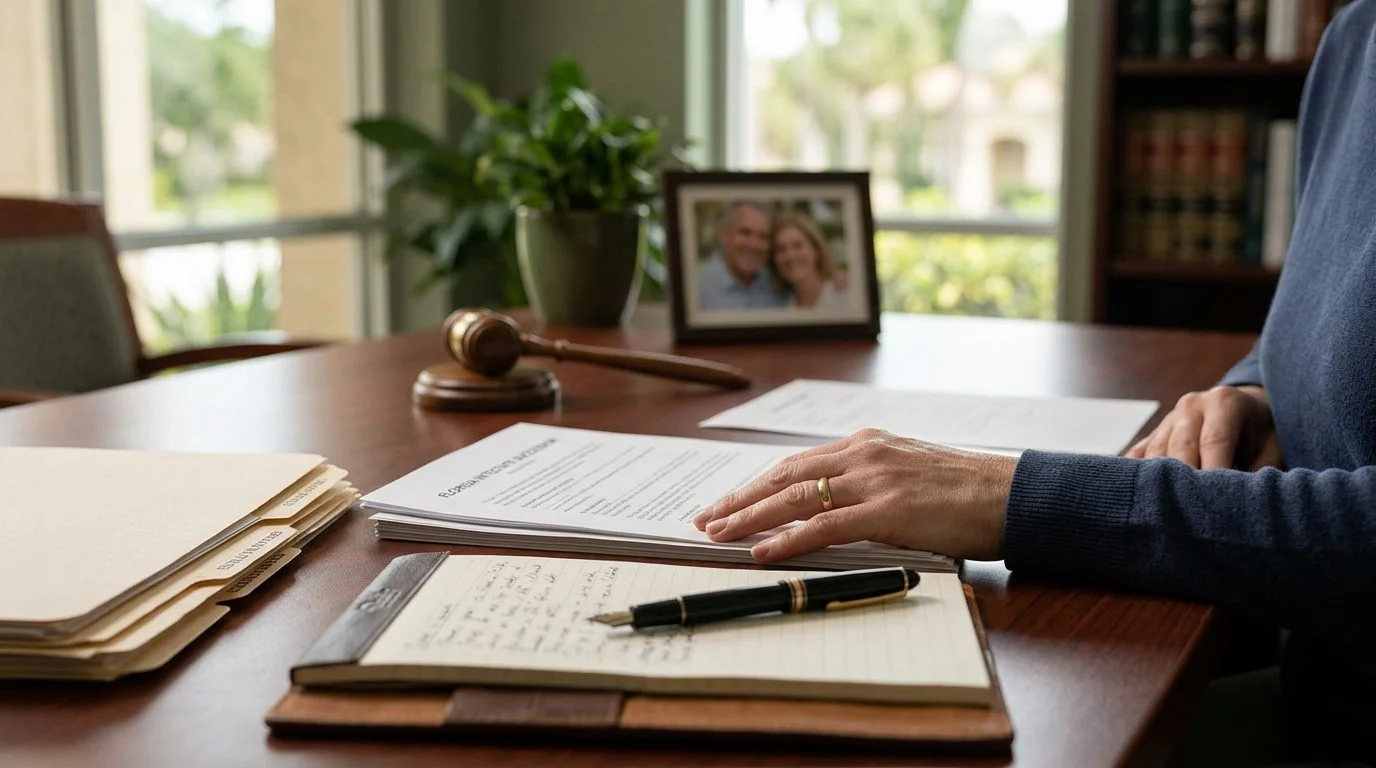
Probate & Estate Planning | Coral Gables, Florida
When a Spouse Dies Without a Will in Florida, Who Inherits?
Florida's intestacy statutes decide who receives property when there is no will. Trust Counsel, PL explains how that works and what the surviving spouse may need to do next. Leslie V. Marenco, Trust Counsel, PL, Coral Gables, Florida.
By Leslie V. Marenco · Published November 3, 2026
If a spouse dies without a will in Florida, state law decides who inherits the estate. The decedent’s wishes don’t control the result. Florida’s intestate succession rules step in, and the surviving spouse’s share depends on whether the decedent left children and whose children they are. This guide explains those rules in plain English so you know what to expect and what to do first.
What Florida law does when a spouse dies without a will
When there is no valid will, Florida’s intestate succession laws decide who inherits. Under Fla. Stat. § 732.101, any part of the estate not effectively disposed of by will passes to the decedent’s heirs as the statutes prescribe. The death itself gives the heirs their right to that property.
Heirs are the people the statutes entitle to inherit. That definition includes the surviving spouse (Fla. Stat. § 731.201). The spouse’s rights come from statute, not from a document the decedent may have meant to sign.
Even when the spouse inherits everything, the estate may still need a court process. Many estates with property in the decedent’s name go through probate. For background on how trust and estate matters are handled, see the trust litigation attorney guide.
If you're facing a spouse's estate with no will and aren't sure what comes first, you don't have to sort out Florida's rules alone. Trust Counsel, PL can talk it through with you. Talk it through with Trust Counsel, PL — the first consultation is free, confidential, and carries no obligation.

How Florida sets the surviving spouse’s share
The spouse’s share depends on who else survives the decedent. The rules sit in Fla. Stat. § 732.102. Read them alongside the family’s actual facts.
If there is no surviving descendant, the spouse takes the entire intestate estate. Descendants means children and later generations.
If all of the decedent’s descendants are also the spouse’s descendants, and the spouse has no other descendants, the spouse takes the entire estate. A shared family with only common children follows this rule.
If one or more of the decedent’s descendants are not the spouse’s descendants, or if all of them are the spouse’s descendants but the spouse also has descendants who are not the decedent’s, the spouse takes one-half. The other half passes to the decedent’s descendants under Fla. Stat. § 732.103.
Children from a prior relationship are where families most often disagree. A surviving spouse may expect the whole estate and find that a stepchild or a child from an earlier marriage has a share. The family tree matters as much as the list of assets.
Who can serve as personal representative when there is no will
Under Florida law, the surviving spouse has first priority in an intestate estate. A personal representative (often called an executor) is the person the court appoints to manage the estate. Fla. Stat. § 733.301 sets the order. For intestate estates, Fla. Stat. § 733.301 lists the surviving spouse first, then the person chosen by a majority in interest of the heirs, then the heir nearest in degree. In testate estates, the personal representative nominated by the will or under a power conferred in the will comes first.
Any interested person may ask the court to open the estate. Fla. Stat. § 733.202 says so in one sentence. Priority only matters once a petition is filed and the court acts on it.
Trust Counsel’s attorneys can serve individually as trustee or personal representative, and the firm advises and represents trustees, personal representatives and beneficiaries. The firm never serves as trustee, personal representative or any other fiduciary.
What happens to the family home
A spouse’s rights in the home depend on how the home was titled and whether it is the family’s homestead. Under Fla. Stat. § 732.401, if the homestead is not devised and the decedent leaves a spouse and descendants, the spouse takes a life estate. A life estate is a right to live in the home for life, and the decedent’s descendants in being at the time of death, per stirpes, take the remainder after that. Fla. Stat. § 732.401 reads: “If not devised as authorized by law and the constitution.”
The surviving spouse may instead elect to take an undivided one-half interest as a tenant in common, or, with court approval, an attorney in fact or guardian of the spouse may make that election; before approving it, the court must determine that the election is in the best interests of the surviving spouse during the spouse’s probable lifetime. The election must be made within 6 months after the death and during the spouse’s lifetime, unless a timely petition by an attorney in fact or guardian extends the time as provided in paragraph (c). Once made, the election is irrevocable.
That section does not apply to property held as tenancy by the entireties or as joint tenancy with rights of survivorship.
Mortgage payments, insurance, property taxes and utilities keep coming due while the estate is open. Raise these questions with counsel early. For who holds title and who may live in the home during probate, see who owns a home during probate.
When probate is needed and what it involves
Venue lies in the Florida county where the decedent was domiciled; if the decedent had no Florida domicile, it lies in any county where the decedent’s property is located, or, if there was no property here, in the county where any debtor of the decedent resides (Fla. Stat. § 733.101).
Once appointed, the personal representative must file a verified inventory. The inventory lists each estate asset with its estimated fair market value at the date of death (Fla. Stat. § 733.604).
The personal representative must also publish a notice to creditors. Publication runs once a week for 2 consecutive weeks in a newspaper published in the county where the estate is administered or, if there is none, in a newspaper of general circulation in that county (Fla. Stat. § 733.2121).
A creditor’s claim is binding only if filed in the probate proceeding on or before the later of 3 months after first publication or, for a creditor who must be served, 30 days after service (Fla. Stat. § 733.702). Other limits in the probate code can also apply.
Some property passes by title or beneficiary designation rather than through the estate. List every asset and how it is titled before deciding what needs court involvement.
Surprises that come up in intestate estates
Intestacy surprises often involve family members no one expected. A child from an earlier relationship can take a share even when the spouse assumed the whole estate would pass to them.
Disputes can also arise over who is appointed and how assets are handled. A family member who believes they were expecting an inheritance may raise concerns that need review. Each concern turns on its own facts and its own legal rules.
Debts and claims can change the picture too. Creditors have a limited window to file, and the estate must deal with valid claims before assets are distributed.
Frequently asked questions
Does a spouse inherit everything if there is no will in Florida?
Sometimes. The spouse takes the entire intestate estate when there are no surviving descendants, or when all surviving descendants are also descendants of the spouse and the spouse has no other descendant who survives the decedent. If the decedent has descendants who are not the spouse’s, the spouse takes one-half (Fla. Stat. § 732.102).
Who can serve as personal representative without a will?
The surviving spouse has first priority under Fla. Stat. § 733.301. Later-found wills can change the appointment.
Some assets pass by title or beneficiary designation instead.
Not sure what your next step is?
Talk it through with Trust Counsel, PL — the first consultation is free, confidential, and carries no obligation.
Early steps for a surviving spouse and when to ask a lawyer
The first steps are about gathering facts. Look for an original will, since a will admitted later revokes the earlier letters and new letters are granted (Fla. Stat. § 733.301).
Next, get several certified death certificates. List bank accounts, property, debts and insurance policies. Keep a record of every payment made from estate funds.
Avoid moving or transferring titled assets, and avoid paying claims, until you understand what the estate holds and what it owes.
Whether you need a probate lawyer depends on the facts. The family tree, the home and the size and makeup of the estate all shape the next step. A lawyer can explain the court’s formal requirements, such as the petition, notice and inventory.
Talk with Trust Counsel about your situation
You may be handling this while grieving, helping a family member, or facing a decision such as who files the petition or whether the home can stay in the family. You don’t have to work through Florida’s rules alone.
Trust Counsel, PL’s only office is in Coral Gables, Florida. Leslie V. Marenco is responsible for this page. Call (305) 707-7126 or schedule online.
The firm offers a free first consultation that is confidential and comes with no obligation to continue.
How Trust Counsel, PL Can Help
Probate Administration
We advise personal representatives, heirs and beneficiaries through the probate process in Florida courts.
Probate and Trust Litigation
We represent beneficiaries, heirs and fiduciaries when family members disagree about an estate or trust.
Fiduciary Services
Trust Counsel's attorneys can serve individually as trustee or personal representative, and the firm advises and represents trustees, personal representatives and beneficiaries.
Estate Planning
We help Florida families and business owners put a will, trust and succession plan in place before a crisis.
Important: Do Not Assume the Spouse Receives Everything
Without a will, Florida's intestacy statutes decide who inherits, and the result may differ from what the couple expected. Children, other relatives or other descendants may have rights to property. Review the facts with an attorney before assuming how an estate will be divided.
Common Questions After a Death Without a Will
Can the Family Agree on Division?
Family members sometimes disagree about the estate. Our attorneys focus on probate and trust disputes and can explain the options available in your situation.
What About Children From Other Relationships?
Blended families often face the most complex intestacy questions. Careful review of the family's facts is essential.
Can Planning Prevent These Problems?
A will, trust or business succession plan can state your wishes clearly. We help clients build those plans well before they are needed.