
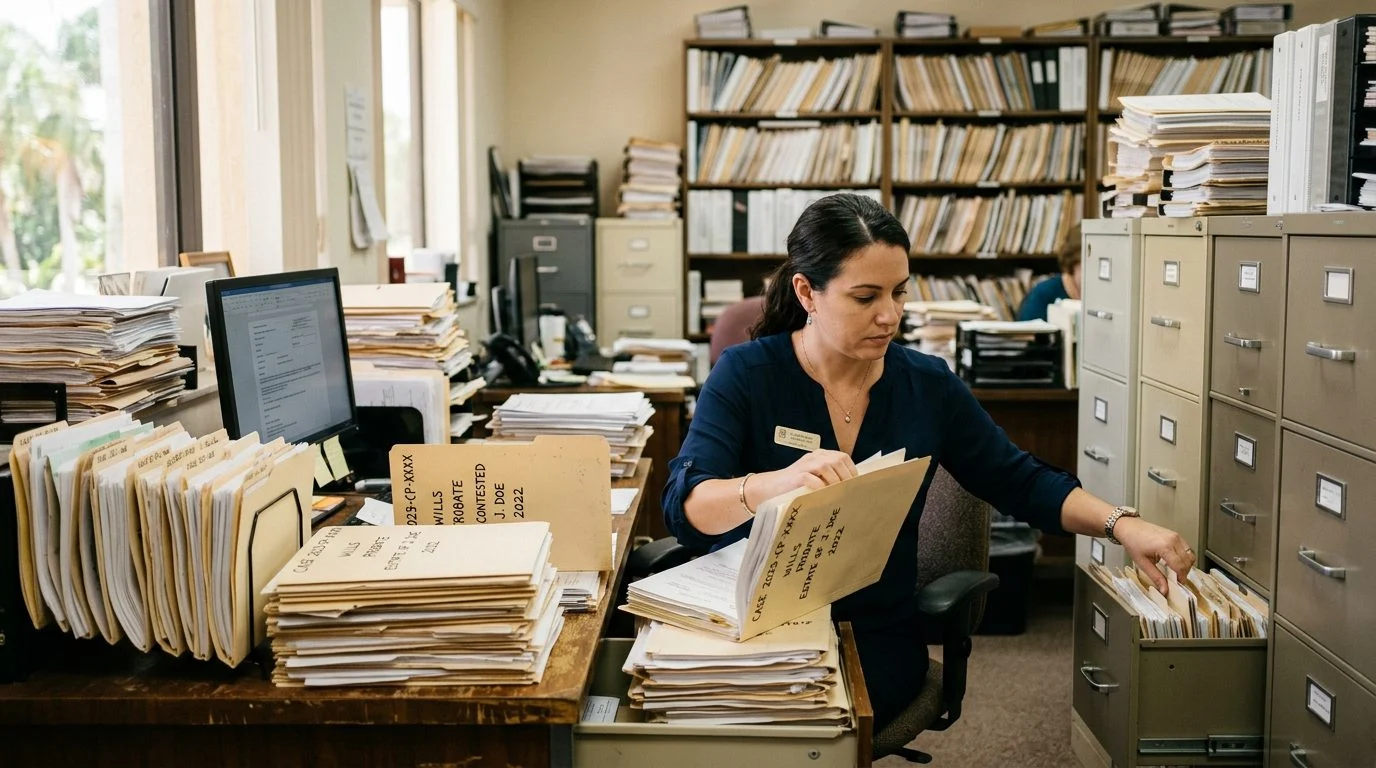
Florida Probate | Coral Gables
What Happens If a Florida Will Is Never Probated?
Trust Counsel, PL explains how Florida probate works, why property can stay tied up without it, and how a free first consultation can help your family decide on next steps.
By Leslie V. Marenco · Published October 31, 2026
What happens if you don’t probate a will in Florida? A will that is never admitted to probate generally cannot transfer the property it covers. Florida law says a will is ineffective to prove title to the decedent’s property until a court admits it. This page explains what that means, who inherits when no will is admitted, and what the family should do first.
What probate does in Florida, in plain terms
Probate is the court process that confirms a will and handles property the decedent owned in his or her own name. Every family’s situation is different, so questions about how Florida’s probate process applies to a specific estate are worth reviewing with an attorney. The person the court appoints to run the estate is the personal representative (often called an executor). The court gives that person authority through “Letters,” which is the court’s grant of authority to the personal representative to act on behalf of the estate. Probate matters are ordinarily handled in state courts, not federal courts (United States Courts). Each estate moves through this court system, step by step, with the personal representative acting under the court’s oversight.
Not sure what your next step is?
Talk it through with Trust Counsel, PL — the first consultation is free, confidential, and carries no obligation.

Does a will still matter if it is never probated?
Yes, a signed will still matters, but it cannot move probate property on its own. Until a will is admitted to probate in this state or in the state where the decedent was domiciled, it is ineffective to prove title to, or the right to possession of, the testator’s property. A will sitting in a drawer has not been put before the court.
Florida also sets a deadline for the person holding the original. The custodian must deposit the will with the clerk of the court within 10 days after learning that the testator has died. The custodian must also give the clerk the date of death or the last four digits of the Social Security number (Fla. Stat. § 732.901). The clerk must keep the original for at least 20 years, whether or not the will is admitted. The Miami-Dade Clerk probate court page covers the deposit deadline and how heirs, interested parties and creditors use caveats. If you hold an original will, the 10-day window runs from the date you learn of the death.
Who inherits when no will is admitted to probate?
When no will is admitted, Florida’s intestacy rules decide who takes the probate estate. Any part of the estate not effectively disposed of by will passes to the decedent’s heirs under those rules. The death itself vests the heirs’ right to that property (Fla. Stat. § 732.101).
For a surviving spouse, the answer turns on the family’s facts. Any part of the estate not effectively disposed of by will passes to the decedent’s heirs as prescribed in the following sections of this code, so if the decedent left no surviving descendants, the spouse takes the entire intestate estate. Where some of the decedent’s surviving descendants are not also descendants of the surviving spouse, the spouse’s intestate share is one-half of the estate. Where every surviving descendant is also the spouse’s and the spouse has no other descendant, the spouse receives the entire intestate estate (Fla. Stat. § 732.102). So a spouse does not always inherit everything. The same framework answers the question “What is the wife entitled to when a husband dies?” The result depends on whether he left descendants and whose descendants they are.
Property that cannot move without a court-appointed personal representative
Property held only in the decedent’s name usually needs a personal representative before anyone can sell or transfer it. Florida gives the personal representative the right to take possession or control of the decedent’s property, except the protected homestead and except as otherwise provided by a decedent’s will (Fla. Stat. § 733.607). The personal representative must also take reasonable steps to manage and protect the estate (Fla. Stat. § 733.607). The personal representative’s duties start at appointment, but the powers relate back to acts taken before appointment that are beneficial to the estate (Fla. Stat. § 733.601).
Heirs usually cannot collect or sell probate assets on their own authority. Banks, brokers and title companies often ask for court-issued papers before they release funds or change title. The protected homestead has its own rule. If it is not occupied by someone with an interest, the personal representative may, but is not required to, take limited possession to protect it (Fla. Stat. § 733.608).
Debts, creditors and the estate’s open obligations
Probate gives creditors a formal way to file claims, and the deadline is strict. The personal representative must promptly publish a notice to creditors. Publication runs once a week for two consecutive weeks in a newspaper in the county where the estate is administered (Fla. Stat. § 733.2121). The notice must state that creditors must file claims within the periods in section 733.702, or be forever barred.
The personal representative must serve a copy of the notice to creditors on any creditor required to be served, and for that creditor the claim deadline is 30 days after the date of service, if later than 3 months after first publication (Fla. Stat. § 733.702). The history note for this section ends with s. 21, ch. 2010-4. Without an appointed personal representative, no one is in place to carry them out.
Assets that pass outside probate
Not every asset in an estate necessarily follows the same process, so it helps to review how each one is held. Assets held jointly or with a named beneficiary can raise different questions, and those questions are worth raising with an attorney. Reviewing how each asset is titled is a useful first step in understanding the overall picture.
Florida also has a separate procedure for some smaller estates, called summary administration. It may be had when the value of the estate subject to administration in Florida, less property exempt from creditors’ claims, does not exceed $150,000. Summary administration is available only if the decedent has been dead for more than 2 years or the estate’s value is within the limit set by statute, and, when there is a will, the will does not direct administration under chapter 733. The current text, amended in 2026, sets these tests (Fla. Stat. § 735.201).
Not sure what your next step is?
Talk it through with Trust Counsel, PL — the first consultation is free, confidential, and carries no obligation.
Disputes, delays and when heirs or beneficiaries ask the court to act
Any interested person can ask the court to open administration (Fla. Stat. § 733.202). The statute defines an interested person as someone who may reasonably be expected to be affected by the outcome. It treats the personal representative as an interested person in proceedings affecting the estate (Fla. Stat. § 731.201).
Disputes can slow an estate down. Family members may disagree about who should serve or whether a will is valid. The ACTEC estate settlement video notes that disputes among beneficiaries, family members or creditors can lead to court involvement. How long that takes depends on the facts.
Key takeaways and next steps for the family
- A will must be admitted to probate before it can transfer probate property.
- If no will is admitted, Florida’s intestacy rules decide who takes the probate estate.
- Some assets carry their own ownership or beneficiary arrangements, which are worth reviewing.
- Any interested person can ask the court to open administration.
If you’re holding an original will after a loved one’s death, you may be trying to act quickly without knowing the rules. Trust Counsel’s attorneys can talk through your options with you.
Trust Counsel offers a free first consultation that is confidential and carries no obligation to continue. Call (305) 707-7126 or schedule online.
Responsible lawyer: Leslie V. Marenco. The firm’s only office is in Coral Gables. Trust Counsel does not serve as personal representative or trustee. Trust Counsel’s attorneys can serve individually as trustee or personal representative. The firm advises and represents trustees, personal representatives and beneficiaries.
Quick answers
Is probate mandatory in Florida?
Probate is the court process that admits a will and handles property held in the decedent’s name. A will cannot transfer that property until a court admits it.
Does a spouse inherit everything if there is no will?
Sometimes. With no surviving descendants, the spouse takes the entire intestate estate. When some descendants are not also the spouse’s, the spouse’s share is one-half; when all are shared and the spouse has no other descendant, the spouse receives the entire intestate estate under s. 732.102(2).
Who can ask the court to open probate?
Any interested person may petition for administration under Florida law, except a beneficiary who has received complete distribution, who is not an interested person.
How Trust Counsel can help
Probate and estate matters
The firm focuses on probate litigation, trust administration and estate planning for Florida families.
Heirs, beneficiaries and fiduciaries
The firm advises and represents trustees, personal representatives and beneficiaries.
Attorneys who can serve individually
Trust Counsel's attorneys can serve individually as trustee or personal representative. The firm itself does not serve as a fiduciary.
Coral Gables office
Our only office is in Coral Gables. We serve clients in Fort Lauderdale, Boca Raton, West Palm Beach, Doral, Kendall, Pinecrest, Key Biscayne and Aventura.
Free first consultation
The initial consultation is free, confidential and carries no obligation to continue.
Do not assume a will is enough
A will does not by itself transfer property held in the decedent's name. Probate is the court process that admits the will and handles that property. Ask a lawyer about your family's situation before assuming the estate can be managed without it.
Common questions about an unprobated will
Who handles the estate if no one opens probate?
Heirs, beneficiaries and others with an interest may need to address the estate. A personal representative appointed by the court is generally the person with authority over estate property.
Can an unprobated estate create disputes?
Unresolved estates can lead to disagreements among heirs, questions about title to property and delays in managing assets. A probate or trust litigation attorney can explain the options.
What should families gather first?
Bring the original will if you have it, a list of known property and debts, and any trust or beneficiary documents. This helps the attorney understand the situation at the first meeting.