
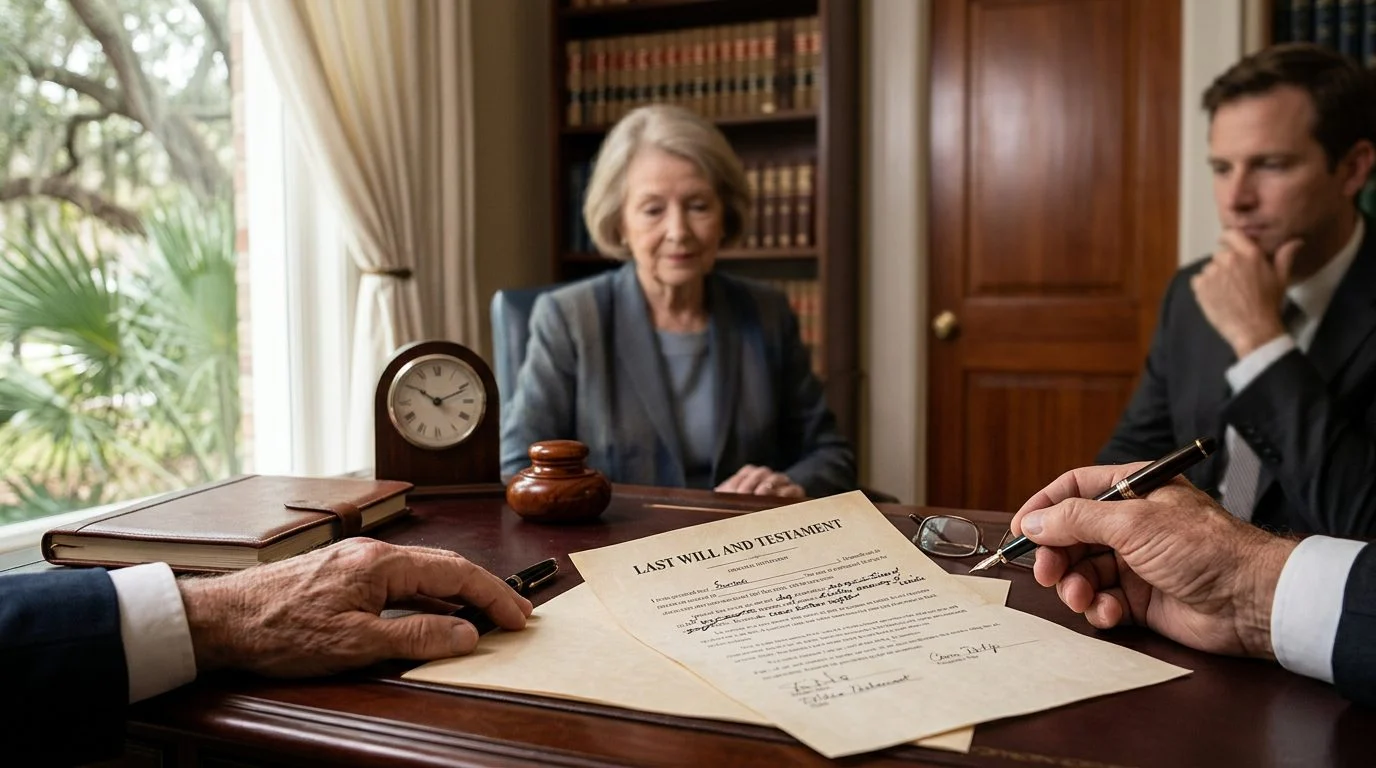
Probate Litigation | Coral Gables, Florida
When Lies Change a Will: Fraud on the Testator in Florida
Trust Counsel, PL represents beneficiaries, heirs and fiduciaries in probate and trust disputes. If you believe false information led someone to make or change a will or trust, a free first discovery call is confidential and carries no obligation to continue.
By Leslie V. Marenco · Published November 6, 2026
Fraud on the testator in Florida is deception that leads a person to make or change a will or trust based on false information. Under Florida law, a will or trust procured by fraud can be void. This page explains what fraud on the testator means, where it can happen, and how state law treats it. It also covers the evidence and deadlines that matter early on.
What Fraud on the Testator Means in Florida
Fraud on the testator is a false statement, hidden fact, or fake document that causes a maker to sign or change a will. The testator is the person who makes the will. In a trust, the same idea applies to the person who creates or changes it.
Deception can take many forms. Someone might tell the maker a false story about a relative. Someone might hide a debt or misstate what a property is worth. Someone might slip in a document the maker never read closely.
The key question is not whether the result seems unfair to you. The key question is whether false information shaped the document, so it no longer reflects the maker’s own intent. Fraud can happen at three points: during creation, at signing, and during administration after the maker dies. Each point raises different issues.
Not sure what your next step is?
Talk it through with our team — the first discovery call is free, confidential, and carries no obligation.
How Florida Law Treats a Will or Trust Procured by Fraud
Florida treats a will as void when fraud procured its execution. A trust, or the part of a trust that fraud procured, is void too.
The will rule appears in Fla. Stat. § 732.5165. It says a will is void if its execution is procured by fraud, duress, mistake, or undue influence. If only part was procured this way, that part is void. The rest stays valid if it is not invalid for other reasons. A revocation procured by fraud is also void.
For trusts, Fla. Stat. § 736.0406 applies the same idea to the creation, amendment, or restatement of a trust. For trusts, Fla. Stat. § 736.0406 applies the same idea to the creation, amendment, or restatement of a trust. A trust or part of it procured by fraud, duress, mistake, or undue influence is void.
These statutes state legal effect. They do not decide whether anyone committed fraud. A court decides that from the evidence. For trusts, the contestant has the burden under Fla. Stat. § 736.0207.
The trust litigation attorney page on this site explains how will and trust contests fit into Florida trust litigation.
Fraud During Will or Trust Creation
Fraud during creation happens when false information shapes the choices the maker makes. The maker still signs, but the choice rests on something untrue.
Common examples include a false claim that a child died, was disloyal, or stopped caring for a parent. Another example is a false statement about assets, debts, or the value of property. If the maker changed a plan after hearing accurate facts, that is a different situation. An honest change of mind is not fraud.
Florida courts describe fraud claims in general by four elements. There must be a false statement of a material fact, the speaker must know it is false, the speaker must intend it to induce action, and the listener must be injured by relying on it.
Pressure tactics raise a separate issue. A reader who sees both pressure and false statements can also read the sibling page on challenging a trust amendment signed under pressure in Florida.
Fraud at the Signing: Forged, Substituted, or Misrepresented Documents
Fraud at signing happens when the maker signs something other than what they believed they were signing. A forged signature is another form of this problem.
Florida sets formal rules for wills. Under Fla. Stat. § 732.502, a will must be in writing. Under Fla. Stat. § 732.502, every will must be in writing. The testator must sign the will at the end, or the testator’s name must be subscribed at the end of the will by some other person in the testator’s presence and by the testator’s direction. The testator’s signing or acknowledgment must be in the presence of at least two attesting witnesses, and the attesting witnesses must sign the will in the presence of the testator and in the presence of each other. The witnesses must sign in the testator’s presence and in each other’s presence. A will that skips these steps raises questions beyond fraud.
Misrepresentation can look routine. A maker might be told a document is a simple form, when it is really a will or a trust amendment. The label on the paper does not control its effect.
Signing details often matter. Ask who was present, who arranged the meeting, who chose the witnesses, who kept the original, and whether the maker read the full document. These facts can show whether the maker understood what they signed.
Preserve evidence now. Keep the original where it is, and do not write on or alter it. Save drafts, emails, texts, and notes.
Have questions about what happened?
Ask our team directly. The first conversation is free, confidential, and there is no obligation to continue.
Fraud During Probate or Trust Administration
Fraud during administration is misconduct after the document is signed. It usually involves the person running the estate or trust. It is a separate claim from fraud on the testator, which concerns how the document was made.
A personal representative owes the same fiduciary duty a trustee owes under an express trust. Under Fla. Stat. § 733.609, a personal representative is liable to interested persons for loss from breach of that duty. In these actions, the court must award taxable costs, including attorney’s fees, as the statute provides.
Inventories matter too. Under Fla. Stat. § 733.604, unless an inventory has already been filed, a personal representative must file a verified inventory of estate property. Fla. Stat. § 733.604 reads: “(1)(a) Unless an inventory has been previously filed, a personal representative shall file a verified inventory of property of the estate, listing it with reasonable detail and including for each listed item its estimated fair market value at the date of the decedent’s death.” If new property turns up, an amended or supplementary inventory must be filed.
Self-dealing is another concern. Under Fla. Stat. § 733.610, a sale to the personal representative or to the personal representative’s spouse, agent, or attorney, or to an entity in which they hold a substantial beneficial or ownership interest, or a transaction affected by the personal representative’s conflict of interest, is voidable by any interested person except one who has consented after fair disclosure. The rule has exceptions, including transactions the will or decedent’s contract authorized, or those a court approved after notice.
For an overview of probate and trust disputes across the state, see the Florida hub page on this site.
How Fraud Differs from Undue Influence and Mistake
Fraud involves deliberate false statements or hidden facts that induced the maker to act. Undue influence involves pressure that overcame the maker’s free will. Mistake involves an honest error.
Florida lists fraud, duress, mistake, and undue influence side by side in its will and trust statutes. Each can be a separate ground. The same facts can sometimes support more than one theory. A court looks at each theory on its own elements.
Undue influence has its own burden rule. Under Fla. Stat. § 733.107, the presumption of undue influence shifts the burden of proof in certain transactions. It exists to guard against abuse of fiduciary or confidential relationships.
Mistake is also its own category. It is an honest error, not a deliberate lie. Keep the vocabulary straight before you review your own facts. Words like fraud, pressure, and error point to different questions.
Evidence, Deadlines, and Options to Address a Suspected Fraud
Evidence matters most, and the deadlines are short. Start by preserving what already exists.
Useful evidence includes the original document, earlier versions, emails and texts, calendars, records of the maker’s health and whereabouts, and the names of anyone present at meetings or signings. Notes written at the time can help show what happened.
Timing depends on the document. These are the main rules:
- A will contest cannot be started before the testator dies, under Fla. Stat. § 732.518.
- Under Fla. Stat. § 736.0207, an action to contest the validity of all or part of a revocable trust, or the revocation of part of a revocable trust, may not be commenced until the trust becomes irrevocable by its terms or by the settlor’s death, and this section does not prohibit such an action by the guardian of the property of an incapacitated settlor.
- Under Fla. Stat. § 733.212, an interested person on whom a copy of the notice of administration is served must object to the validity of the will, the venue, or the jurisdiction of the court by filing a petition or other pleading requesting relief in accordance with the Florida Probate Rules on or before the date that is 3 months after service of the notice of administration on that person, or those objections are forever barred. The 3-month period may only be extended for estoppel based on a misstatement by the personal representative about the time period for filing an objection, and for no other reason. All such objections must be filed no later than the earlier of the entry of an order of final discharge of the personal representative or 1 year after service of the notice of administration. Fla. Stat. § 733.212(3) sets the objection deadline: any interested person on whom a copy of the notice of administration is served must object to the validity of the will, the venue, or the jurisdiction of the court within 3 months after service of that notice, or those objections are forever barred. The 3-month period can be extended only for estoppel based on a personal representative’s misstatement about that period.
- A contest of a trust that was revocable at the settlor’s death is barred if not started within the earlier of the time under chapter 95 or six months after the trustee sent the person a copy of the trust instrument and a notice of the trust’s existence, the trustee’s name and address, and the time allowed to bring a proceeding, under Fla. Stat. § 736.0604.
The right path depends on the facts. Some matters end without a court fight. Others require a court filing. Because the deadlines are short, early review helps.

Talk With Trust Counsel About Your Situation
Trust Counsel, PL focuses on trust and estate disputes, including will and trust contests. The firm’s only office is in Coral Gables. Leslie V. Marenco is the responsible attorney for this page. The firm’s lawyers include Leslie V. Marenco and Tanya Vega.
We serve clients in Fort Lauderdale and elsewhere in Florida. The firm advises and represents trustees, personal representatives, and beneficiaries. Trust Counsel’s attorneys can serve individually as trustee or personal representative. A matter may be referred to another lawyer or firm when that is the better fit.
Common Questions
What is fraud on the testator in Florida?
It is deception that leads a person to make or change a will or trust based on false information.
Is a will void if someone lied to the maker?
Florida treats a will as void when fraud procured its execution, under Fla. Stat. § 732.5165.
If a signed will or trust has you worried that false statements changed it, you don’t have to work through the facts alone. Call (305) 707-7126 or request a contact through our form. The first discovery call is free, confidential, and carries no obligation to continue.
Want to know where you stand?
Tell us what happened and our team will walk you through the options available to you, at no cost.
What Shapes a Fraud on the Testator Claim
Deception at the core
Fraud on the testator involves false statements or hidden facts that led a person to make or change a will or trust.
Evidence of the change
Drafts, signing records, communications and earlier estate plans often show how a document came to be and what the maker knew.
The people involved
Who had access to the maker, who arranged meetings and who benefited from the change are common areas of review.
Preserve Records Early
Keep emails, texts, calendar entries, and any copies of prior wills or trusts. Write down who arranged meetings with the estate planning attorney and who was present when documents were signed.
Questions Families Ask
What is fraud on the testator in Florida?
It is deception that leads a person to make or change a will or trust based on false information.
Can a will be void because someone lied?
Florida treats a will as void when fraud procured its execution, under Fla. Stat. § 732.5165. Each case turns on its own facts and documents.
How does a probate litigation attorney help?
Trust Counsel's attorneys focus on probate and trust litigation, reviewing the documents, timeline and circumstances behind a disputed will or trust change.