
Trust and Estate Litigation | Coral Gables, Florida
Foreign Beneficiaries Facing a Florida Trust Dispute: Where the Case Is Heard and What Is at Stake
Trust Counsel, PL represents beneficiaries, heirs and fiduciaries in Florida trust and probate disputes involving out-of-state or overseas families, trust property and cross-border assets.
By Leslie V. Marenco · Published October 23, 2026
A foreign beneficiary trust dispute in Florida can be heard in a Florida court when the trust has a real connection to Florida. Florida’s trust code sets the rules for which courts can hear the case, where it can be filed and how trust assets can be reached. This page explains those rules in plain language for families who live outside Florida or outside the United States.
What a Florida Trust Dispute Involving Out-of-State or Foreign Families Covers
This page covers a trust with ties to Florida where a beneficiary, heir or trustee lives outside Florida or outside the United States. The Florida connection might be a Florida trustee, a trust administered in Florida, or Florida real estate held by the trust.
This guide is most useful for:
- Non-resident beneficiaries and heirs who expect distributions from a Florida trust.
- Families with a trustee based in another state or another country.
- Families holding U.S. bank, brokerage or real estate assets under a Florida trust who now disagree about how the trust is run.
Trust Counsel, PL focuses on probate litigation, trust litigation, trust administration and fiduciary advice in Florida. The firm advises and represents trustees, personal representatives and beneficiaries. Trust Counsel’s attorneys can serve individually as trustee or personal representative, but the firm itself does not serve as a fiduciary.
Leslie V. Marenco is the responsible lawyer for this page. Tanya Vega is also one of the firm’s lawyers. The firm’s only office is in Coral Gables, and we serve clients in Miami-Dade, Broward and Palm Beach counties.
If a Florida trust you're named in is now in dispute from abroad, you may have a claim worth reviewing, and our free first consultation can look at where it belongs. Talk it through with Trust Counsel, PL — the first consultation is free, confidential, and carries no obligation.

Where a Florida Trust Dispute Is Heard
A foreign beneficiary trust dispute can reach a Florida court through the trust’s ties to Florida. The trustee’s acts and the trust’s place of administration matter, and a person can be subject to Florida courts whether or not they are a citizen or resident of Florida.
Under Fla. Stat. § 736.0202, a trustee who accepts a trusteeship of a trust with its principal place of administration in Florida submits to the jurisdiction of Florida courts for that trust. A beneficiary of that trust is also subject to Florida courts, to the extent of the beneficiary’s interest.
The venue rules are in Fla. Stat. § 736.0204. A trust case may be filed in a county where venue is proper under chapter 47. It may also be filed where the beneficiary suing or being sued lives or has its principal place of business, or where the trust is administered.
The “principal place of administration” is the key idea. Under Fla. Stat. § 736.0108, the trust document can name this place, but the named place must have a sufficient connection. Without a valid designation, it is the trustee’s usual place of business where trust records are kept. If the trustee has no business, it is the trustee’s residence.
Which law reads the trust’s terms is a separate question. Fla. Stat. § 736.0107 applies the law of the place the trust names, if there is a sufficient nexus to that place, but that designation is not controlling as to any matter for which it would be contrary to a strong public policy of this state. Without a controlling designation, it applies the law of the jurisdiction, which may be another country, where the settlor lived when the trust was first created.
How U.S.-Held and Foreign-Held Trust Assets Can Be Reached
U.S.-held trust assets are usually reached through court orders directed to the trustee and the bank or brokerage that holds them. Assets held outside the United States may need a separate case in that country, under its own courts and rules.
Florida law gives courts tools to protect trust property. Under Fla. Stat. § 736.1001, to remedy a breach of trust that has occurred or may occur, a court can impose a lien or constructive trust on trust property, subject to s. 736.1016, which protects a person other than a beneficiary who in good faith assists or deals with a trustee, without knowledge of improper exercise of powers, as if the trustee properly exercised the power. It can also trace trust property that was wrongfully disposed of and recover it or its proceeds. A court can appoint a special fiduciary to take possession of trust property and run the trust.
Service of papers follows Fla. Stat. § 736.02025 and chapter 48. When only in rem or quasi in rem relief is sought, papers can go by commercial delivery or by mail that requires a signed receipt.
Keep two kinds of claims separate. A claim against a trustee personally is different from a claim to trust property. Gather statements, deeds, transfer records and prior accountings early, because they show where assets went.
What Trust Litigation Can Include
Trust litigation can cover a demand for information, a claim against a trustee, a request to remove a trustee, and a dispute over what the trust says. Each one follows its own statute.
- Accounting and information. A trustee of an irrevocable trust must give each qualified beneficiary a trust accounting at least once a year, and on termination or change of trustee, under Fla. Stat. § 736.0813. If a family trust company, licensed family trust company, or foreign licensed family trust company is the trustee, the trust terms may instead permit accounting only at termination; upon the removal, resignation, or other event resulting in a trustee ceasing to serve as a trustee; or upon demand of a qualified beneficiary or the representative of a qualified beneficiary. On reasonable request, the trustee must also provide a complete copy of the trust instrument.
- Accounting format. Fla. Stat. § 736.08135 requires a trust accounting to be a reasonably understandable report. For the accounting period, it must show all cash and property transactions and all significant transactions affecting administration, including compensation paid to the trustee and the trustee’s agents.
- Removal of a trustee. Fla. Stat. § 736.0706 permits the settlor, a cotrustee or a beneficiary to request that the court remove a trustee, and the court may also remove a trustee on its own initiative. The court may remove a trustee for a serious breach of trust, for cotrustee non-cooperation that substantially impairs administration, for unfitness, unwillingness or persistent failure to administer the trust effectively when the court determines removal best serves the beneficiaries’ interests, or for a substantial change of circumstances (or where all qualified beneficiaries request removal) when the statutory conditions are met.
- Remedies for breach. When a breach of trust has occurred or may occur, Fla. Stat. § 736.1001 allows the court to choose from several remedies. These include ordering the trustee to account, reducing or denying the trustee’s compensation, and compelling the trustee to redress the breach by paying money, restoring property or by other means.
- Validity contests. In a contest, the person challenging the trust has the burden of proving the grounds for invalidity, under Fla. Stat. § 736.0207. A contest of a trust that was revocable at death is barred if not filed within the earlier of the chapter 95 time or six months after the required notice, under Fla. Stat. § 736.0604.
Practical Steps When the Family Lives Outside Florida
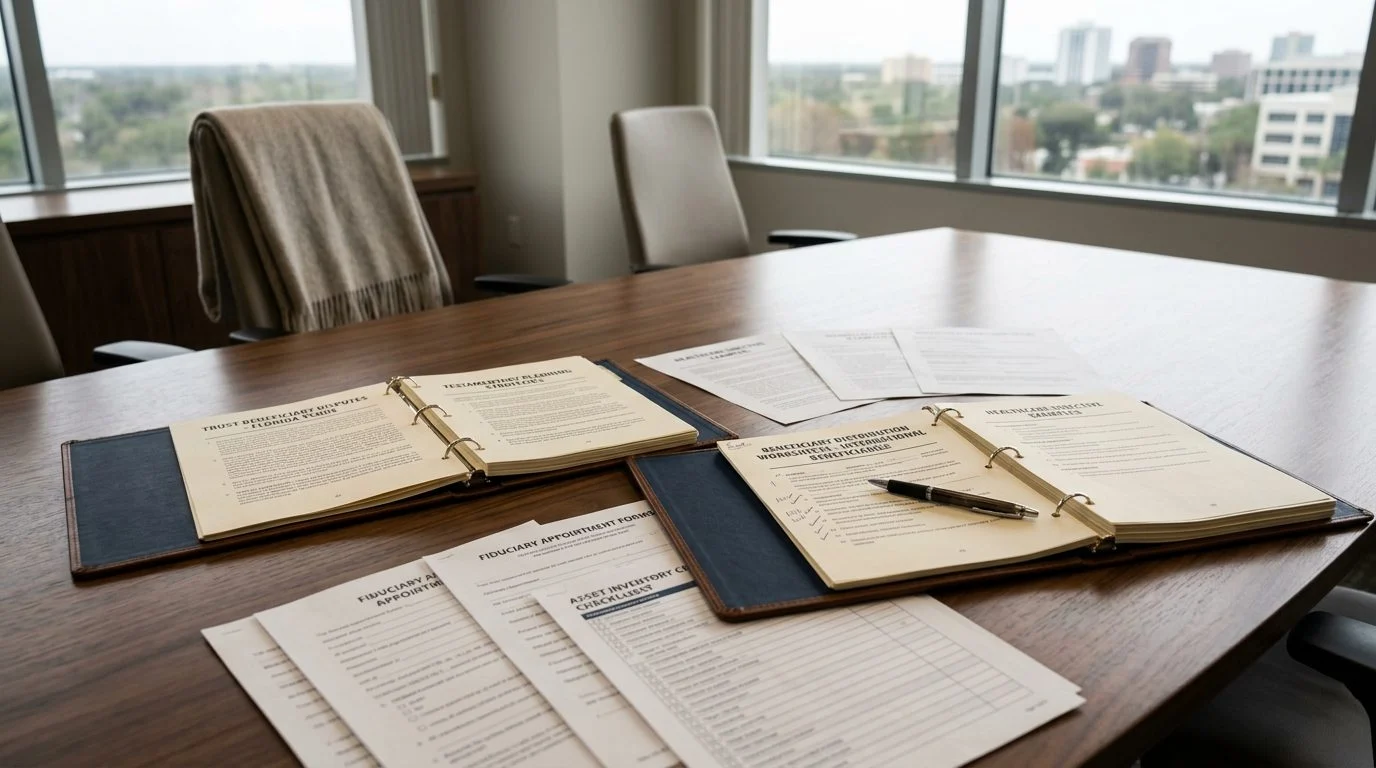
Start by collecting the documents. The trust instrument answers many early questions.
- Core records. Gather the trust instrument, every amendment, trustee letters, account statements and records of past distributions. Certified or authenticated copies help where you can get them.
- Translations. Spanish or other foreign-language papers need certified English translations for court use. Make a list of what must be translated before you file.
- Written communication. Keep emails and letters in writing. Set a call schedule that fits your time zone and the trustee’s.
- Deadlines. Trust claims can carry time limits tied to notice and administration events. Other claims fall under chapter 95.
- U.S. representative. Decide early who will handle filings, service and court appearances in the United States, and how that person will be authorized to act.
How the Process Works, Step by Step
A dispute usually moves from document review to a written demand, then to a court filing if needed. The timeline depends on the facts, the parties and the court’s schedule.
- Free first consultation. We review the trust, the dispute and the family’s goals.
- Document review. We build a written list of issues, possible courts and where assets are located.
- Demand or request. Before filing, we may send a demand letter or request an accounting in writing.
- Filing and service. If needed, the case is filed in the proper Florida court. Papers are served on the trustee and other parties, including those abroad.
- Litigation steps. The case may move through discovery, motions, mediation or a hearing.
- Resolution and enforcement. The case ends with a court order or settlement.
Not sure what your next step is?
Talk it through with Trust Counsel, PL — the first consultation is free, confidential, and carries no obligation.
Why Trust Counsel, PL for a Florida Trust Dispute with Out-of-State or Foreign Parties
Trust Counsel, PL focuses on Florida trust and estate matters. The reasons to contact the firm are its practice areas and its clear role limits.
- Practice focus. The firm handles probate litigation, trust litigation, trust administration and fiduciary advice.
- Role limits. The firm advises and represents trustees, personal representatives and beneficiaries. This helps the firm explain each side’s duties.
- Fiduciary service. Trust Counsel’s attorneys can serve individually as trustee or personal representative. The firm itself does not serve as a fiduciary.
- Office location. The firm’s only office is in Coral Gables. We serve clients in Florida, including Miami-Dade, Broward and Palm Beach counties.
- Plain explanations. We explain your options in plain words. We don’t promise any result.
Common Questions About Florida Trust Disputes for Families Abroad
Do I have to travel to Florida?
Document review and consultations can often happen by phone or video. Court appearances follow the court’s rules and may require attending in person.
Can a Florida court reach a trustee who lives abroad?
Possibly. Under Fla. Stat. § 736.0202, a trustee who accepts a trust with its principal place of administration in Florida submits to Florida courts for that trust.
Can I challenge a trust if I live outside the United States?
Florida contests put the burden of proof on the person challenging the trust.
Who pays attorney fees in a trust lawsuit?
The answer turns on the trust terms and the claims. We review that question during the first consultation.
What if I don’t have the original trust document?
On reasonable request, a trustee must give a qualified beneficiary a complete copy of the trust instrument under Florida law. Make the request in writing and keep proof that you sent it.
Is the first consultation free?
The firm offers a free first consultation that is confidential and comes with no obligation to continue (Spanish: consulta inicial gratuita, confidencial y sin compromiso).
If a trust you’re named in is in dispute and your family lives outside Florida, a foreign beneficiary trust dispute review can show where the case belongs and which records matter most. Call (305) 707-7126 or schedule online.
How we help foreign beneficiaries and fiduciaries
Venue and jurisdiction review
We look at where the trust is administered, where the trustee lives and where the assets sit to help identify the Florida court that may hear a dispute.
Trust and asset documents
We review trust instruments, accountings, account records and property titles so you understand what the trust holds and how it is managed.
Litigation for beneficiaries and heirs
Trust Counsel, PL focuses on trust litigation and probate litigation, representing beneficiaries and heirs who need to challenge or enforce a trust.
Advice for trustees and personal representatives
The firm advises and represents trustees, personal representatives and beneficiaries. Trust Counsel's attorneys can serve individually as trustee or personal representative.
Remote consultations when possible
Many consultations and document reviews can be held by phone or video. Court appearances follow the court's rules and may require attending in person.
Start with the facts
Where a dispute is filed can affect which court hears it and what law applies. The trust terms, the trustee's location and where the assets are held all matter. Gather the trust documents and any correspondence before you speak with an attorney.
Areas of practice
Trust litigation
Disputes over trust terms, trustee conduct, accountings and distributions, handled for beneficiaries and trustees.
Probate litigation
Contested estates, will challenges and disputes among heirs, with representation for beneficiaries and personal representatives.
Trust administration
Guidance for trustees and personal representatives on administering a trust or estate under Florida law.
Asset protection and succession
Planning for business owners and high-net-worth families with cross-border ties, including estate tax and business succession planning.
Talk with Trust Counsel, PL about your Florida trust dispute. Our free first consultation is confidential and comes with no obligation to continue. We serve clients in Coral Gables, Fort Lauderdale, Boca Raton, West Palm Beach, Doral, Kendall, Pinecrest, Key Biscayne and Aventura.
Related practice areas
- Trust Litigation Attorney
- What to Do When a Trust Document Is Lost in Florida
- Mediation Trust Dispute Florida: When It Helps