
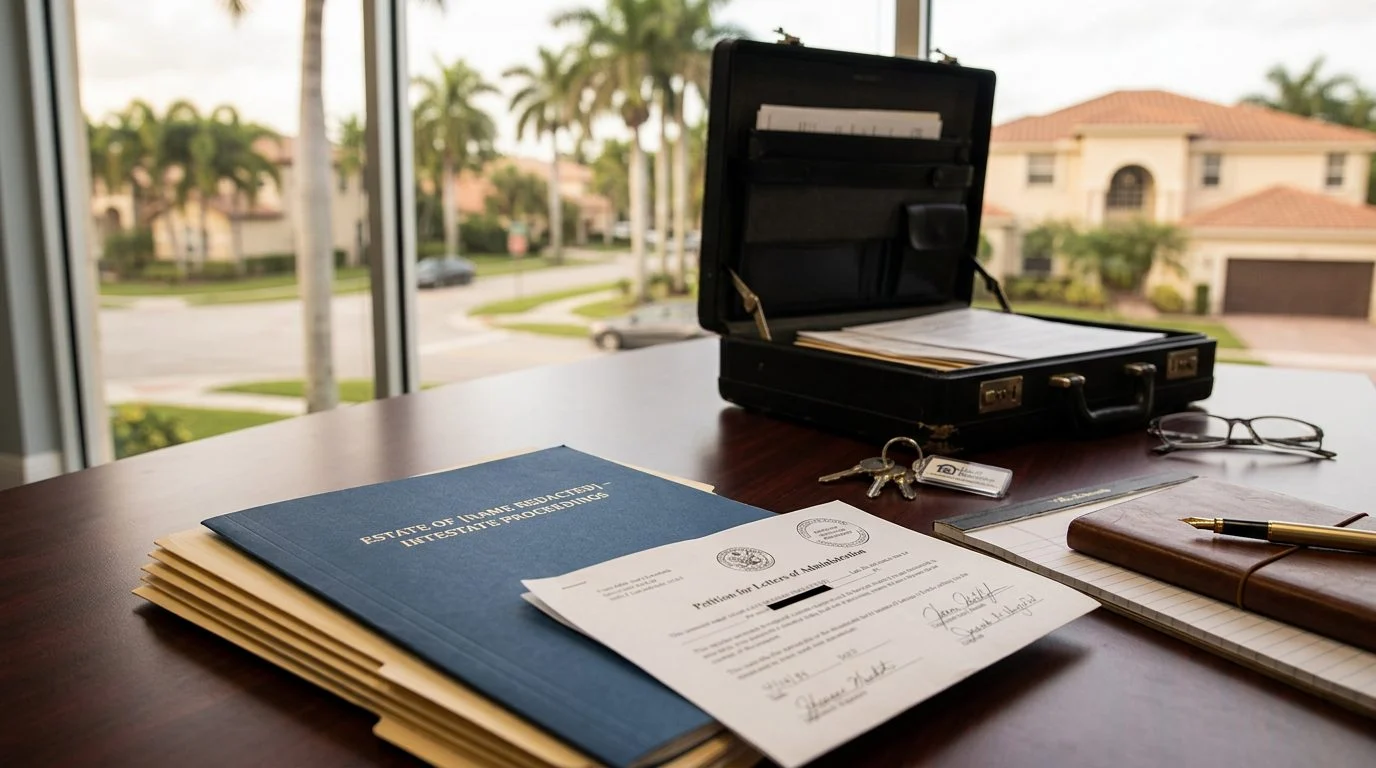
Probate and Estate Planning | Coral Gables, Florida
When a Florida Loved One Dies Without a Will, Who Decides What Happens Next?
Florida law sets the order for the estate. Learn how the process works and when a lawyer can help you respond.
By Leslie V. Marenco · Published November 17, 2026
If someone you love died in Florida and left no will, you’re probably asking who gets their property. Florida law answers that question, even though the person never wrote down a plan.
When there’s no valid will, Florida’s intestacy statutes decide who inherits. When a will does not effectively dispose of all of a decedent’s property, the remaining property passes to the decedent’s heirs as the Probate Code prescribes (Fla. Stat. § 732.101).
What Happens to Property When Someone Dies in Florida Without a Will?
The death itself starts the process. Under Fla. Stat. § 732.101, the decedent’s death vests the heirs’ right to that intestate property.
Heirs are the people the statute names. They include the surviving spouse and the others entitled under the intestacy rules (Fla. Stat. § 731.201).
A will normally sets the plan. Without one, the statute’s order of heirs takes its place. A note, a text or a verbal promise does not work as a will. Florida requires a will to be in writing (Fla. Stat. § 732.502).
Many families assume every asset follows the same path. Imagine a father who dies with a bank account in his name alone and no will. That account is likely to go through the estate, and the court process starts there. That’s a common mistake to avoid: how each asset is titled decides whether it goes through this process at all.
If you're handling a family estate with no will, you don't have to work out who inherits alone. Talk it through with our team — the first discovery call is free, confidential, and carries no obligation.
Who Inherits When a Surviving Spouse Is Left?
A surviving spouse takes the entire intestate estate only in some families. The answer turns on whether the decedent’s descendants are also the spouse’s descendants. Under Fla. Stat. § 732.102:
- No surviving descendants: the spouse takes the entire estate.
- All descendants are also the spouse’s, and the spouse has no other descendants: the spouse takes the entire estate.
- Some descendants are not the spouse’s: the spouse takes one-half.
- All descendants are the spouse’s, but the spouse also has descendants who are not the decedent’s: the spouse takes one-half.
Blended families surprise people. Take a husband who dies, leaving a wife and a daughter who is also the wife’s child. Change the facts so the daughter is from his earlier marriage, and the wife takes only half.
The family home follows its own rule. When a spouse and descendants survive, the spouse takes a life estate in the homestead, with the remainder passing to the descendants. Under Fla. Stat. § 732.401(2), the spouse may elect, in lieu of that life estate, an undivided one-half interest as a tenant in common. That election must be made within 6 months after death and during the surviving spouse’s lifetime, with a limited extension when a timely petition is filed by an attorney in fact or guardian, and once made it is irrevocable.
Who Inherits When There Is No Surviving Spouse?
When no spouse survives, the decedent’s descendants take first. Children share the estate. Under Florida’s intestacy rules, the part of an intestate estate not passing to the surviving spouse goes first to the decedent’s descendants.
Stepchildren often ask about this. The code’s definition of “child” excludes a person who is only a stepchild (Fla. Stat. § 731.201).
Which Assets Pass Through Intestacy and Which Do Not?
Intestacy reaches property that has no other way to pass. Many assets have their own route.
- Property in the decedent’s sole name with no beneficiary generally goes through the estate.
- Jointly held property with survivorship generally passes to the surviving owner.
- Accounts and insurance with named beneficiaries generally pay the named person.
- Property in an existing trust generally follows the trust’s terms.
Florida’s homestead rule also leaves out property held as tenancy by the entirety and joint tenancy with survivorship (Fla. Stat. § 732.401). A family may find the house passes one way, the car another way and the bank accounts a third. Gather the titles and beneficiary forms early. They show what the court must handle and what passes outside it.
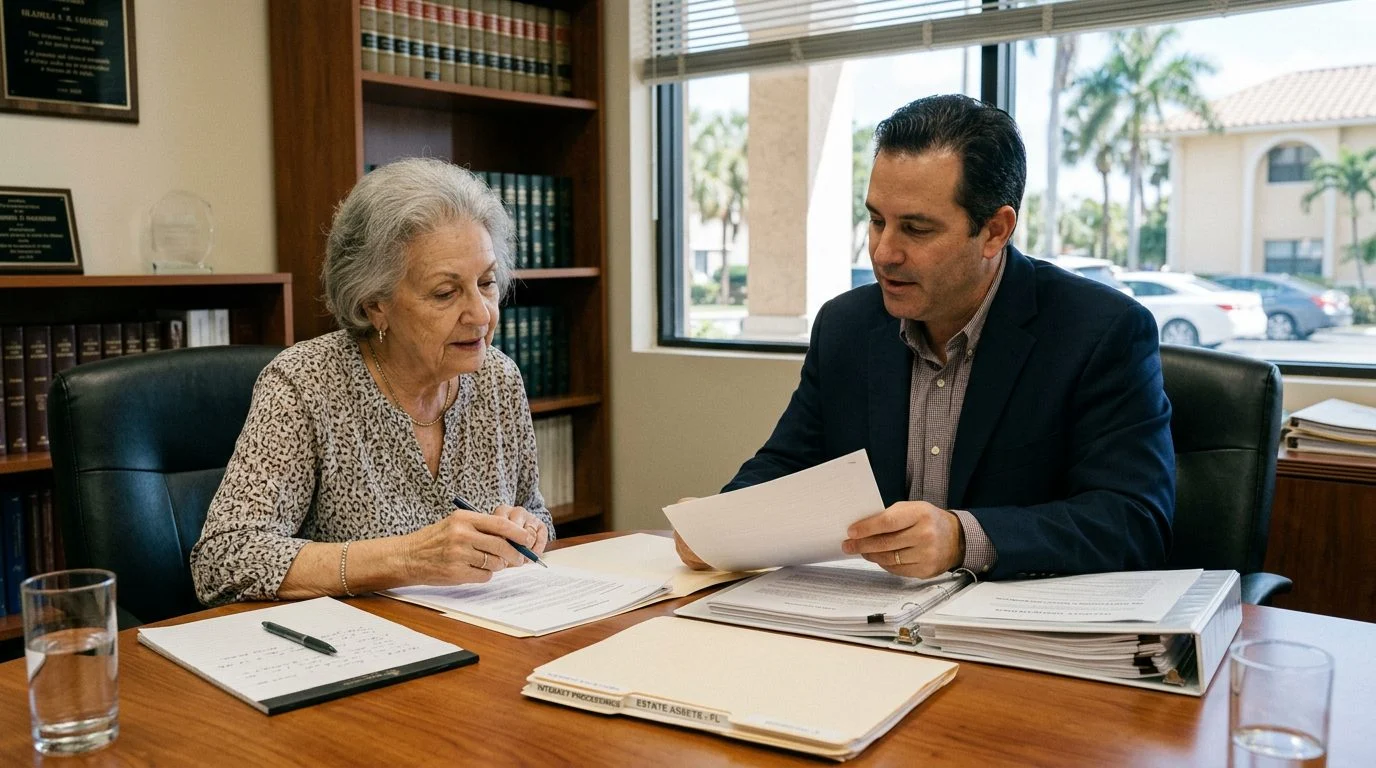
Not sure what your next step is?
Talk it through with our team — the first discovery call is free, confidential, and carries no obligation.
Who Handles the Estate When There Is No Will?
Without a will, the court appoints a personal representative (often called an executor). Florida’s order of preference for that role is set out in Fla. Stat. § 733.301.
The surviving spouse comes first. Next is a person selected by a majority in interest of the heirs, then the heir nearest in degree. If nobody applies, the court appoints a capable person. That person cannot work for, or hold public office under, the court, or be employed by, or hold office under, any judge exercising probate jurisdiction.
When granting letters of administration, the court follows a set order of preference for who serves as personal representative. The role must follow the standards of care that apply to trustees (Fla. Stat. § 733.602). The personal representative pays expenses and debts in the order set by Fla. Stat. § 733.707.
Trust Counsel’s attorneys can serve individually as trustee or personal representative, and the firm advises and represents trustees, personal representatives and beneficiaries.
When Does Florida Law Give Property to the State?
Florida gives property to the state only when no one is entitled to that part of the estate. This is called escheat. Under Fla. Stat. § 732.107, when a person dies without any surviving person entitled to part of the estate, that part escheats to the state.
Escheated property is sold under the Florida Probate Rules. The proceeds go to the Chief Financial Officer and into the State School Fund. A person who claims the right to those proceeds may reopen the administration within 10 years after payment. If no claim is timely made, the state’s rights become absolute.
The common mistake is assuming the state takes everything when there’s no will. It doesn’t. A living relative who qualifies as an heir means the state does not take that part.
How Does a Valid Will Change the Result?
A valid will changes the result for the property it covers. Its terms replace the intestacy order for those assets. A will can leave property to a friend, a charity or a trust, people the statute would not reach.
To control the estate, a will must meet Florida’s formalities. Under Fla. Stat. § 732.502, the will must be in writing and signed by the testator at the end, or by another person in the testator’s presence and by direction. The testator’s signing or acknowledgment must happen before at least two attesting witnesses, who sign in the testator’s presence and in each other’s presence.
A document that misses these Florida steps may not count as a will in Florida, but a will executed by a nonresident, other than a holographic or nuncupative will, is valid here if valid under the laws of the place where it was executed, and a qualifying military testamentary instrument is also valid. Surviving family members may still have rights that affect how a will works. Those rights depend on the facts of each family.
Talking Through a Florida Estate Without a Will
If you’re handling this estate now, you’re probably doing it while grieving. You may be arranging a funeral, telling relatives and searching for papers, all at once.
Does a spouse inherit everything in Florida without a will?
Not always.
Does the state take property when someone dies without a will?
Under Fla. Stat. § 732.107, when a person dies leaving an estate without being survived by any person entitled to a part of it, that part escheats to the state.
Who handles the estate when there is no will?
In an intestate estate, the court grants letters of administration in this order of preference: first the surviving spouse, then the person selected by a majority in interest of the heirs, then the heir nearest in degree.
The initial free discovery call is free, confidential and carries no obligation to continue. Leslie V. Marenco is the lawyer responsible for this page, and the firm’s only office is in Coral Gables, Florida. If you’re handling a family estate with no will, you don’t have to work out who inherits alone. Call (305) 707-7126 or schedule your free discovery call online.
Have questions about what happened?
Ask our team directly. The first conversation is free, confidential, and there is no obligation to continue.
How Trust Counsel Can Help
Probate litigation
Trust Counsel focuses on probate litigation, including disputes among heirs and beneficiaries over an estate's administration.
Advice for every side
The firm advises and represents trustees, personal representatives and beneficiaries, so each party understands its role and options.
Fiduciary roles
Trust Counsel's attorneys can serve individually as trustee or personal representative. The firm itself does not serve as a fiduciary.
Planning going forward
Estate planning, estate tax planning and asset protection work can help families organize their affairs before a crisis arises.
Do not wait to get organized
Acting without understanding how the estate is handled can create confusion and conflict among family members. Speaking with a lawyer early can help you see the steps that apply to your situation.
Questions Families Often Ask
Who inherits the property?
Florida's intestacy statutes set out who receives the estate when there is no will, depending on the family members who survive.
Who manages the estate?
The court appoints a personal representative (often called an executor) to collect assets, pay debts and distribute what remains.
What if relatives disagree?
Heirs and beneficiaries sometimes dispute the appointment or the handling of property. Probate litigation can address those disagreements.
Can planning help later?
Trust administration, guardianship and succession planning are areas where a lawyer can explain options for a family's next chapter.