
Estate Planning | Coral Gables, Florida
What 5 Documents Do You Need for Estate Planning in Florida?
A plain-language guide from Trust Counsel, PL, a Coral Gables law firm that focuses on trusts and estates, to the core documents Florida families often put in place.
By Leslie V. Marenco · Published October 19, 2026
Asking what 5 documents do you need for estate planning? For most Florida families, the answer is five documents that work together. They cover property at death, decisions during illness, and who receives certain accounts. This guide explains each one and the Florida law that governs it.
The Short Answer: The Five Core Documents in a Florida Estate Plan
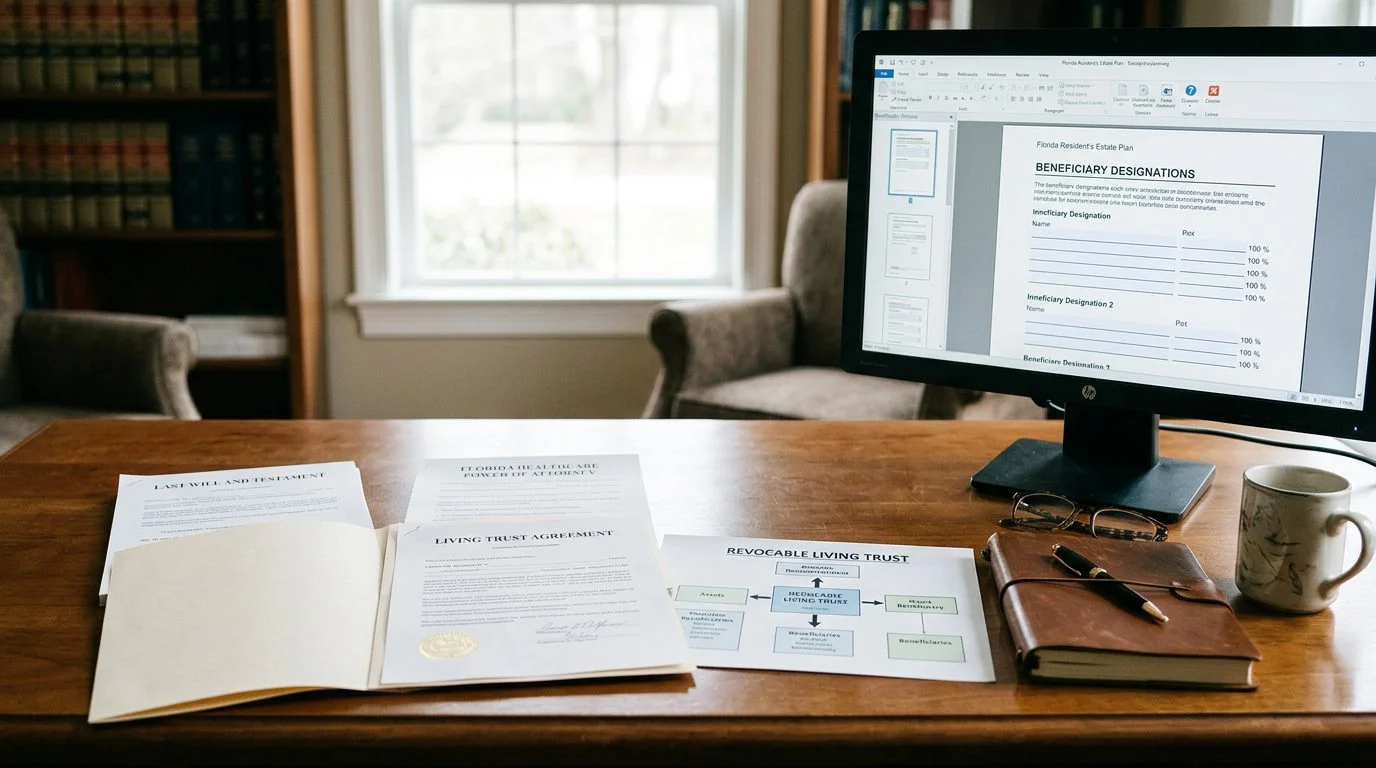
Most Florida estate plans rely on five core documents:
- A last will and testament. It directs how probate property passes after death.
- A revocable living trust. It is used when it fits your goals.
- A durable power of attorney. It lets an agent handle money and legal matters if you can’t act.
- A health care surrogate designation and a living will. They address medical decisions and treatment wishes.
- Beneficiary designations. These name who receives certain accounts and insurance policies.
An estate plan is the set of documents that work together. Each one controls a different part of your property, your decisions, or your care. This list is a common starting framework, not a legal requirement. Which documents you need depends on the facts, including your family, property, and health wishes. For a broader view, read the estate tax planning guide.
If a parent's health has changed or you're sorting a relative's papers, you don't have to work out these documents alone. Talk it through with Trust Counsel, PL — the first consultation is free, confidential, and carries no obligation.

1. Last Will and Testament
A will directs how property passes through probate. It can name a personal representative (often called an executor) to manage the estate. Florida is strict about how a will is signed. Under § 732.502, the will must be in writing and signed at the end by the testator (the person making the will). The testator’s signing or acknowledgment must happen in front of at least two attesting witnesses. Those witnesses must sign in the presence of the testator and of each other.
A will can also be made self-proved, under § 732.503, by the testator’s acknowledgment and the affidavits of the witnesses, made before an officer authorized to administer oaths. Within 10 days after receiving information that the testator is dead, anyone holding the original will must deposit it with the clerk of the court having venue of the decedent’s estate. That rule is in § 732.901.
A will works through probate. It does not replace your other documents. For what a personal representative can and cannot do, read personal representative limits in Florida.
2. Revocable Living Trust
A revocable living trust holds property during your life and sets rules for managing it after death. Florida lets a person create a trust by transferring property to a trustee during life, or by a will or other disposition that takes effect at death. See § 736.0401. Unless the trust says it is irrevocable, the settlor (the person who creates it) may revoke or amend it. See § 736.0602.
A trust does not cover everything by itself. Under § 733.103, a will is ineffective to prove title to, or the right to possession of, the testator’s property until it is admitted to probate in this state or in the state where the decedent was domiciled. Property must be moved into the trust, or the trust may not control it. Not every estate needs a trust. The right choice depends on what you own and what you want to happen.
A trustee is the person who manages the trust. Trust Counsel’s attorneys can serve individually as trustee or personal representative, while the firm advises and represents trustees, personal representatives and beneficiaries.
3. Durable Power of Attorney
A durable power of attorney names an agent to handle money and legal matters if you become unable to act. This document matters before death, because a will does not take effect until death. A power of attorney is durable if it contains specific words, or similar words, showing the authority continues after incapacity. See § 709.2104. Both you and two subscribing witnesses must sign it, and you must acknowledge it before a notary public or as otherwise provided in section 695.03 of the Florida Statutes. See § 709.2105.
Authority is narrower than many people expect. Under § 709.2201, an agent may only use authority the document specifically grants, plus what is reasonably needed to carry out that grant. General phrases like “all acts the principal can do” do not grant specific authority. Court approval is not required for an agent’s act that carries out an express grant.
Drafting and use errors are common enough to review on their own. See common power of attorney mistakes.
4. Health Care Surrogate Designation and Living Will
A health care surrogate designation names the person who makes medical decisions for you if you cannot. A living will records your wishes about medical treatment. These are medical documents. A financial power of attorney does not cover health care on its own. Under § 709.2201, an agent may make health care decisions only when that authority is specifically granted in a durable power of attorney.
If a guardian is ever appointed, the court must check for an advance directive. Under § 744.3115, the court must determine whether the ward signed a valid advance directive under chapter 765 before incapacity. If one exists, the court’s order states what authority the guardian and the surrogate keep. That is one more reason to have these documents in place early.
Give copies to the person you name as surrogate and to your medical providers. Review both documents when your relationships or your wishes change.
5. Beneficiary Designations on Accounts and Policies
A beneficiary designation is a form that names who receives an account or policy when its owner dies. These forms sit outside the will, so they should be reviewed alongside it. Florida has a specific rule for former spouses. Under § 732.703, a designation that passes an interest to a former spouse is void as of the time the marriage was judicially dissolved, if the designation was made before the dissolution. Under Fla. Stat. § 732.703(9), this section applies to all designations made by or on behalf of decedents dying on or after July 1, 2012, regardless of when the designation was made.
Here is a simple example. Imagine a will that splits everything equally among three children. An old life insurance form, though, names only one of them. Check that form against the will. A mismatch like this can send money somewhere you did not plan.
Forms like these are often forgotten after life changes such as marriage, divorce, or the birth of a child. Make a habit of checking them whenever your family changes.
Not sure what your next step is?
Talk it through with Trust Counsel, PL — the first consultation is free, confidential, and carries no obligation.
What Should Not Go in a Will, and What Belongs Elsewhere
Medical instructions belong in your health care documents, not in your will. Keep treatment wishes in the living will and surrogate designation, so the right person can find them quickly. Account numbers and asset lists change over time. Keep them in a separate record and update it when accounts change.
Your will should not try to hand off your decisions to an agent. Under § 709.2201, an agent may not execute or revoke any will or codicil for the principal. Questions about updating a will depend on each person’s circumstances. A free initial consultation with Trust Counsel, PL is confidential and carries no obligation to continue.
Keep your will consistent with your trust and beneficiary forms. When the will gives property to one person and a form names another, the two documents need review together.
Common Mistakes When Assembling the Documents
Common mistakes include signing errors, unfunded trusts, outdated forms, and documents left unchanged after a major life event. Watch for these four problems:
- Signing and witnessing errors. A will must meet § 732.502, and a power of attorney must meet § 709.2105. A plan signed in another state may still need review for Florida property.
- A trust that was never funded. Property still in your own name may not follow the trust’s rules.
- Beneficiary forms that conflict with the will. Review forms after any major change, including marriage, divorce, or a move.
- Documents left unchanged after divorce. Under § 732.507, a will provision that affects a spouse is void once the marriage is dissolved. That applies to decedents who die on or after June 29, 2021. The statute has exceptions, including a specific intention stated in the will. Because of those exceptions, review every document after a divorce.
For a plain look at the steps families face, see probate steps and costs in Florida.
Bringing the Five Documents Together
Reviewing all five documents at the same time keeps them consistent. Each one affects the others. A change to one may call for a change to another. You may be one of three people reading this: a parent whose health recently changed, a relative trying to find a will and forms after a death, or an adult who realizes nothing is in place yet. Each situation starts with the same question: which documents exist, and do they still match your wishes?
Quick Answers to Common Questions
Is a will enough on its own?
No. A will does not handle incapacity or medical decisions, which need a power of attorney and health care documents.
Can a power of attorney change my will?
No. Under § 709.2201, an agent may not execute or revoke a will for you.
How many witnesses does a Florida power of attorney need?
Two subscribing witnesses, plus a notary acknowledgment, under § 709.2105.
Do I need a trust if I have a will?
Not always. A trust is one option, and people often use it for specific goals about property and management.

Talk Through Your Own Documents with Trust Counsel
Asking what 5 documents do you need for estate planning is a good first step. If a parent’s health has changed, or you’re sorting a relative’s papers after a death, these questions can feel hard to answer alone. Trust Counsel, PL is located in Coral Gables, Florida, and attorney Leslie V. Marenco can talk through which documents you have and which ones are missing. Call (305) 707-7126 or schedule a free strategy call online. The first consultation is free, confidential, and carries no obligation to continue.
The five documents at a glance
1. Last will and testament
A will names who receives your property at death, who you want to serve as personal representative (often called an executor), and who should care for any minor children.
2. Revocable living trust
A trust can hold assets during your life and direct how they are managed and distributed, which may help avoid probate for trust-held property.
3. Durable power of attorney
This document lets an agent you choose handle financial matters if you become unable to act for yourself. Under Florida law, an agent may not execute or revoke a will for you.
4. Health care surrogate and advance directive
These documents name the person who can make medical decisions for you and record your wishes for end-of-life care if you cannot speak for yourself.
5. Beneficiary designations and asset titling
Retirement accounts, life insurance and bank accounts often pass by beneficiary designation or title, so these forms must match the rest of your plan.
A will alone does not cover incapacity
A will only takes effect after death. If you become incapacitated, a will cannot make financial or medical decisions for you, which is why the power of attorney and health care documents matter.
Why people start with Trust Counsel, PL
Coral Gables office
Our only office is in Coral Gables. We serve clients in Miami-Dade, Broward and Palm Beach counties, including Doral, Kendall, Pinecrest, Key Biscayne, Aventura, Fort Lauderdale, Boca Raton and West Palm Beach.
Focused trusts and estates practice
The firm focuses on estate planning, trust and probate matters, guardianship and business succession for individuals, families and business owners.
Led by Leslie V. Marenco
Leslie V. Marenco is the attorney responsible for this page. Our support staff assists with scheduling, document preparation and client communication.
Free first consultation
Your first consultation is free, confidential and carries no obligation to continue.