
Estate Planning | Coral Gables, Florida
Common POA Mistakes to Avoid in Florida
A power of attorney is simple to sign and often difficult to fix later. Learn the errors that most often cause problems, and how to avoid them. Leslie V. Marenco, one of the firm's lawyers, is responsible for this page.
By Leslie V. Marenco · Published October 20, 2026
Here’s the short answer to “what are common POA mistakes to avoid?” The most common errors involve signing, agent choice, unclear powers, bank acceptance, and mixing up a power of attorney with a will or trust. Each one can leave an agent without authority when it’s needed most.
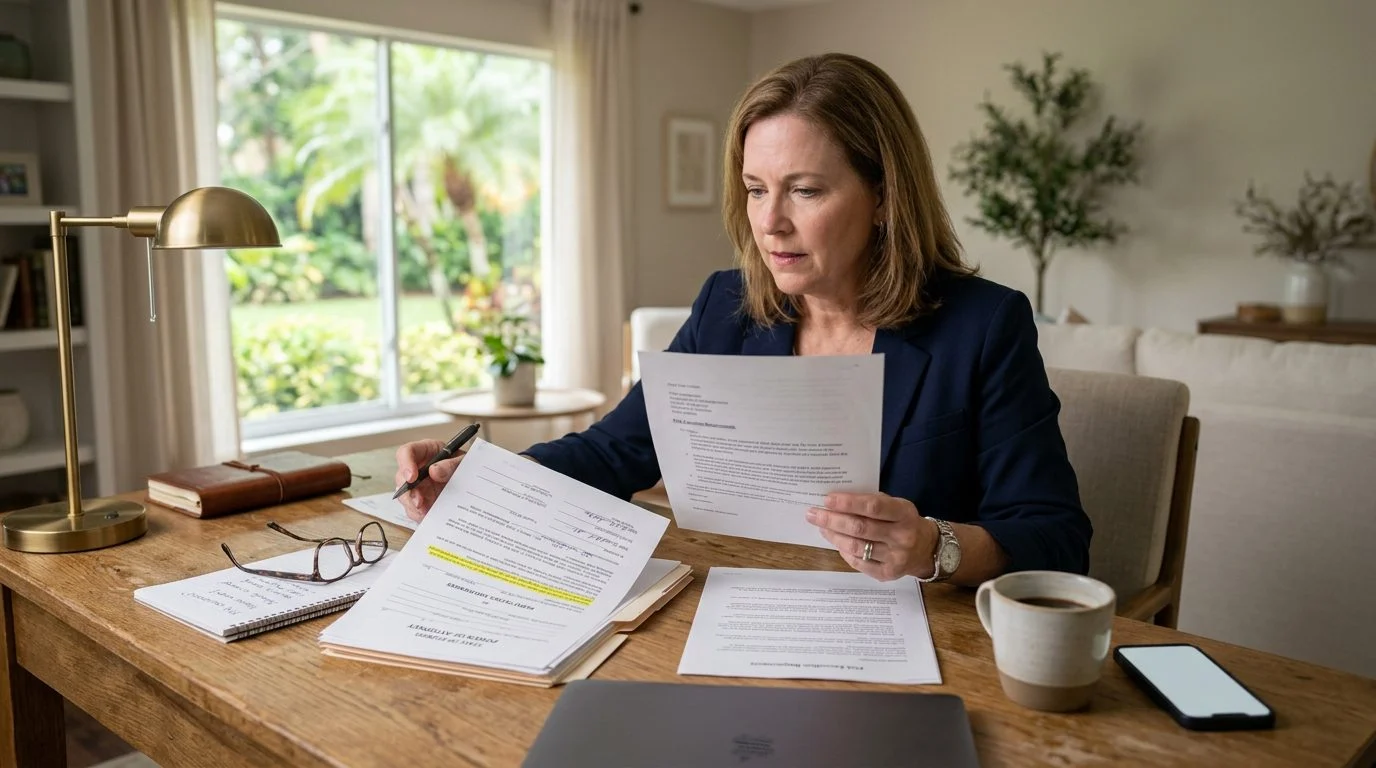
Picture a daughter whose father has just come home from the hospital. His bills are due, and his bank needs instructions. She has a power of attorney in a folder, but she never read it closely. She isn’t sure it’s valid, and she isn’t sure the bank will accept it.
That’s when these errors surface. A Florida power of attorney works only when three things line up. The document must be validly signed. The agent must be willing and able to act. And the wording must be clear enough for the agent and the bank to know what the agent may do.
The details depend on the facts of each family and each document. Use this page as a checklist of what to look for, not a final verdict on any one document.
Signing and witnessing errors
Signing errors are among the most common POA mistakes to avoid. A Florida power of attorney must be signed by the principal and two subscribing witnesses. The principal must also acknowledge it before a notary public. Fla. Stat. § 709.2105 sets out this requirement.
For a document signed on or after October 1, 2011, Fla. Stat. § 709.2106 says validity depends on following that signing rule. A flaw at the signing step puts the whole document in question.
Common errors include:
- Witness lines left blank or unsigned.
- An incomplete notary section.
- A signed version that doesn’t match the one the family reviewed.
A bank can rely in good faith on a document that appears to be executed the way the law requires. Fla. Stat. § 709.2119 addresses that reliance. A document with visible gaps gives the bank a reason to refuse.
The fix often means starting over with a new signing, which takes time. Keep the signed original in one known place. Give the agent a copy.
If you're handling a parent's bank accounts and aren't sure the power of attorney will work, you don't have to sort it out alone. Talk it through with Trust Counsel, PL — the first consultation is free, confidential, and carries no obligation.

Choosing the wrong agent or naming no successor
Choose an agent who is trustworthy, able to handle paperwork, and free of conflicts with the principal’s interests. The agent controls money, property, and access to records, so this choice matters a great deal.
Under Fla. Stat. § 709.2105, the agent must be a natural person age 18 or older. A financial institution with trust powers can also serve, if it meets the statute’s place-of-business and trust-business rules.
Avoid these agent mistakes:
- Naming someone who lives far away, with no plan for local bills and paperwork.
- Naming someone already stretched thin by work or caregiving.
- Naming someone whose personal interests conflict with the principal’s.
Florida requires an agent to avoid conflicts that could impair impartial action. Fla. Stat. § 709.2114 sets out that duty.
A successor agent is a backup. Fla. Stat. § 709.2111 lets the principal name one or more successors. A successor can act only after the earlier agent resigns, dies, becomes incapacitated, is not qualified, or declines to serve. Fla. Stat. § 709.2111 reads: “Unless the power of attorney otherwise provides, a successor agent: (a) Has the same authority as that granted to the original agent; and.”
If the agent’s authority ends and the document names no one else, the power of attorney can terminate. Fla. Stat. § 709.2109 lists that outcome. Pick an agent based on the principal’s real wishes, not convenience alone.
What are the disadvantages of being someone’s power of attorney?
The role carries legal duties, record-keeping work, and personal exposure if the agent doesn’t follow them. Florida treats the agent as a fiduciary, meaning a person trusted to act for someone else. Fla. Stat. § 709.2114 sets out those duties.
An agent must act only within the authority the document grants. Fla. Stat. § 709.2114 reads: “Notwithstanding the provisions in the power of attorney, an agent who has accepted appointment: (a) Must act only within the scope of authority granted in the power of attorney.” The agent must act in good faith and keep a record of all receipts, disbursements, and transactions. The agent must also act loyally for the principal’s sole benefit.
Records can be requested. Unless a court or another authorized party asks, the agent doesn’t have to disclose them. If asked, the agent must comply within 60 days, or give a written reason and then comply within another 60 days.
An agent who violates the law can be liable. Fla. Stat. § 709.2117 requires restoring the property’s value to what it would have been without the violation, and repaying attorney’s fees and costs paid from the principal’s funds on the agent’s behalf to defend the agent’s actions. Still, an agent who hasn’t breached a duty isn’t liable just because property declines in value.
The daily burden is real. The agent may need time for banking, bills, and records. Family members may question every payment, so clear documentation protects the agent.
Trust Counsel’s attorneys can serve individually as trustee or personal representative in other settings. The firm advises and represents trustees, personal representatives and beneficiaries. This section focuses on the agent role under a power of attorney.
Powers that are too broad, too narrow, or unclear
A power of attorney should name the authority the agent needs, in words specific enough for a bank to act on. Generic forms often miss this.
The National Academy of Elder Law Attorneys notes that broad powers may not be honored. That is why specific wording matters. A document that is too narrow can leave out banking, real estate, or tax authority the agent will need.
Some powers need extra care.
General gift authority has limits too. The IRS gift tax FAQ describes the federal annual gift tax exclusion.
Self-dealing is another risk.
Remote witnessing has limits as well. Check that the two subscribing witnesses required by Fla. Stat. § 709.2105 have signed the document.
Vague wording invites questions from banks about scope. Clear limits protect the principal, and they protect the agent too.
Why acceptance and sharing matter
A valid power of attorney can still be refused in practice. A bank may question it, ask for its own form, or take time to decide.
Florida requires a third person to accept or reject a power of attorney within a reasonable time. Fla. Stat. § 709.2120 says a third person who rejects must state the reason in writing, unless an exception applies.
The same statute says a third person may not require a different form of power of attorney for authority the document already grants. It also says a third person doesn’t have to accept a document it believes in good faith is not valid.
Copies usually work. Under Fla. Stat. § 709.2106, a photocopy generally has the same effect as the original, unless the document says otherwise. An original may still be required when the document is used to affect title to real property.
Sharing is where many families fail. A document kept in a drawer, unknown to the agent and key relatives, can’t help when someone needs it. Give copies to the agent and to any institution that may need one. Keep a simple record of when and where you gave each copy.
Confusing a power of attorney with a will, trust, or health care directive
A power of attorney generally ends when the principal dies. It can’t pass property the way a will or trust does. Fla. Stat. § 709.2109 lists the events that end it, including the principal’s death.
Health care is a separate track. Florida handles health care decisions under Chapter 765 of the Florida Statutes. Fla. Stat. § 709.2109 reads: “If the principal has executed a health care advance directive designating a health care surrogate, the terms of the directive control if the directive and the power of attorney are in conflict unless the power of attorney is later executed and expressly states otherwise.” Fla. Stat. § 709.2109 reads: “(b) Notwithstanding the provisions of this section, unless otherwise ordered by the court, a proceeding to determine incapacity does not affect the authority of the agent to make health care decisions for the principal, including, but not limited to, those provided in chapter 765.”
Health care documents can conflict with a power of attorney. Under § 709.2109, if the principal has a health care advance directive naming a health care surrogate, that directive controls a conflict, unless a later power of attorney says otherwise.
If someone starts proceedings to determine incapacity, the authority under a power of attorney given to a parent, spouse, child, or grandchild is suspended when the petitioner files a motion under s. 744.3203 stating that the power of attorney should be suspended on specified grounds. This applies at any time during those proceedings but before the court enters an order determining incapacity. Suspension of authority granted to other agents is governed by s. 709.2109. However, if the agent is the principal’s parent, spouse, child, or grandchild, the authority under the power of attorney is not suspended unless the petitioner files a verified motion in accordance with s. 744.3203 stating that the power of attorney should be suspended on one of the listed grounds.
Ask whether any property is already held in a trust. The trust’s own terms and the power of attorney’s wording both shape what the agent can do. Mixing these documents up is a common source of confusion.
Not sure what your next step is?
Talk it through with Trust Counsel, PL — the first consultation is free, confidential, and carries no obligation.
Frequently asked questions about avoiding POA mistakes
Can a power of attorney be revoked?
Yes. Under Fla. Stat. § 709.2110, the principal can revoke it in a later signed writing. Signing a new document alone doesn’t cancel an older one.
What happens if the agent cannot serve?
If the document names a successor, that person can step in once the first agent resigns, dies, becomes incapacitated, is not qualified to serve, or declines to serve. Without a successor, the power of attorney can terminate, as Fla. Stat. § 709.2109 explains.
Does a power of attorney need to be updated?
Review it when your agent, finances, or family situation changes, because the document controls what the agent can do. Many families check it when the named agent moves away or can no longer serve.
Should a family review the document with a lawyer?
A lawyer can review the signing, the powers, and the agent choice in your specific document. No one can promise how a particular document will be read or accepted by a bank.

Talk with Trust Counsel about your situation
If you’re handling a parent’s bills right now, paperwork can feel like one more weight. Not knowing whether the document will hold up makes it harder. You don’t have to answer that question by yourself.
Bring the document you have, any questions from the bank, and the decisions you’re facing about the agent, the powers, or where copies are kept. Leslie V. Marenco is the lawyer responsible for this page. The firm’s only office is in Coral Gables. Its lawyers include Leslie V. Marenco and Tanya Vega.
The first consultation is free, confidential, and carries no obligation to continue. Call (305) 707-7126 or schedule online.
What a carefully drafted power of attorney should do
Name the right people
The agent and any backup agent should be chosen deliberately, with clear authority over the matters that matter most to you.
Define the powers clearly
Specific, well-written powers reduce confusion for banks, institutions and the people relying on the document.
Keep it current
Life changes such as marriage, divorce, a move or a new asset can make an older document outdated.
Plan with your family in mind
Talking through your choices with the people affected can prevent surprises when the document is needed.
Don't assume an old document is cancelled
Signing a new power of attorney does not always mean the older one is no longer in effect. Gather every document you have signed and make sure your current wishes are clear.
Mistakes to avoid
Naming an agent without a backup
If your first choice cannot act, a planned successor can prevent delays at the moment support is needed.
Leaving old documents in place
Multiple powers of attorney can create conflicting instructions. Review and update your documents together.
Using vague or overly broad language
General wording may not be accepted by banks or other institutions. Clear, tailored powers are easier to use.
Waiting until there is a crisis
Planning ahead gives you more control.
Review your power of attorney with a Florida estate planning attorney. Your first consultation is free, confidential and comes with no obligation to continue. Call (305) 707-7126 or schedule online.
Related practice areas
- Estate Tax Planning Attorney in Coral Gables, Florida | Trust Counsel, PL
- Estate Planning Attorney Fort Lauderdale Fl