
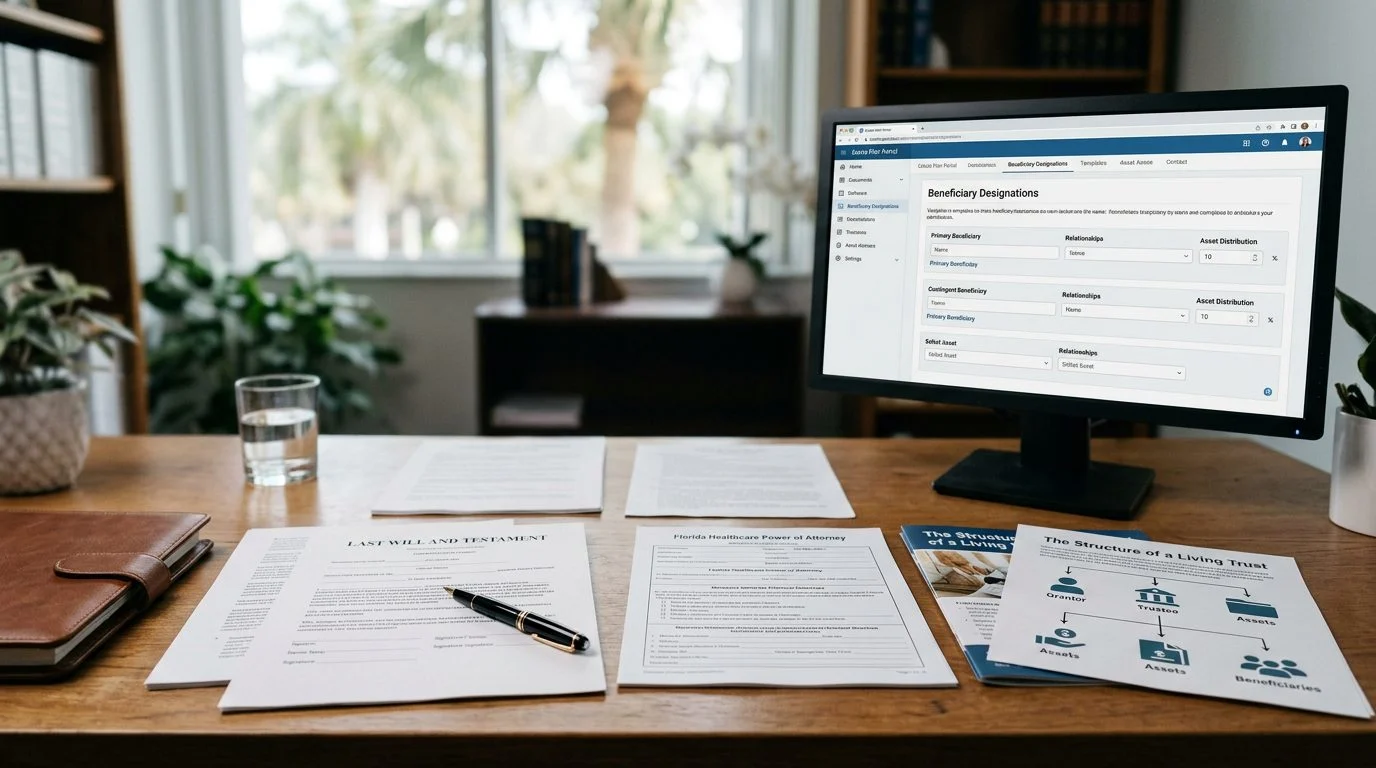
Gather Your Documents Before Your Estate Planning Meeting
A clear checklist of the papers, account details and family information Trust Counsel's attorneys in Coral Gables use to prepare Florida estate plans, trusts and succession plans.
By Leslie V. Marenco · Published October 30, 2026
What documents, asset records, and family information should I gather before meeting with an estate planning attorney in Florida?
Gather four kinds of records before you meet: identity and family papers, any estate documents you already have, a list of assets and debts with supporting statements, and business or foreign-ties paperwork if either applies. Bring them to the first meeting so your time goes to decisions instead of searching for papers.
Good planning starts with an accurate picture. The attorney needs to know what you own, who matters to you, and which documents already exist. An estate planning attorney helps clients gather and assess family and financial information during an initial meeting and treats that information as confidential (ACTEC guidance on initial meetings).
Many people arrive with a pile of papers. Sorting them first saves time and shows gaps, such as a missing deed or an unsigned form. Florida’s signing rules for wills and powers of attorney are strict, so know which originals exist.
Treat the list below as a starting point. The right set depends on your family, your property and your goals. For the wider planning picture, read the Florida estate tax planning guide.
If you're pulling these records together for a parent or for your own plan, you don't have to sort it out alone. Our attorneys can talk it through with you. Talk it through with Trust Counsel, PL — the first consultation is free, confidential, and carries no obligation.

Identity, marriage, and family records to collect
Start with proof of identity and family relationships. These records show who may inherit and who may claim a share under Florida law.
- Identification: Government photo ID, plus Social Security numbers for you and your spouse. Keep them in a secure place, not in a shared folder.
- Marriage and divorce papers: Your marriage certificate, any divorce judgment, and any prenuptial or postnuptial agreement.
- Children: Birth certificates for children and dependents, plus adoption or guardianship orders if they exist.
- Family list: Full legal names, birth dates, relationships and contact details. Include stepchildren and children from earlier relationships.
- Chosen people: Names of anyone you may want as personal representative (often called an executor), trustee, guardian for a minor child, or health care surrogate. Note whether each person has agreed.
Divorce changes plans. Under Florida law, a will provision that affects a spouse is void when the marriage is dissolved, unless an exception applies (Fla. Stat. § 732.507). Bring any divorce judgment so the attorney can check which provisions apply.
Existing wills, trusts, and powers of attorney
Gather every estate document you have signed, and note where each original is kept. Florida’s rules for wills are detailed, so the original and its signing details matter.
Florida requires a will to be in writing and signed at the end, with the testator signing, or acknowledging the signature, in the presence of at least two attesting witnesses. Those witnesses must sign in front of the testator and each other (Fla. Stat. § 732.502). The custodian of a will must deposit the will with the clerk of the court having venue of the estate within 10 days after receiving information that the testator is dead (Fla. Stat. § 732.901). So tell the attorney who holds the original.
- Wills and trusts: The original will, any codicils, and each trust agreement, with the date signed. Florida lets a settlor revoke or amend a revocable trust unless its terms say it is irrevocable, though this rule does not apply to trusts created under instruments signed before the Florida Trust Code took effect (Fla. Stat. § 736.0602). Bring every amendment.
- Durable power of attorney: The document and the names of the agents. Florida requires the principal’s signature, two subscribing witnesses and acknowledgment before a notary public or as otherwise provided in s. 695.03 (Fla. Stat. § 709.2105).
- Health care documents: Health care surrogate designations, advance directives and any living will. Give copies to your medical providers.
- Guardianship designations: Any nomination for a minor child or an adult who may become incapacitated. In a guardianship case, the court must check whether a valid advance directive exists (Fla. Stat. § 744.3115).
- Prior changes: Memoranda, amendments and older versions, so the attorney can confirm which document controls.
Asset, debt, and beneficiary designation records
Gather a statement for each account, property and debt, plus the current beneficiary forms. A beneficiary designation can send an asset to a named person outside your will or trust, so check its wording.
- Real estate: Deeds and recent property tax bills for each property, with the Florida county where it sits.
- Financial accounts: Bank, brokerage and retirement statements, with the beneficiary form for each.
- Insurance and annuities: Policies and contracts, with primary and contingent beneficiaries listed.
- Vehicles and property: Vehicle titles and a personal property inventory.
- Debts and digital access: Mortgages, lines of credit and recent tax returns, plus a secured list of online account access. Share it only as needed.
Divorce matters here too. A designation made by or on behalf of the decedent that provides for payment or transfer at death of an interest in an asset to a former spouse is void if it was made before a judicial dissolution of marriage, for decedents dying on or after July 1, 2012, subject to exceptions (Fla. Stat. § 732.703). Review every form after a divorce.
Business interests, foreign ties, and tax records
Business owners and families with assets abroad need more paperwork. Gather the agreements that control ownership and transfers, plus records of any entity or account outside the United States.
For a business, bring operating or shareholder agreements, buy-sell agreements, ownership percentages and recent financial statements. Under Florida’s LLC law, an operating agreement governs relations among the members as members and between the members and the limited liability company, and the statute’s default rules apply to any matter the operating agreement does not otherwise provide for. Note who would run the business and any key employee or partner arrangements.
Tax figures help frame the planning. IRC § 2010(c)(3) states that, for purposes of that subsection, the basic exclusion amount is $15,000,000. In the case of any decedent dying in a calendar year after 2026, that dollar amount is increased by a cost-of-living adjustment determined under section 1(f)(3), and any adjusted amount that is not a multiple of $10,000 is rounded to the nearest multiple of $10,000. The annual gift tax exclusion is $19,000 per donee (IRS gift tax FAQs). An individual who makes gifts beyond the listed exceptions must file a gift tax return for that year. Bring prior gift tax returns.
For assets outside the United States, list the country, asset type, how it is titled, and any foreign trust, company or bank account.

Organizing your folder and taking the next step
Put everything in one labeled folder, on paper or in secured digital storage. Add a one-page index that lists each document, its date and where its original is kept.
Many people start this work after a parent’s health changes or a spouse dies. Searching drawers and inboxes at that time is hard. Go one category at a time, and bring partial records if that’s all you have. Add a short list of goals, questions about family, and any concerns about a relative’s capacity or care needs.
Frequently asked questions
Should I bring my original will?
Yes, bring the original and any codicils if you have them. The clerk must keep the original will in its original form.
Does a Florida will need witnesses?
Yes. Florida requires at least two attesting witnesses, who must sign the will in the presence of the testator and in the presence of each other.
How long must the clerk keep an original will?
At least 20 years, under Florida law (Fla. Stat. § 732.901).
Leslie V. Marenco is the responsible lawyer for this page. The firm’s only office is in Coral Gables. If you’re gathering these records for a parent or for your own plan, you can book a free, confidential initial consultation, with no obligation to continue. Call (305) 707-7126 or schedule online. Trust Counsel’s attorneys can serve individually as trustee or personal representative, and the firm advises and represents trustees, personal representatives and beneficiaries.
Core Documents to Collect
Existing Wills and Codicils
Bring any original will, codicils and prior drafts. Keep originals in their original form so they can be reviewed as signed.
Trust Agreements and Amendments
Gather every revocable or irrevocable trust, restatement and amendment, along with any letters of wishes or trust schedules.
Property and Account Records
List deeds, mortgages, bank and brokerage statements, retirement accounts, life insurance policies and beneficiary designation forms.
Business Ownership Papers
Collect operating agreements, shareholder or partnership agreements, buy-sell agreements and recent valuations for any closely held business.
Information to Have Ready
Family and Beneficiaries
Names, birth dates and contact details for spouses, children, grandchildren and other intended beneficiaries.
Fiduciary Choices
Names and contact details for anyone you are considering as a trustee, personal representative or guardian, including backup choices.
Real Estate and Foreign Holdings
Addresses of Florida and out-of-state property, and any assets or accounts held in other countries.
Identity and Insurance
Copies of identification, Social Security numbers, health care directives and existing insurance policies.
Do Not Discard Older Documents
Earlier wills, trusts and beneficiary forms can still matter. Keep them until your attorney has reviewed your full set of documents, so nothing is overlooked.
How to Prepare for Your Meeting
Make a Written Inventory
List your major assets, debts and accounts in one document, with approximate values and where each item is held.
Note Your Goals
Write down what you want to accomplish, such as protecting a spouse, planning for a business transfer or managing care for a family member.
Share Your Questions
Bring a list of concerns so your attorney can address tax, asset protection and succession issues during the first meeting.