
Estate Planning Attorney, Fort Lauderdale
Estate Planning Documents for Fort Lauderdale Families
Clear documents for who receives your property, who decides for you if you cannot, and who cares for your minor children. Start with a free first consultation, which is confidential and carries no obligation to continue.
By Leslie V. Marenco · Published October 19, 2026
A Fort Lauderdale estate planning attorney helps families decide who receives property, who makes decisions if they cannot, and who cares for minor children. In Florida, that usually means a will, a revocable trust, a durable power of attorney, and a health care surrogate designation. This guide explains what each document does, the mistakes that cause trouble, and how a plan connects to probate and trust administration later.
What Estate Planning Covers for Fort Lauderdale Families
Estate planning sets out who receives your property and who acts for you if you cannot. Most Florida plans use several documents, because each one does a different job.
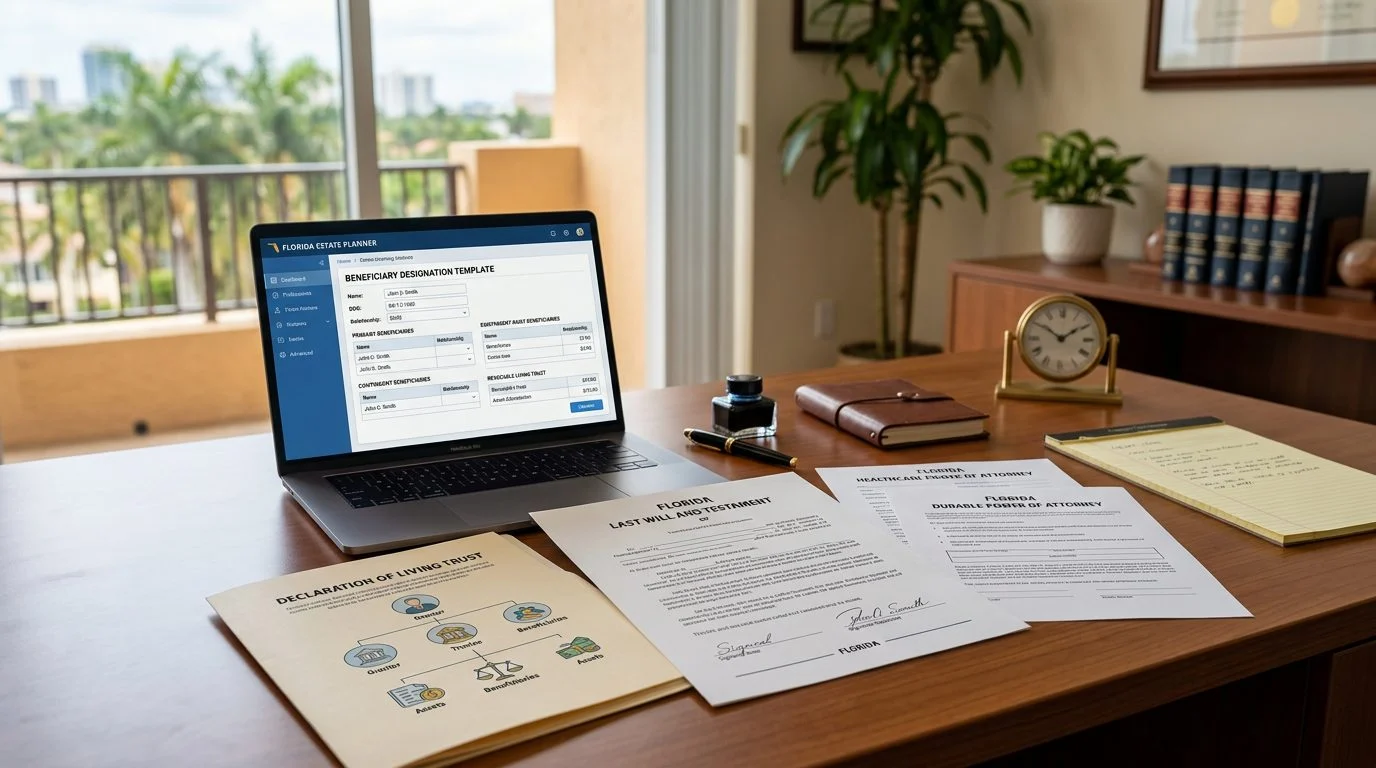
A last will directs how property passes at death and names a personal representative (often called an executor). A revocable trust holds assets during your life and sets out how they pass later. A durable power of attorney names an agent for money matters if you cannot act. A health care surrogate designation names who speaks for you on medical decisions.
A will alone does nothing while you are alive, so incapacity documents matter too. Our estate planning overview covers the practice area in more detail.
If you live in Fort Lauderdale and still lack a will, trust, or power of attorney, reach out to Trust Counsel and let's review your documents together. Talk it through with Trust Counsel, PL — the first consultation is free, confidential, and carries no obligation.

Why Fort Lauderdale Residents Plan Early
Planning early matters most when property, people, or a business span more than one place. Many Broward County families have a home, an out-of-state bank account, or an adult child living far away.
Florida has firm signing rules. Under Fla. Stat. § 732.502, the person making a will (the testator) must sign at the end. Someone else may sign for them, but only in their presence and at their direction. The attesting witnesses must sign the will in the presence of the testator and in the presence of each other, as provided in Fla. Stat. § 732.502.
Skipping a required step can put the whole will in doubt, so the signing ceremony matters as much as the wording. A nonresident’s will can be valid in Florida if it is valid under the law of the state or country where it was signed, under the same statute, unless it is a holographic or nuncupative will.
Review your plan when your family or property changes, and plan for incapacity, not only death. We serve clients in Fort Lauderdale from our only office, in Coral Gables. See our Fort Lauderdale planning page.
Common Power of Attorney Mistakes to Avoid
Five power of attorney errors cause avoidable trouble. Each one is easy to check before you sign.
Mistake one: choosing an agent by default. An agent must be a natural person 18 or older, or a financial institution that has trust powers, a Florida place of business, and authorization to conduct trust business in Florida, under Fla. Stat. § 709.2105. Choose someone trustworthy and willing to keep records. An agent must keep a record of all receipts and transactions, under Fla. Stat. § 709.2114.
No successor agent. A principal may designate one or more successor agents to act if an agent resigns, dies, becomes incapacitated, is not qualified to serve, or declines to serve, as provided in Fla. Stat. § 709.2111. Unless the power of attorney otherwise provides, a successor agent may not act until the predecessor agents have resigned, have died, have become incapacitated, are no longer qualified to serve, or have declined to serve. Name a replacement so there is a clear next person.
Mistake four: conflicting documents. A power of attorney that ignores your will or trust can clash with it. Keeping one controlled set of original documents, rather than many copies, can help prevent confusion when documents or agents change.
Improper signing. A power of attorney must be signed by the principal and by two subscribing witnesses, as provided in Fla. Stat. § 709.2105. It also requires that the principal acknowledge it before a notary public or as otherwise provided in s. 695.03. Under § 709.2202, if a principal domiciled in Florida signs a power of attorney witnessed remotely by someone not in the principal’s physical presence, it is not effective to grant the agent authority to create a trust, amend or revoke a trust, make gifts, create or change survivorship rights or beneficiary designations, waive survivor annuity rights, or disclaim property. Tell your agent where the original is kept.
Wills, Revocable Trusts, and Probate in Florida
A will alone does not prove title to property until a court admits it to probate, under Fla. Stat. § 733.103.
A revocable trust can hold property during your life and direct it after death. Under Fla. Stat. § 736.0602, unless the terms of the trust expressly provide that it is irrevocable, the settlor (the person who creates the trust) may revoke or amend it, except for a trust created under an instrument executed before the effective date of this code.
The trust’s terms control how the trustee manages and distributes property. A personal representative (often called an executor) handles a probate estate, while a trustee handles trust property. Those roles differ, so name each one clearly in your documents.
Trust Counsel’s attorneys can serve individually as trustee or personal representative, and the firm advises and represents trustees, personal representatives and beneficiaries.
For statewide questions, see our Florida planning page.
Business Succession and Estate Tax Planning
Business succession planning decides who takes over a company and how ownership moves. Estate tax planning organizes that ownership around the family’s goals.
A buy-sell agreement sets terms for transferring an owner’s interest. Those terms should match the will and trust, so company and family documents do not point in different directions. Owners should review succession terms when ownership or management changes.
Under IRC § 2010(c)(3)(A), the basic exclusion amount is $15,000,000, and it is adjusted for inflation for decedents dying in calendar years after 2026. Whether that figure matters to a family depends on the facts. Florida law also asks an agent to weigh minimizing taxes when preserving a plan, under § 709.2114.
Asset protection planning looks at how assets are titled and held. It is a planning discussion, and no particular outcome is promised.
We serve clients in Boca Raton too. Our estate tax planning page covers South Florida planning questions.
How a Plan Is Reviewed and Updated Over Time
Review your plan after major changes, such as marriage, divorce, a new grandchild, a move, or the sale of a business.
Divorce changes a will. Under Fla. Stat. § 732.507, a will provision affecting the spouse is void upon dissolution of the marriage. The exceptions apply if the will was executed by the testator after the dissolution of the marriage, if the will states a specific intention to the contrary, or if the dissolution of marriage judgment expressly provides otherwise. A later marriage, a new birth, or an adoption of descendants does not revoke the prior will, but a spouse or child not provided for may still inherit under Florida law regardless of the prior will.
Beneficiary designations and property titling work outside the will, so check them alongside your documents.
Guardianship is the court process for a person who cannot make decisions. Under Fla. Stat. § 744.3045, a competent adult may name a preneed guardian in a written declaration. It must be signed in front of two attesting witnesses present at the same time.
Trust administration and probate litigation are separate services. They begin when administration work or a dispute arises, not when a plan is signed.
Not sure what your next step is?
Talk it through with Trust Counsel, PL — the first consultation is free, confidential, and carries no obligation.

Working With Trust Counsel on Fort Lauderdale Estate Planning
Trust Counsel, PL focuses on trusts and estates law, including estate planning, trust administration, probate litigation, trust litigation, guardianship, estate tax planning, asset protection, and business succession.
The practice has support staff, and Leslie V. Marenco is the lawyer. The firm’s only office is in Coral Gables, and we serve clients in Fort Lauderdale.
The first consultation is free, confidential, and without obligation to continue.
How many witnesses does a Florida will need?
Two attesting witnesses must be present when the will is signed or acknowledged, under Fla. Stat. § 732.502.
Does a Florida power of attorney need a notary?
It must be signed by you and two subscribing witnesses, and acknowledged before a notary public or as the statute otherwise provides, under Fla. Stat. § 709.2105.
Can I change a revocable trust in Florida?
Usually yes. Unless the terms of the trust expressly provide that it is irrevocable, the settlor may revoke or amend it, but this does not apply to a trust created under an instrument executed before the effective date of the Florida Trust Code, under Fla. Stat. § 736.0602.
If you live in Fort Lauderdale with a home, out-of-state accounts, or a family business and still lack a will, trust, or power of attorney, call (305) 707-7126 or schedule online to review your documents with us.
How Trust Counsel Approaches Florida Estate Planning
Florida-specific documents
Trust Counsel concentrates in trusts and estates law, so each plan is built around the Florida documents that govern property, incapacity and health care decisions.
Planning that connects to administration
The firm advises and represents trustees, personal representatives and beneficiaries, so a plan can be drafted with the later steps of probate and trust administration in mind.
Serving Fort Lauderdale and nearby areas
The firm's only office is in Coral Gables. We serve clients in Fort Lauderdale, Boca Raton, West Palm Beach and other South Florida communities.
A signed document is only part of the plan
Documents that are never reviewed, updated after major life changes, or aligned with how assets are titled may not do what you intended. Review your plan whenever your family, property or health situation changes.
The Core Florida Estate Planning Documents
Revocable trust
A revocable trust can hold property during your lifetime and names a successor trustee to manage it if you become unable to, with terms you can change while you are able.
Durable power of attorney
This document names an agent to handle financial matters if you are unable to act for yourself, and it can be tailored to the authority you choose to grant.
Health care surrogate designation
This designation names the person you trust to make medical decisions for you if you cannot communicate your own wishes.