
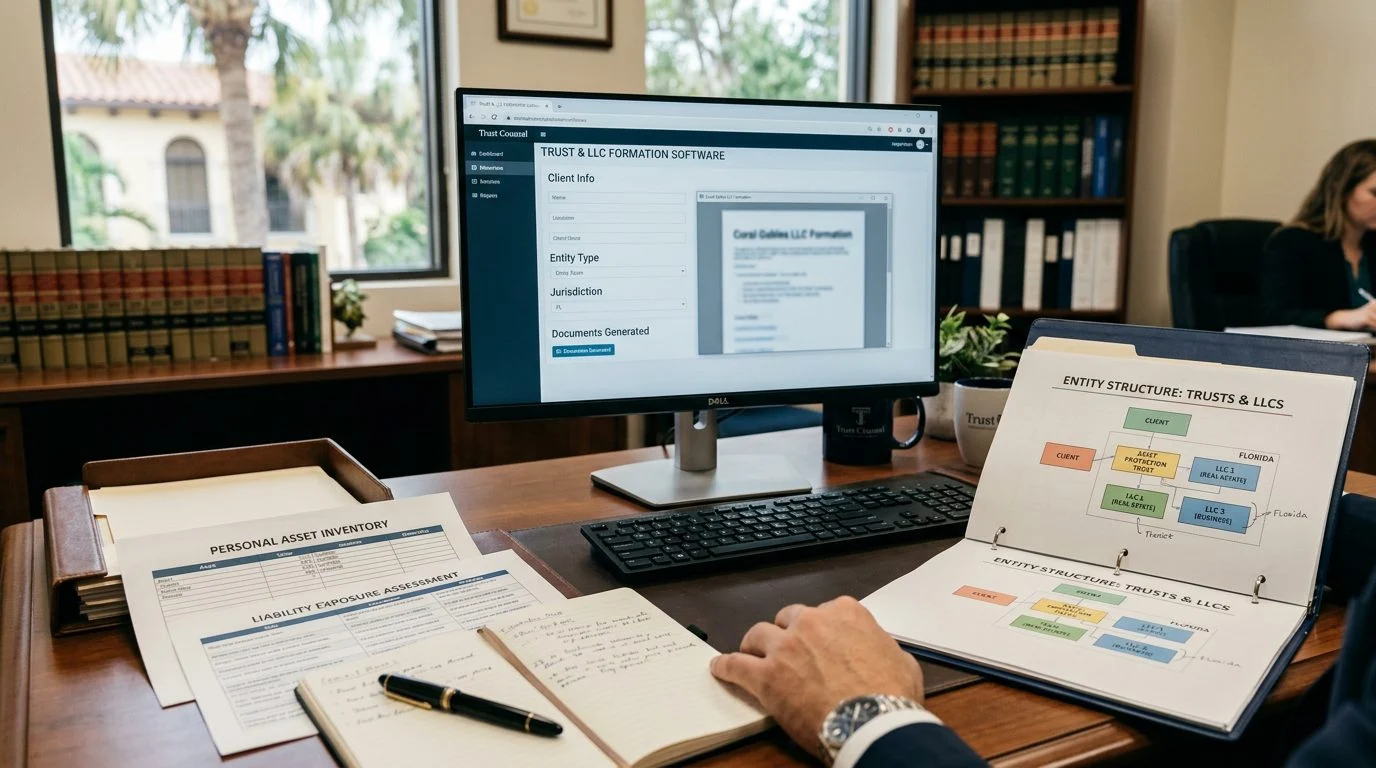
Asset Protection Attorney in Coral Gables, Florida
Plan to protect your assets before a problem arises
Business owners and families with substantial holdings can put lawful, documented structures in place while there is time to plan them carefully.
By Leslie V. Marenco · Published November 14, 2026
If you run a business or hold significant assets, you may wonder whether a future lawsuit could reach your home, savings or family wealth. Lawful asset protection planning answers that question before a claim exists, through how you own property and how your business is set up.
For business owners weighing asset protection planning, the right tools depend on the details of their situation. Business owners who want that answer can work with Trust Counsel, PL, whose only office is in Coral Gables; we serve clients in Tampa and across Florida.
What asset protection planning is and who it is for
Asset protection planning is the lawful structuring of how you own property, done in advance. It aims to keep personal wealth separate from business exposure where Florida law allows.
It is not the same as hiding assets. Transfers arranged to defeat a creditor you already know about can be set aside, as explained below.
This planning fits three kinds of clients:
- Business owners who want company debts kept apart from their home and savings.
- Professionals who have made personal promises to pay business debts and want to know how far those promises reach.
- Families with significant assets who want an orderly transfer to heirs.
Leslie V. Marenco is the responsible lawyer for this page.

Not sure what your next step is?
Talk it through with our team — the first discovery call is free, confidential, and carries no obligation.
How a lawful plan separates personal assets from business exposure
An LLC generally keeps its debts with the company, not with its members. Under Fla. Stat. § 605.0304, a member or manager is not personally liable for company debts solely because of that role. The same statute says a failure to observe formalities is not, by itself, a ground for liability.
Separation has limits. Under Fla. Stat. § 605.0503, a charging order is a lien on a member’s interest. It requires the company to pay the creditor the distributions that would otherwise go to the member. For a company with more than one member, a court may not order foreclosure on that interest. For a company with only one member, a court may order a foreclosure sale if distributions would not satisfy the judgment within a reasonable time.
Two practical points matter. The company also needs its own accounts and records, so it stays distinct from your personal finances.
What the planning covers: trusts, property and business succession
Florida trusts can protect some assets, but the answer depends on the trust’s type and its terms. Under Fla. Stat. § 736.0502, that provision is valid only if it restrains both voluntary and involuntary transfers of the beneficiary’s interest.
A settlor’s own creditors are a different question. Under Fla. Stat. § 736.0505, property in a revocable trust is subject to the settlor’s creditors during the settlor’s lifetime, to the extent it would not be exempt if owned directly. With an irrevocable trust, a settlor’s creditor may reach the maximum amount that can be distributed to or for the settlor’s benefit, but the trust’s assets are not reachable solely because the trustee has a discretionary power to pay the settlor’s taxes on trust income or principal.
Be careful with trusts sold as tax shelters.
Your home may have protection too. Under Fla. Const. art. X, § 4, a homestead owned by a natural person and located inside a municipality is exempt from forced sale up to one-half acre of contiguous land, except for the payment of taxes and assessments thereon, obligations contracted for the purchase, improvement or repair thereof, or obligations contracted for house, field or other labor performed on the realty. The exemption is limited to the residence of the owner or the owner’s family. Personal property owned by a natural person is exempt from forced sale up to a value of one thousand dollars, except for the payment of taxes and assessments thereon, obligations contracted for the purchase, improvement or repair thereof, or obligations contracted for house, field or other labor performed on the realty.
For larger estates, federal tax limits matter. Under 26 U.S.C. § 2010(c)(3)(A), the basic exclusion amount is $15,000,000, and the inflation adjustment applies to decedents dying in calendar years after 2026. Ownership interests in a company can move to successors on the same timeline as trust terms, so business and family goals stay aligned.
Why timing matters and how this differs from a challengeable transfer
Planning done before a claim is known is judged differently from a transfer made to get ahead of a creditor. Under Fla. Stat. § 726.105, a transfer can be fraudulent as to a creditor whether the claim arose before or after the transfer.
One route is a transfer made with actual intent to hinder, delay or defraud creditors. Another is a transfer made without reasonably equivalent value while the debtor’s remaining assets were unreasonably small for its business, or while the debtor intended to incur, or believed or reasonably should have believed it would incur, debts beyond its ability to pay as they became due.
To judge intent, a court may look at whether the debtor was sued or threatened with suit before the transfer. It may also weigh transfers to insiders, whether the debtor kept control of the property, and whether the transfer was disclosed or concealed.
Planned structures tend to share features: a documented business or family purpose, a transfer made before any claim was threatened, and clear records of the change in ownership. The facts of each transfer decide how a court views it.
How the process works: from discovery call to funded plan
The process starts with a free discovery call and ends with signed documents and retitled assets.
- Free discovery call. The call is free, confidential and carries no obligation to continue. We review business exposures, family goals and existing documents.
- Asset inventory. We list entities, property titles, beneficiary designations, personal promises to pay business debts and pending obligations.
- Written recommendations. We propose structures such as entities, trusts and titling changes, and explain the tradeoffs in writing.
- Documents and funding. We draft documents and complete funding steps, including retitling and entity records.
- Periodic review. We revisit the plan as the business grows, ownership changes or the law changes.
Simple plans move faster than plans with several entities and properties.
Have questions about what happened?
Ask our team directly. The first conversation is free, confidential, and there is no obligation to continue.
Durable power of attorney and related incapacity documents
It has real drawbacks that planning can address.
Under Florida’s durable power of attorney statute, Fla. Stat. § 709.2104, a power is durable when it includes the statutory words or similar words showing the authority continues after incapacity.
Its main drawbacks are these:
- The agent holds broad authority, which can be misused.
- Under Fla. Stat. § 709.2109, the power ends at the principal’s death, when the principal becomes incapacitated if the power is not durable, or when a court adjudicates the principal totally or partially incapacitated, unless the court determines that certain authority is to be exercisable by the agent. It also ends when the principal revokes it, when its purpose is accomplished, or when its stated terms end it, among other listed events.
- Under Fla. Stat. § 709.2110, a principal can revoke a power in a later signed writing. A new power does not revoke an older one unless it says so.
NAELA guidance on durable powers advises signing before incapacity and using specific language, because broad powers may not be honored. A revocable trust with successor fiduciaries can address some of these limits when your goals call for it.
Why work with Trust Counsel, PL
Trust Counsel, PL focuses on trusts and estates law in Florida. The firm represents beneficiaries, heirs and fiduciaries in probate and trust disputes. It advises professional trustees and personal representatives, and it plans for business owners and high-net-worth domestic and foreign families.
Trust Counsel’s attorneys can serve individually as trustee or personal representative. The firm itself does not serve as a fiduciary, and the firm advises and represents trustees, personal representatives and beneficiaries.
Its planning work covers estate tax, asset protection and business succession in one plan. The firm’s only office is in Coral Gables. We serve clients in Tampa and across Florida. Leslie V. Marenco is the responsible lawyer for this page, and Tanya Vega is also a lawyer at the firm.
Frequently asked questions
Is asset protection the same as hiding assets?
No. Lawful planning is set up in advance and in the open. Transfers meant to defeat a known creditor can be set aside.
Can a plan be set up after a lawsuit is filed?
Florida law treats a prior suit or threat as a factor in judging a transfer’s intent. Planning made before a claim is known is judged differently from one made after.
Does an LLC protect me from all business debts?
No. An LLC generally keeps company debts with the company. It does not cover personal promises to pay or your own personal liability.
Do I need a trust if I already have a will?
A will and a trust work in different ways and suit different goals. Your assets and family goals decide which tools fit.

Talk with Trust Counsel, PL before a claim arises
If you own a business and wonder whether a company debt could reach your home or savings, you can talk with us before any claim appears. Book a free discovery call by calling (305) 707-7126 or scheduling online.
Want to know where you stand?
Tell us what happened and our team will walk you through the options available to you, at no cost.
How we approach asset protection
Planning in advance
We design structures before any claim is known, so the planning is open, documented and built around your goals.
Lawful, transparent structures
Our work focuses on arrangements that hold up when reviewed, not on moving assets out of reach.
Coordinated with your other planning
Asset protection often connects with estate tax planning, business succession and trust administration, and we address those together.
Clear, direct communication
We explain the options, the tradeoffs and the steps involved so you can make informed decisions.
Timing matters
Transfers made to avoid a creditor you already know about can be challenged in court and set aside. Planning done early, before a dispute begins, is the approach we focus on.
Related services at Trust Counsel, PL
Estate tax planning attorney
Planning to address estate tax exposure for families with substantial assets.
Business succession planning attorney
Planning for the transfer or continuity of a closely held business.
Trust litigation attorney
Representation of beneficiaries, trustees and other parties in trust disputes.
Estate planning attorney
Wills, trusts and related documents designed around your family and goals.