
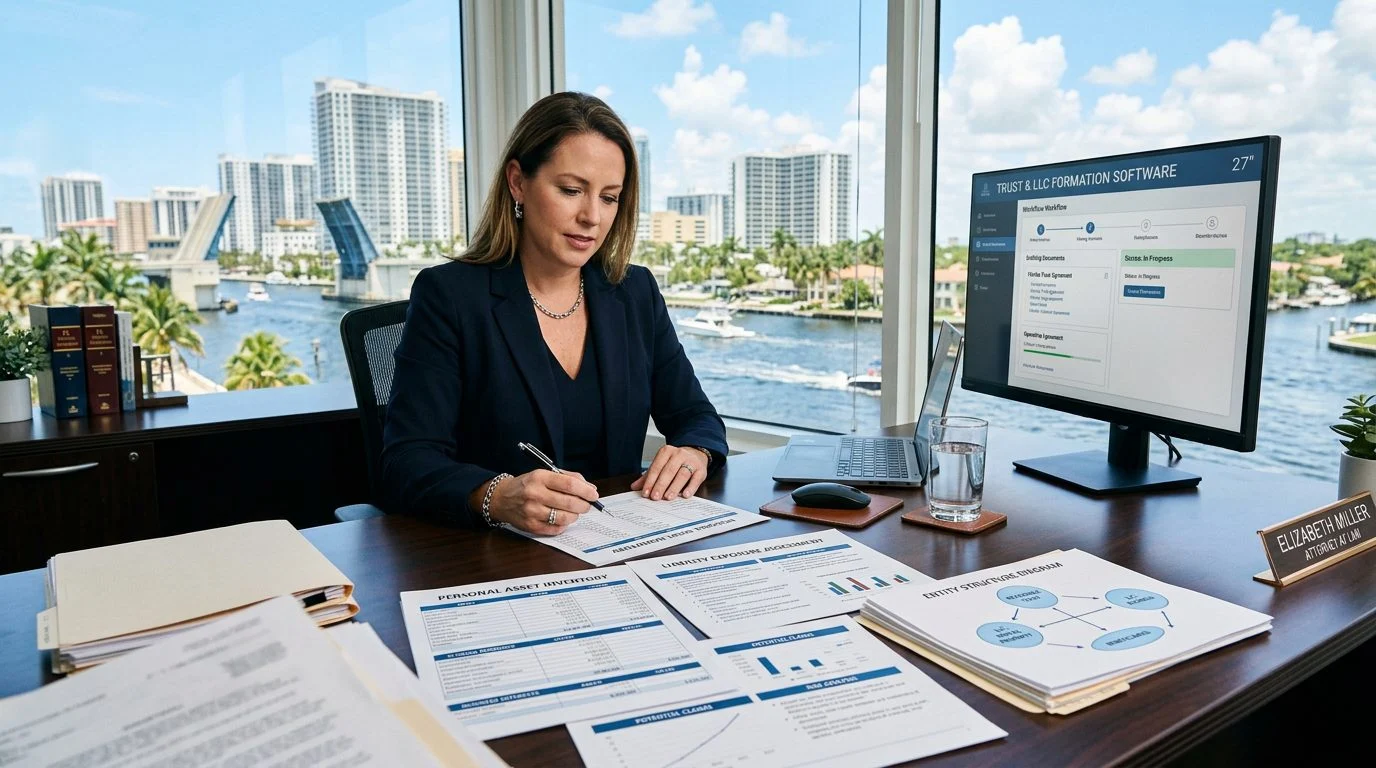
Asset Protection Attorney in Florida
Plan Ahead to Help Protect the Assets You Have Built
Trust Counsel, PL helps Florida families and business owners review their exposure and build a plan they can maintain over time.
By Leslie V. Marenco · Published November 13, 2026
If a creditor claim ever reached you, what would happen to your home, your business interests and the assets you plan to leave your family? Florida law gives several tools to protect those assets, but each tool has limits, and timing can decide whether it works.
Asset protection planning means arranging your assets before a claim arises, so that Florida’s exemptions and trust rules apply as the law provides. This page explains the main Florida tools, where the law limits them, and what a first conversation with a Florida attorney involves.
Asset protection planning under Florida law
Asset protection planning is the work of reviewing what you own and owe, then choosing the structures the law allows. An asset protection attorney does that review before a dispute starts, not after a judgment arrives.
Trust Counsel, PL focuses on asset protection planning as part of its trusts and estates practice. That work sits alongside estate planning, estate tax planning and business succession planning, because the same entities and trusts often serve more than one goal.
Planning in advance is very different from reacting to a lawsuit. Florida’s transfer rules, covered below, look hard at moves made after a claim is already known. The sections that follow explain each Florida tool and its limits so you know what to ask.

Not sure what your next step is?
Talk it through with our team — the first discovery call is free, confidential, and carries no obligation.
Florida exemptions for homes and business interests
Florida’s constitution protects a qualifying homestead from most forced sales, but the protection has size limits. Inside a municipality, it covers one-half acre of contiguous land, limited to the owner’s residence or family; outside a municipality, it covers up to one hundred sixty acres of contiguous land. The same provision exempts personal property up to one thousand dollars in value (Fla. Const. art. X, § 4).
Married couples who hold property by the entirety need to understand how that ownership changes if the marriage ends. On divorce, tenants by the entirety become tenants in common (Fla. Stat. § 689.15). Fla. Stat. § 689.15 reads: “The doctrine of the right of survivorship in cases of real estate and personal property held by joint tenants shall not prevail in this state; that is to say, except in cases of estates by entirety, a devise, transfer or conveyance heretofore or hereafter made to two or more shall create a tenancy in common, unless the instrument creating the estate shall expressly provide for the right of survivorship; and in cases of estates by entirety, the tenants, upon dissolution of marriage, shall become tenants in common.”
If you own an interest in an LLC, Florida limits what a personal creditor can reach. A charging order, which a court may enter on application by a judgment creditor of the member or transferee, is a lien on the member’s transferable interest that requires the LLC to pay the creditor distributions the member would otherwise receive (Fla. Stat. § 605.0503). For an LLC with more than one member, foreclosure on that interest is not available to a judgment creditor. A single-member LLC has a narrow exception, so the ownership setup matters.
Spendthrift and irrevocable trusts in Florida
A properly drafted spendthrift provision can keep a beneficiary’s creditors from reaching the trust interest. A revocable trust does not give the person who created it the same shield.
Under Fla. Stat. § 736.0502, a spendthrift provision is valid only if it restrains both voluntary and involuntary transfers of a beneficiary’s interest. Words stating that the interest is held subject to a spendthrift trust are enough. A creditor generally cannot reach the interest or a distribution before the beneficiary receives it.
The protection has exceptions. Fla. Stat. § 736.0503 makes a spendthrift provision unenforceable, to the extent provided in its subsection (3), against a beneficiary’s child, spouse or former spouse who has a judgment or court order against the beneficiary for support or maintenance, and the remedy applies only as a last resort upon an initial showing that traditional methods of enforcing the claim are insufficient. It also reaches, as a last resort after an initial showing that traditional enforcement methods are insufficient, certain judgment creditors who provided services for the protection of the beneficiary’s interest, and reaches claims of this state or the United States to the extent a law so provides.
Creating your own trust works differently. Fla. Stat. § 736.0505 says property in a revocable trust is subject to the settlor’s creditors during life, to the extent it would not be exempt if the settlor owned it directly. For an irrevocable trust, a settlor’s creditor may reach the maximum amount that can be distributed to or for the settlor’s benefit. If the trust has more than one settlor, the amount a particular settlor’s creditor may reach may not exceed that settlor’s interest in the portion of the trust attributable to that settlor’s contribution.
Irrevocability is the trade-off. The settlor gives up ownership and control, and that loss is what gives the trust its protective value. Choosing the trustee, the terms and the funding of each trust turns on the facts of the family and its assets.
Transfers that Florida law can reverse
Florida law lets creditors challenge transfers made to hinder, delay or defraud them. It also lets them challenge transfers made without fair value when the debtor either had unreasonably small remaining assets for a business or transaction, or intended to incur, or believed or reasonably should have believed that it would incur, debts beyond its ability to pay as they became due.
Under Fla. Stat. § 726.105, a transfer is fraudulent if the debtor made it with actual intent to hinder, delay or defraud any creditor. That is true whether the claim arose before or after the transfer. A court may weigh several factors, including whether the transfer went to an insider, whether the debtor kept control of the property, and whether the debtor had been sued or threatened with suit beforehand.
Fla. Stat. § 726.106 covers transfers made without reasonably equivalent value when the debtor was insolvent at the time or became insolvent because of the transfer, as to a creditor whose claim arose before the transfer was made or the obligation was incurred. The timing rules are strict. Florida’s fraudulent transfer statute, Fla. Stat. § 726.110, provides that a claim based on a transfer made with actual intent to hinder, delay, or defraud a creditor (Fla. Stat. § 726.105(1)(a)) is extinguished unless the action is brought within 4 years after the transfer was made or, if later, within 1 year after the transfer was or could reasonably have been discovered by the claimant.
A planning attorney reviews your transfer history before recommending any new structure, so the plan does not create a new problem.
Have questions about what happened?
Ask our team directly. The first conversation is free, confidential, and there is no obligation to continue.
Asset protection FAQs
What do asset protection attorneys do?
An asset protection attorney inventories your assets and liabilities and reviews your exposure. The attorney then drafts trust or LLC documents, coordinates funding with your accountant and reviews the plan over time.
Does Florida have asset protection laws?
Yes. Florida’s constitution exempts a qualifying homestead and some personal property. Florida statutes also set spendthrift, trust, LLC charging order and fraudulent transfer rules.
What is a major disadvantage of an asset protection trust?
Irrevocability is the main drawback, because the settlor gives up control of the assets. Trust administration and reporting also add ongoing duties, and no trust shields assets from claims the law lets creditors reach.
How much does an asset protection lawyer cost?
Fees vary with each matter. The fee terms for your situation are explained during the free discovery call.
Business owners and families in Florida who plan early
Planning early matters most for business owners, professionals and families with a Florida homestead, rental property or a multi-generation estate. These readers often hold assets in several places at once.
Federal tax rules sit on top of Florida’s protections. As the IRS explains in its revenue procedure for calendar year 2026, federal legislation amends § 2010(c)(3) by increasing the basic exclusion amount to $15,000,000 for calendar year 2026.
The gift tax annual exclusion amount per donee is set by the IRS and can change from year to year (IRS gift tax FAQs).
Families with foreign ties need extra care. The IRS explains that some nonresidents with U.S. assets must file estate tax returns, and that transferee liability for unpaid estate tax may apply (IRS nonresident estate tax returns).
We serve clients in Fort Lauderdale, Boca Raton and West Palm Beach, and across Florida. The facts of your home or business location are part of the review.
Coral Gables office and the lawyers on this page
Trust Counsel, PL’s only office is in Coral Gables, Florida. That is where the firm’s lawyers meet with clients.
Leslie V. Marenco is the lawyer responsible for this page. Tanya Vega is also a lawyer at the firm.
Trust Counsel’s attorneys can serve individually as trustee or personal representative (often called an executor). The firm advises and represents trustees, personal representatives and beneficiaries. The firm itself does not act as a fiduciary.

Want to know where you stand?
Tell us what happened and our team will walk you through the options available to you, at no cost.
The free discovery call and what happens first
The first step is a free discovery call, which is confidential and carries no obligation to continue. It gives you time to describe your situation before you decide on any next step.
Bring a list of your major assets and the entities you own. Note any pending or anticipated claims, and list the family members or beneficiaries involved. Having these details ready helps the call cover more ground.
During the call, the attorney identifies the Florida tools that may apply to your facts. The attorney also flags timing and transfer issues and outlines the next steps you can choose.
To book a free discovery call, schedule online or call (305) 707-7126.
Why Clients Plan With Trust Counsel
Coral Gables Office
Our office is in Coral Gables. We serve clients in Fort Lauderdale, Boca Raton, West Palm Beach, Doral, Kendall, Pinecrest, Key Biscayne and Aventura.
Planning Built Around Your Assets
We review your assets, liabilities and business interests before recommending any documents or structure.
Families and Business Owners
Our practice covers asset protection for domestic and foreign families, as well as business succession planning.
A Free Discovery Call
Your first call is free, confidential and carries no obligation to continue.
Plan Before a Dispute Begins
Asset protection planning is easier to do well before a claim or dispute arises. Speak with an attorney before moving or retitling assets, not after a problem has surfaced.
How Asset Protection Planning Works
Review Your Exposure
We inventory your assets and liabilities and look at where your risks come from.
Choose the Right Structure
We discuss trust and entity options that may fit your goals, and explain the trade-offs of each.
Coordinate Funding
We work with your accountant to make sure assets are titled and transferred as the plan requires.
Review the Plan Over Time
As your family, finances and business change, we revisit the documents and keep the plan current.