
Probate Litigation | Coral Gables, Florida
Torn or Burned Will: Is It Still Valid in Florida?
Trust Counsel, PL explains how Florida law treats a damaged will and what to do next. Leslie V. Marenco focuses on probate and trust matters from our Coral Gables office.
By Leslie V. Marenco · Published October 22, 2026
Short answer: a torn or burned will can be revoked in Florida
A torn or burned will can be revoked in Florida when the act was done with intent and for the purpose of revoking it. The rule comes from Fla. Stat. § 732.506. That section covers burning, tearing, canceling, defacing, obliterating, and destroying a paper will. Damage alone doesn’t answer the question.
Physical acts fall under § 732.506. A later will, codicil, or other writing can also revoke an earlier will under Fla. Stat. § 732.505. Under Fla. Stat. § 732.505, a later inconsistent will or codicil revokes an earlier one only so far as the inconsistency extends, and a later writing executed with the same formalities required for wills revokes it when the writing declares the revocation. This page focuses on the physical-act rule.
Electronic wills follow a different test under § 732.506. A party seeking to show that an electronic will was revoked must prove by clear and convincing evidence that the testator, or some other person in the testator’s presence and at the testator’s direction, deleted, canceled, rendered unreadable or obliterated it, with intent and for the purpose of revoking it.
If you're holding a torn or burned original after a family member's death, you don't have to sort out the next steps alone. Our team can talk through what you have. Talk it through with Trust Counsel, PL — the first consultation is free, confidential, and carries no obligation.
What the statute requires: intent and purpose
Under Fla. Stat. § 732.506, a will or codicil, other than an electronic will, is revoked by burning, tearing, canceling, defacing, obliterating, or destroying it with the intent, and for the purpose, of revocation. The act must be done with the intent to revoke, and for the purpose of revocation. Both focus on the reason behind the act, not only on the condition of the paper.
That difference matters. A paper that is creased, stained, or partly burned is not automatically revoked.
Start by writing down what you know. Note when the will was last seen intact and who had access to it. Record where you found the pieces and how the damage looks. Also note any statements the person who died made about the will. These notes organize the facts. They don’t answer the legal question on their own.
Who can perform the act: the testator or someone acting at the testator’s direction
The statute covers an act by the testator. It also covers an act by another person, but only if that person acts in the testator’s presence and at the testator’s direction. The wording requires both presence and direction.
So the central questions are practical. Who held the paper? Who touched it? Was the testator in the room? Did the testator tell someone to tear or burn it? Each answer can change the analysis. A family member who handled the will without the testator’s direction raises a different question than one who acted at the testator’s request.
Custody also matters. Where the will was kept, who had keys or access, and whether anyone moved it all shape the evidence. These facts usually come from witnesses and records, such as household members, neighbors, or the people who were present. Gathering them early helps preserve what people remember.
How a torn or burned original differs from a lost original will
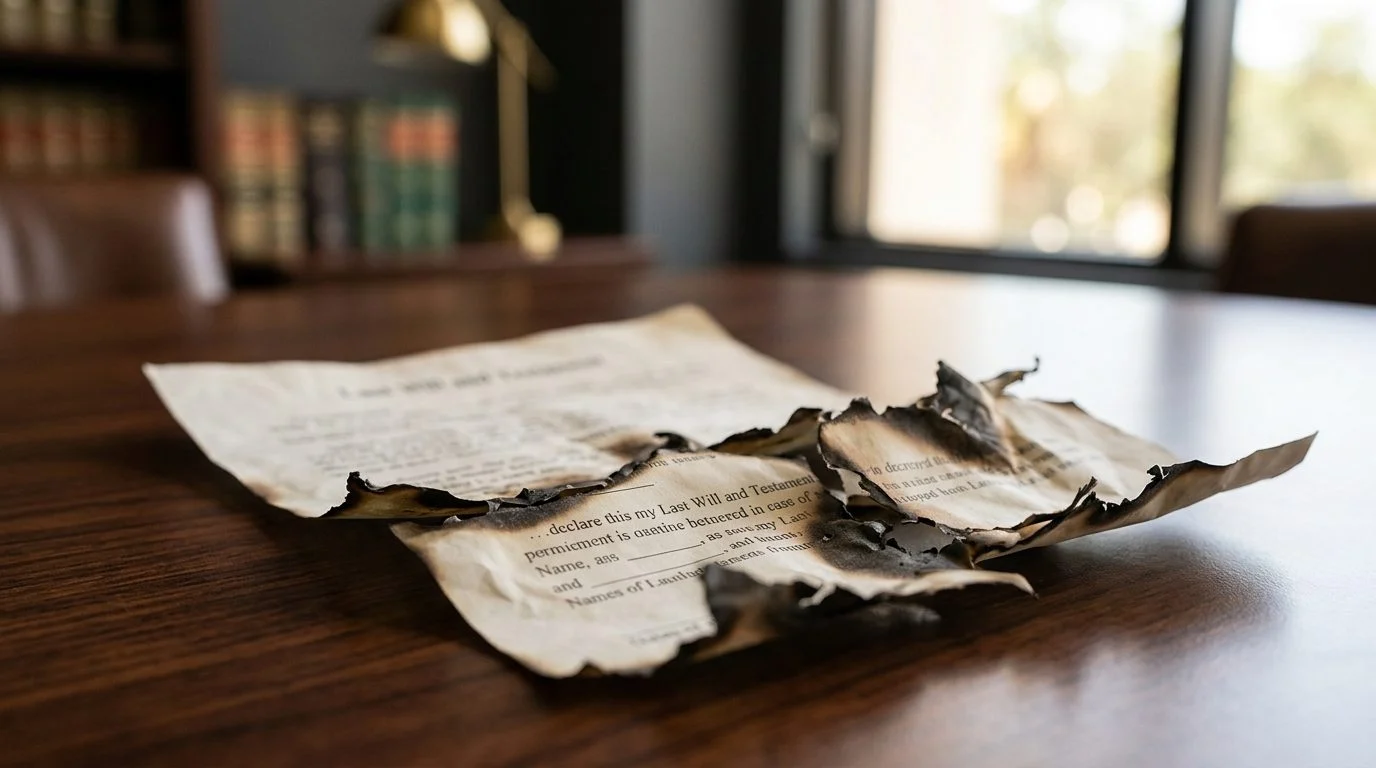
A torn or burned original still exists in some form.
A lost original is different. The document itself is missing. Under Fla. Stat. § 733.207, an interested person may establish the full terms of a lost or destroyed will and offer it for probate. The terms must be proved by two disinterested witnesses. If a correct copy exists, one disinterested witness may be enough. Our lost original will page covers that process in more detail.
Some families face both issues. Fragments may be found, but the original may be too incomplete to read. In that case, the court may need to address both the revocation question and the proof of the will’s contents.
What to do with the damaged original and when to call
Keep every piece in the condition you found it. Don’t tape, glue, or reassemble the paper. Don’t write on it or try to read hidden text. Place each fragment, and any ash, in a clean envelope or container. Label it with the date and the place where you found it.
Photograph the pieces where they lie, then again after you gather them. Take a photo of the room and the container where the will was kept. Photos help show the condition of the paper at the time you found it.
Related questions, such as trust contests and discovery in will disputes, are covered on other pages of our site.
If you’re holding a torn or burned original after a family member’s death, you’re dealing with this during a hard time. Leslie V. Marenco, the responsible lawyer for this page, can review the facts with you. Trust Counsel, PL has its only office in Coral Gables. The first consultation is free, confidential, and carries no obligation to continue. Schedule online at our contact page or call (305) 707-7126.
Frequently Asked Questions
Is a torn or burned will still valid in Florida?
A torn or burned will is not automatically invalid. Its legal effect depends on whether the testator, or another person in the testator’s presence and at the testator’s direction, physically destroyed it with the intent and for the purpose of revoking it.
Does tearing or burning a will automatically revoke it in Florida?
Under Fla. Stat. § 732.506, a will or codicil, other than an electronic will, is revoked when the testator, or another person in the testator’s presence and at the testator’s direction, burns, tears, cancels, defaces, obliterates, or destroys it with the intent, and for the purpose, of revocation. The act can be done by the testator or by another person in the testator’s presence and at the testator’s direction, and both the act and the intent are required.
What if a Florida will was damaged by accident instead of on purpose?
Accidental damage, such as a tear from handling or water damage, generally does not revoke a will because the required intent is missing.
Can a lost or damaged Florida will still be admitted to probate?
Under § 733.207, Florida Statutes, any interested person may establish the full and precise terms of a lost or destroyed will and offer it for probate, and the will’s specific content must be proved by the testimony of two disinterested witnesses, or by one disinterested witness if a correct copy is provided. Call (305) 707-7126 to discuss your situation.
What Shapes the Question
The Original Document
The condition of the original will, and where it was kept, often matters as much as how it looks.
The Reason Behind the Damage
Courts look closely at the circumstances in which the will was torn, burned or otherwise altered.
Who Handled the Will
Whether the testator or another person acted in the testator's presence and at the testator's direction can change the analysis.
Evidence Preserved Early
Witness accounts, photographs and records made soon after the event help clarify what happened.
Handle the Document Carefully
Do not tape, glue, iron, re-sign or rewrite a damaged will on your own. Keep every piece and every envelope, and write down what you know about how the damage happened. Careful handling protects the evidence a court may need.
Common Situations We Address
Torn Will
Questions about whether a torn will was revoked, and whether the remaining text can still be given effect.
Burned or Partly Burned Will
Disputes over who destroyed the will, the intent behind it, and what proof is available.
Lost or Missing Will
Situations where the original cannot be found and family members disagree about the testator's final wishes.