
Estate Planning in Coral Gables, Florida
What Is the Biggest Mistake With Wills in Florida?
A will that no longer reflects your life can defeat its purpose. Learn the most common error, why it happens, and how to review your plan with Leslie V. Marenco of Trust Counsel, PL.
By Leslie V. Marenco · Published October 29, 2026
The short answer: the biggest mistake is letting a will go out of date
What is the biggest mistake with wills? For most people, it is letting the will go out of date. A will reflects the family, property, and wishes at the time it was signed. When life changes and the document does not, the will can work against what the person meant to do.
Many people sign a will once and never look at it again. They assume it still says what they intended years later. That assumption can defeat a will’s purpose. The rest of this page covers the other common errors: signing and witnessing problems, vague wording, weak personal representative choices, beneficiary forms, minor children, digital assets, and will contests.
Not sure what your next step is?
Talk it through with Trust Counsel, PL — the first consultation is free, confidential, and carries no obligation.

Failing to update after major life events
Failing to update a will after a major life event can cause harm. Common triggers include marriage, divorce, the birth or adoption of a child or grandchild, the death of a named beneficiary or personal representative, a move into or out of Florida, and a large change in property.
Florida law addresses one of these changes directly. Under Fla. Stat. § 732.507, a later marriage, birth, or adoption does not revoke a prior will, but a pretermitted child or spouse still inherits as set out in ss. 732.301 and 732.302, regardless of the prior will. A dissolution of marriage works differently. Any will provision that affects the spouse is void once the marriage is judicially dissolved or declared invalid by court order.
The statute has exceptions. The voiding rule does not apply to a will the person signed after the dissolution. It also does not apply if the will states a specific intention to the contrary, or if the dissolution judgment expressly provides otherwise.
That rule has a limit. It covers gifts affecting a spouse. For broader context on estate disputes, see the Trust Litigation Attorney page.
Signing and witnessing errors that can invalidate a will
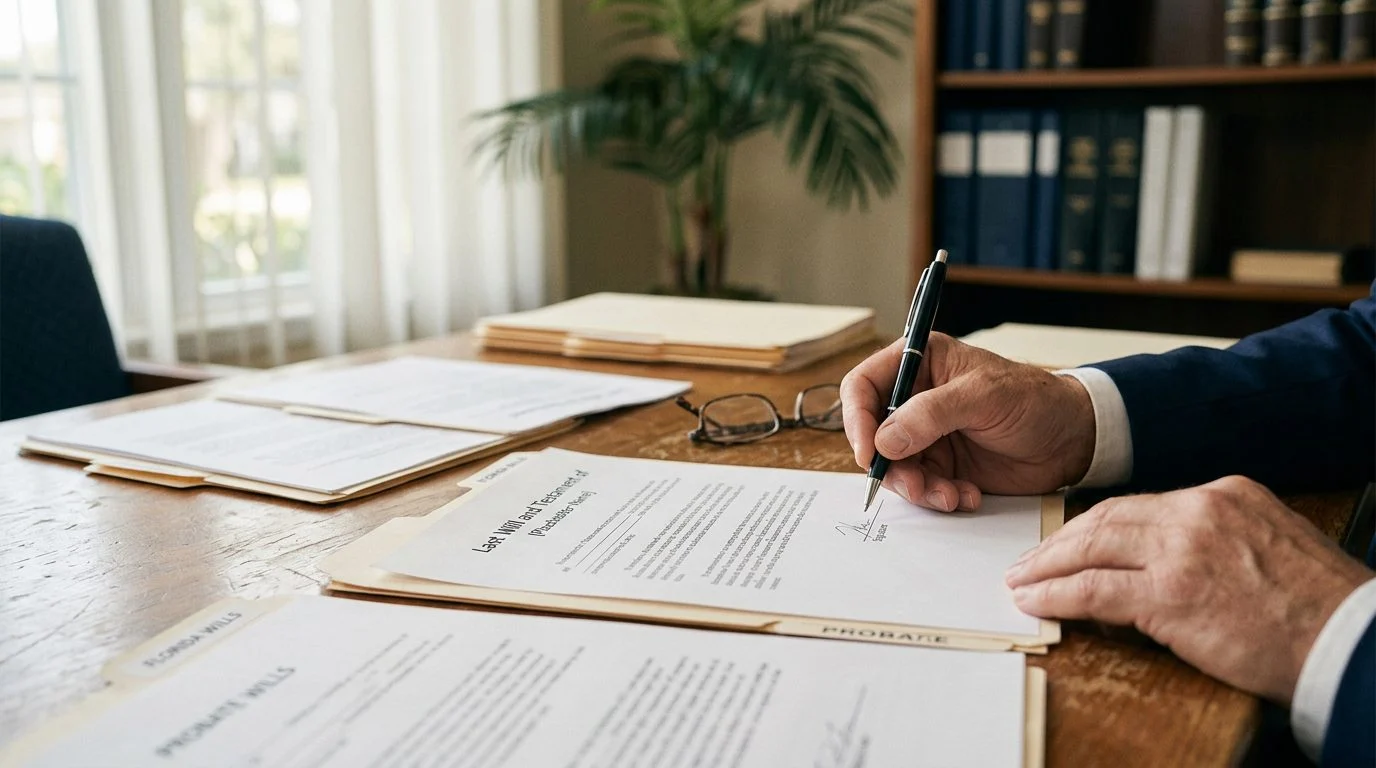
A will that is not signed and witnessed the right way can fail. Under Fla. Stat. § 732.502, a will must be in writing. The testator must sign at the end, or have another person sign the name in the testator’s presence and at the testator’s direction.
The signing or acknowledgment must happen in front of at least two attesting witnesses. The witnesses must then sign in the presence of the testator and in the presence of each other. No particular form of words is required once these formalities are met.
A will written in the person’s own handwriting is not automatically a holographic will. Under the same statute, a handwritten will that is executed with the witnessing steps is not considered holographic.
Common errors include a missing signature, a page without a witness signature, and a copy presented as the original. Any of these can start a fight in court. A self-proved will executed in accordance with the probate code may be admitted to probate without further proof, but a purportedly self-proved electronic will may be admitted only in the manners prescribed in subsections (2) and (3) of Fla. Stat. § 733.201 if there was a substantial failure to comply with the online notarization procedures in § 117.265.
Keep the signed original in a safe, known place. Tell a trusted person where it is. Under Fla. Stat. § 732.901, the custodian of a will must deposit it with the clerk within 10 days after learning the testator has died.
Vague language and unclear gifts
Vague wording is the next common problem. Phrases such as “my belongings” or “the family house” can mean different things to different people. Courts start with the person’s intent as the will expresses it.
Under Fla. Stat. § 732.6005, the intention of the testator as expressed in the will controls the legal effect of the dispositions. Fla. Stat. § 732.6005 reads: “The rules of construction expressed in this part shall apply unless a contrary intention is indicated by the will.” Clear words make that intent easier to follow. The same statute says a will passes property the testator owns at death, including property acquired after the will was signed.
Be specific. Use full legal names for people. Describe property well enough that no one has to guess which item is meant. Check that percentage gifts add up to the whole estate. Make sure the residuary clause, which covers what is left after specific gifts, clearly says where leftover property goes.
Contact Trust Counsel to have each gift read and explained in plain words. Hearing the gift explained out loud often reveals where the wording is unclear, before anyone signs.
Choosing the personal representative and backups
The personal representative (often called an executor) manages the estate, pays debts, and distributes property under the will. Choose someone for capability, time, and trustworthiness, not only for family relationship.
In testate estates, the first preference for appointment goes to the personal representative nominated by the will, under Fla. Stat. § 733.301. Naming a backup matters.
Florida sets clear duties. Under Fla. Stat. § 733.602, a personal representative is a fiduciary who must observe the standards of care that apply to trustees. A personal representative may be removed for causes that include wasting or maladministration of the estate, under Fla. Stat. § 733.504.
Trust Counsel’s attorneys can serve individually as trustee or personal representative. The firm advises and represents trustees, personal representatives and beneficiaries. For the process when a personal representative fails to act properly, see the Remove Personal Representative in Florida page.
Beneficiary designations, accounts, and the probate myth
Some assets do not follow the will. Reviewing the beneficiary and payable-on-death forms for retirement accounts, life insurance policies, and payable-on-death accounts is a useful step when planning an estate. That named person can differ from the person the will names.
Review these forms at the same time as the will. Make sure the two documents tell the same story. Check after major changes, such as a marriage, a divorce, or a death in the family.
Many people believe a will keeps an estate out of court. Probate is the court process for settling an estate. How each asset is titled and how it passes affects whether it goes through probate.
For how probate and non-probate transfers work in Florida, see the In Florida, Does a Will Automatically Avoid Probate? page.
Not sure what your next step is?
Talk it through with Trust Counsel, PL — the first consultation is free, confidential, and carries no obligation.
Overlooking minor children and digital assets
A will is one of the places where a parent can name a guardian for minor children. If the will is silent on this, the family may need a court to decide. Think about who would raise the children, who has the time and stability to do it, and whether that person is willing to serve. Name a backup too.
Digital assets are another common gap. Online accounts, stored photos, digital files, and subscriptions are property many families overlook. Name them in the estate plan. Give clear instructions for who can access them and how they should be managed or closed.
Keep a secure list of account locations and access steps, and make sure the personal representative knows where it is. Without this, a family may spend weeks looking for accounts and passwords.
The Guardianship Attorney and Estate Planning Attorney practice areas cover these issues when they come up.
Can a will be challenged, and what can a personal representative not do?
A will can be challenged in court. Under Fla. Stat. § 732.518, an action to contest a will may not be commenced before the testator’s death. Common grounds include improper execution, fraud, duress, mistake, and undue influence.
Under Fla. Stat. § 732.5165, a will is void if its execution is procured by fraud, duress, mistake, or undue influence; if only part of it was so procured, only that part is void and the rest stays valid unless invalid for other reasons. Under Fla. Stat. § 733.107, the proponent of the will must first establish its formal execution and attestation. After that, the contestant must establish the grounds for opposing probate.
A personal representative cannot act outside the duties of the role. Florida law, in Fla. Stat. § 733.609, holds a personal representative to the same fiduciary duty that a trustee of an express trust owes. Under Fla. Stat. § 733.609, a personal representative is liable to interested persons for damage or loss resulting from the breach of that duty.
For altered or forged estate documents, see the Forged Trust Amendment in Florida page.
If you are reviewing a will right now
You may be reading a parent’s or relative’s will after a death, or in the middle of a family disagreement. The questions can feel urgent and personal. Because dates, signatures, and wording all matter, the common questions below can help you see where to start.
Common questions
What is the biggest mistake with wills?
Letting the will go out of date after major life changes can defeat its purpose.
Can a divorce cancel a will in Florida?
A divorce voids will provisions that affect the former spouse, with exceptions, but only for wills of decedents who die on or after June 29, 2021. Florida law addresses how a dissolution of marriage affects a will’s provisions for a spouse.
Does a Florida will need witnesses?
Yes. The testator’s signing or acknowledgment must be in front of at least two attesting witnesses, under Fla. Stat. § 732.502.
Can a will be challenged before the person dies?
No. A contest may not begin before the testator’s death, under Fla. Stat. § 732.518.
Our only office is in Coral Gables. We serve clients in Fort Lauderdale, Boca Raton, West Palm Beach, Doral, Kendall, Pinecrest, Key Biscayne, and Aventura. Leslie V. Marenco is the lawyer responsible for this page.
Trust Counsel, PL offers a free first consultation that is confidential and carries no obligation to continue. Call (305) 707-7126 or schedule online to talk through your questions about a will you are reviewing now.
Key warning
Major life changes such as marriage, divorce, the birth or adoption of a child, a move, or the sale of a business are the moments most likely to make a will out of date. Review your will after each one.
Common Will Mistakes to Review
Letting the will go stale
A will written years ago may name people or plans that no longer fit your family or finances.
Ignoring beneficiary designations
Accounts and policies with named beneficiaries can pass outside the will, so they should match your overall plan.
Assets not aligned with the plan
Property held in a trust, jointly owned, or titled in a business may not follow the instructions in your will.
Choosing a personal representative without review
The person you name to administer your estate should still be willing and able to serve, and an alternate should be considered.
How a Will Review Helps
Review your current documents
We look at your will alongside your trust, beneficiary designations, and property ownership to identify gaps.
Plan for your family's needs
We discuss guardianship, asset protection, and business succession goals that may call for updates.
Clarify your options
Florida's rules on wills, trusts, and personal representatives can be complex, and a discussion helps you see your choices.
Coordinate with your fiduciaries
Trust Counsel's attorneys can serve individually as trustee or personal representative, and the firm advises and represents trustees, personal representatives and beneficiaries.