
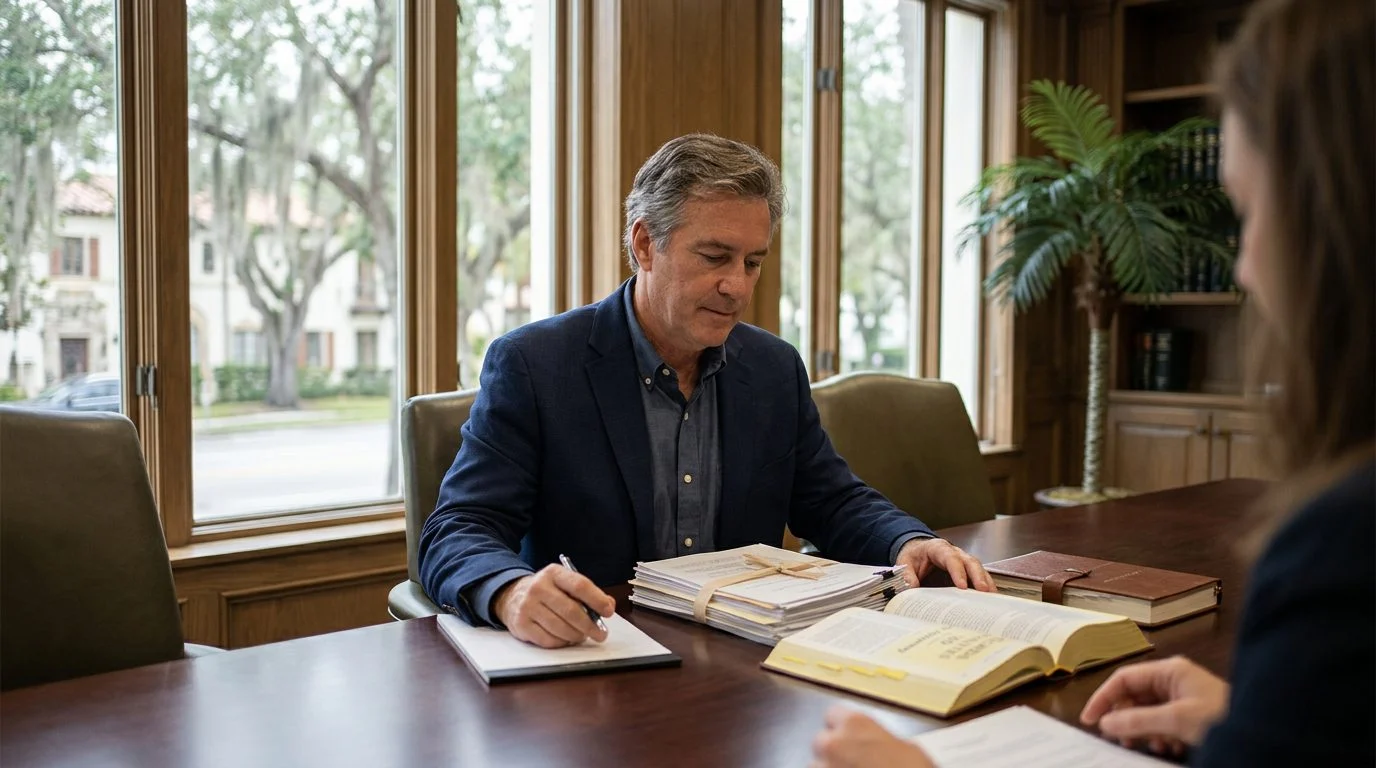
Coral Gables, Florida | Estate Planning Guide
What Is Florida Statute 709?
A plain-language guide to Florida's Power of Attorney Act, how it shapes the documents Floridians sign, and when to speak with a Coral Gables estate planning attorney.
By Leslie V. Marenco · Published November 6, 2026
It is the state law that governs powers of attorney. It sets who can act as an agent, how the document must be signed, and when it starts and ends. Chapter 709 of the Florida Statutes governs powers of attorney.
This page is written under the responsibility of Leslie V. Marenco, a lawyer at Trust Counsel, PL in Coral Gables, Florida.
What Chapter 709 of the Florida Statutes covers
Chapter 709 is the part of Florida law that deals with powers of attorney, a document addressed in estate planning. The statute defines a power of attorney as “a writing that grants authority to an agent to act in the place of the principal, whether or not the term is used in that writing” (Fla. Stat. § 709.2102). In plain terms, it lets one person act for another.
You can read the official wording in the Florida Legislature’s statute library. Chapter 709 is one part of Florida’s wider trust and estate law. For that bigger picture, see our trust litigation attorney guide.
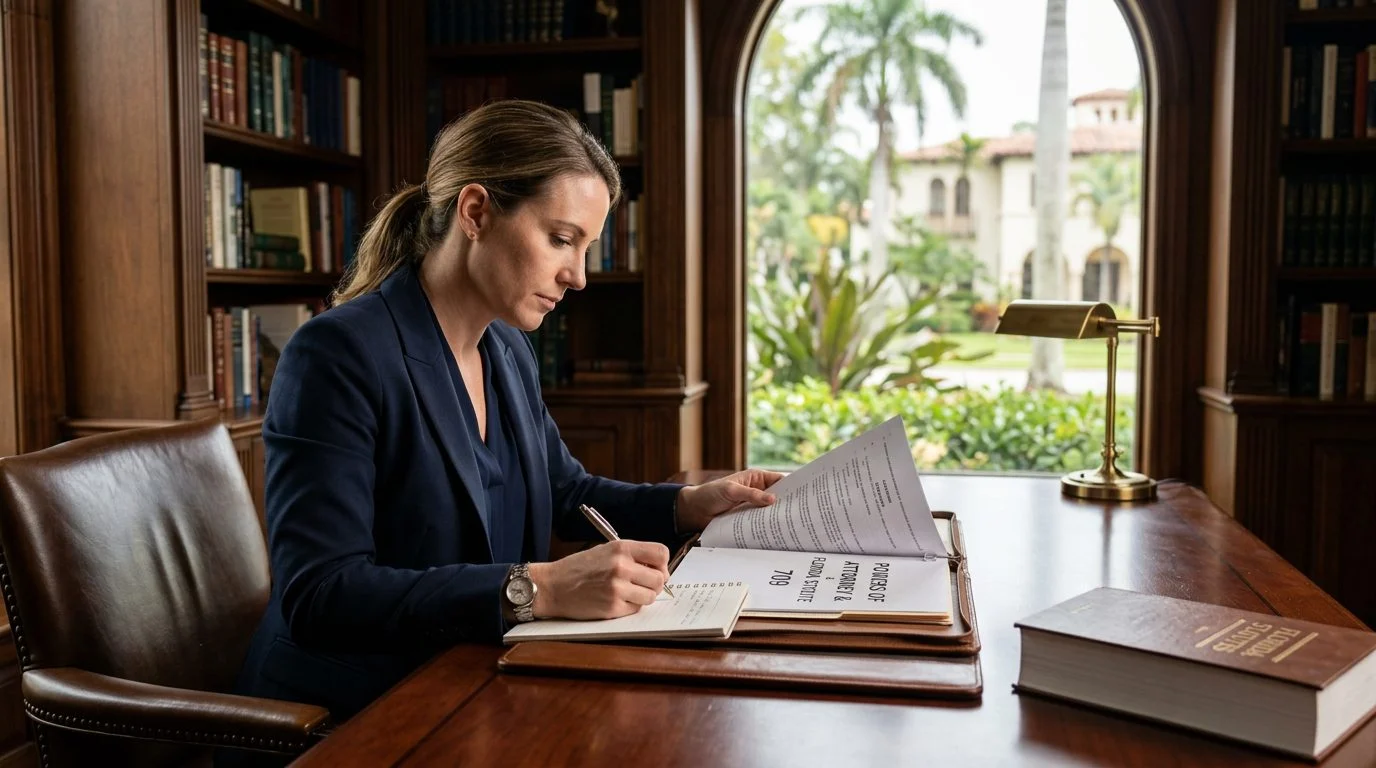
Not sure what your next step is?
Talk it through with our team — the first discovery call is free, confidential, and carries no obligation.
How a power of attorney under chapter 709 works
A power of attorney has three roles. The principal signs it. The agent is the person given authority to act. Third parties, such as banks, receive the document and rely on it.
The agent must be a natural person age 18 or older, or a financial institution that has trust powers, a place of business in Florida, and authorization to conduct trust business in Florida (Fla. Stat. § 709.2105). The principal must sign the document and two subscribing witnesses must sign it, and the principal must acknowledge it before a notary public or as otherwise provided in s. 695.03.
A power of attorney is “durable” when the principal’s later incapacity does not end it. Except as otherwise provided under this part, the statute says a power is durable if it contains specific words or similar language showing that intent (Fla. Stat. § 709.2104). If it is not durable, it ends when the principal becomes incapacitated (Fla. Stat. § 709.2109). Fla. Stat. § 709.2109 reads: “(c) The principal is adjudicated totally or partially incapacitated by a court, unless the court determines that certain authority granted by the power of attorney is to be exercisable by the agent.”
A power of attorney works while the principal is alive. A will takes effect at death. A trust holds and manages property under its own terms. Each tool controls property differently and starts at a different time.
Except as provided in this section or other applicable law, the agent may act on powers the document expressly grants and on any authority reasonably necessary to give effect to that express grant. Broad phrases such as “all acts the principal can do” do not count (Fla. Stat. § 709.2201). The signed wording matters.
Versions of chapter 709 and reading the current text
The current official text controls, and older articles may not match it.
Section 709.2201 was amended in 2024 by chapter 2024-242. Under Fla. Stat. § 709.2201, an agent may only exercise authority specifically granted to the agent in the power of attorney, and any authority reasonably necessary to give effect to that express grant. Confirm the exact wording in the current official text before you rely on any section.
Section 709.2109 explains when a power of attorney ends. It ends when the principal dies, when a non-durable power is affected by incapacity, when a court finds the principal incapacitated (with exceptions), when the principal revokes it, when the power of attorney provides that it terminates, when its purpose is accomplished, or when the agent’s authority terminates without another agent provided for.
If someone starts a court case about incapacity or a guardian advocate, the agent’s authority is suspended until the petition is dismissed or withdrawn or the court enters an order letting the agent use one or more of the powers, though unless the court orders otherwise, the case does not affect the agent’s authority to make health care decisions. A parent, spouse, child or grandchild acting as agent is an exception unless a verified motion is also filed (Fla. Stat. § 709.2109).
Have questions about what happened?
Ask our team directly. The first conversation is free, confidential, and there is no obligation to continue.
Disputes that involve chapter 709 documents
The agent is a fiduciary. An agent must act in good faith and must keep a record of receipts, disbursements and transactions.
Except as otherwise provided in the power of attorney, when the principal, a court, a court-appointed guardian, another fiduciary acting for the principal, or a governmental agency with authority to protect the principal’s welfare asks for records (or, after the principal’s death, the personal representative or successor in interest of the principal’s estate), the agent must comply with the request within 60 days or provide a writing substantiating why additional time is needed, and then comply within an additional 60 days (Fla. Stat. § 709.2114). Other disputes involve interference with an expected inheritance, such as our page on tortious interference with an inheritance, or questions about whether a document is authentic, covered in our page on a forged trust amendment.
Florida law also limits who can serve as personal representative. For more on this point, read our page on whether a law firm can be a personal representative. Trust Counsel’s attorneys can serve individually as trustee or personal representative. The firm advises and represents trustees, personal representatives and beneficiaries.

Talking with a Coral Gables trusts and estates attorney
If you’re reading this because a parent signed a power of attorney, or a relative is handling money, you didn’t choose this situation. You don’t need every answer today.
Start by gathering the signed document and any records the agent has kept. Then note the specific powers it grants and the dates of key transactions.
Trust Counsel, PL’s only office is in Coral Gables. We serve clients in Fort Lauderdale, Boca Raton, West Palm Beach, Doral, Kendall, Pinecrest, Key Biscayne and Aventura.
Does a power of attorney end when the principal dies?
Yes. Under Florida law, a power of attorney terminates when the principal dies (Fla. Stat. § 709.2109).
Does a Florida power of attorney need witnesses?
Yes. Section 709.2105 requires signature by the principal and two subscribing witnesses, with acknowledgment before a notary public or as otherwise provided in s. 695.03 (Fla. Stat. § 709.2105).
If you have questions about a power of attorney, call (305) 707-7126 or schedule online. The first discovery call is free, confidential and without obligation to continue.
Want to know where you stand?
Tell us what happened and our team will walk you through the options available to you, at no cost.
Key points about Chapter 709
Chapter 709 governs powers of attorney
Florida Statutes Chapter 709, the Florida Power of Attorney Act, sets the rules for how a power of attorney is created, used and ended in Florida.
Formalities deserve attention
A power of attorney has to meet the signing requirements the statute sets out, so drafting and execution details matter as much as the wording.
Two roles, clearly defined
The statute addresses the principal, who grants authority, and the agent, who is authorized to act for the principal under the document's terms.
A power of attorney is not a complete plan
A power of attorney authorizes someone to act for you within the limits you set. It does not replace a will or a trust, and it may not address tax, asset protection or business succession goals. Review your documents with counsel before relying on them.
How Trust Counsel, PL can help
Estate planning
Trust Counsel's estate planning attorney in Coral Gables reviews powers of attorney together with wills, trusts and beneficiary designations, so the documents work as one plan.
Guardianship
Our guardianship attorney services address situations where a family needs court-supervised protection for an adult who can no longer manage personal or financial affairs.
Trust and probate disputes
The firm advises and represents trustees, personal representatives and beneficiaries in trust litigation and probate litigation, including disputes that arise when a document's authority is questioned.