
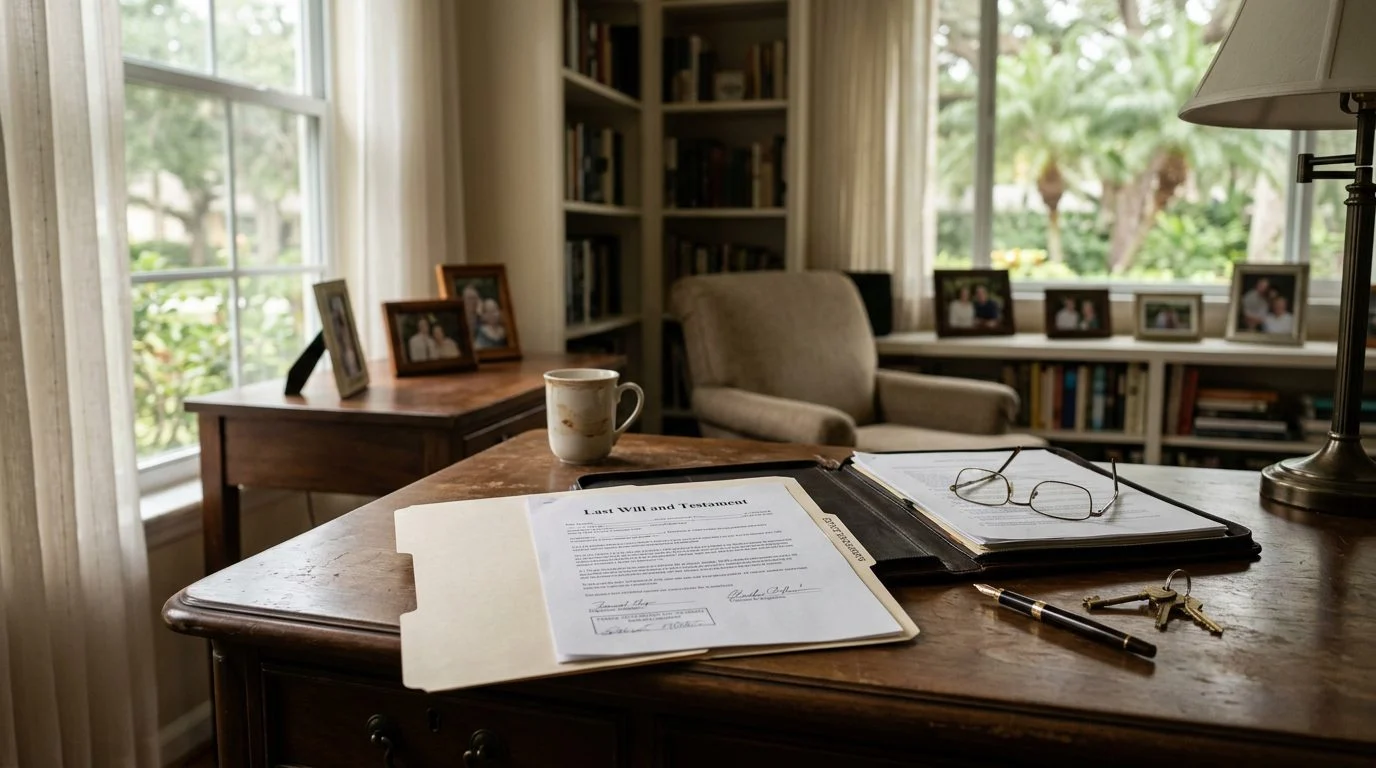
Probate and Estates | Coral Gables, Florida
Someone Has the Will After a Death? Know the Key Rules Before You Act
Trust Counsel, PL explains how a will is handled in Florida probate, what the personal representative does, and when to get legal advice. Free first consultation, confidential and without obligation.
By Leslie V. Marenco · Published October 25, 2026
If someone has the will after a death in Florida, the person holding it generally has a legal duty to act quickly. Under Florida law, the custodian of the will must deposit it with the clerk of the court within 10 days after learning of the death. This page explains that duty, what happens after filing, and what heirs can do when a will is delayed or withheld. It gives general information about Florida law. Leslie V. Marenco is the responsible lawyer for this page at Trust Counsel, PL, whose only office is in Coral Gables.
Why the Will Holder’s Duty Matters Right Away
The person holding the original will has a legal duty, and timing matters for the whole family. Often the holder is a spouse, an adult child, a close friend, or the lawyer who prepared the document. Sometimes the family does not learn the will exists until after the funeral.
Delay creates real problems. Heirs cannot tell whether the will names a personal representative (often called an executor). They also cannot tell how the property will pass. Questions stay open, and the family waits without answers.
The rules below come from Florida statutes and court rules. They explain what the holder must do, what a court can require, and what heirs can do. Each section starts with the direct answer and then gives the detail.
If you hold a relative's will or just learned someone else has it, you do not have to sort out the filing steps alone. Talk it through with Trust Counsel, PL — the first consultation is free, confidential, and carries no obligation.
What Florida Law Requires of the Person Holding the Original Will
Under Florida law, the custodian of a will must deposit it with the clerk of the court within 10 days after learning that the person has died. The rule is in Fla. Stat. § 732.901. The clerk is the clerk of the court having venue of the decedent’s estate.
The custodian must also give the clerk the date of death or the last four digits of the decedent’s Social Security number when the will is deposited.
“Custodian” is the statute’s word for the person who holds the original will. That person may be a relative, a friend, or a lawyer. The duty falls on whoever holds the paper, not only on a named personal representative.
Delivering the will is a filing step. Those questions go to the court. A self-proved will executed in accordance with this code may be admitted to probate without further proof, but a purportedly self-proved electronic will may be admitted only by the oath procedures if its online notarization substantially failed to comply with s. 117.265, as Fla. Stat. § 733.201 explains.
What Happens to the Will Once It Reaches the Clerk
Once the clerk receives the will, the clerk must keep the original for at least 20 years. This applies whether or not the will is admitted to probate, under Fla. Stat. § 732.901. Florida Probate Rule 5.043 sets the same 20-year retention rule.
The attesting witness’s oath is taken before any circuit judge, commissioner appointed by the court, or clerk, as Fla. Stat. § 733.201 provides. If it appears to the court that the witnesses cannot be found, have become incapacitated after the will was signed, or cannot testify within a reasonable time, the will may be admitted on the oath of the personal representative nominated by the will (whether or not that person is interested in the estate), or on the oath of any person with no interest in the estate under the will who states that they believe the writing is the decedent’s true last will.
The will may name a personal representative. Under Fla. Stat. § 733.302, any person who is sui juris and a Florida resident at the time of death is qualified to act, subject to the limits in the part. In testate estates, Fla. Stat. § 733.301 puts the personal representative nominated by the will first in line.
Why Probate Can Be Needed Even When a Will Exists
A will does not settle every asset by itself. The way each asset was titled affects whether the court process is involved. Some property may pass outside that process, depending on how it was owned.
Make a simple list of what the person owned. Include bank accounts, real estate, vehicles, brokerage and retirement accounts, business interests, and property held jointly with someone else. For each item, note how it was titled and whether it names a beneficiary.
Trust Counsel’s probate litigation and trust administration work covers these questions in more depth. Each asset can raise its own issue, so a written list makes the review easier for everyone involved.
If No Will Is Found: How Florida Intestate Succession Works
When a person dies without a valid will, Florida’s intestacy statutes decide who inherits. Property the will does not effectively dispose of passes to the decedent’s heirs as the Probate Code prescribes, under Fla. Stat. § 732.101. The decedent’s death is the event that vests the heirs’ rights.
The surviving spouse’s share follows Fla. Stat. § 732.102. If there is no surviving descendant, the spouse takes the entire intestate estate. If one or more descendants are not also descendants of the spouse, the spouse takes one-half.
The rest passes under Fla. Stat. § 732.103. That part goes first to the decedent’s descendants. If there are none, it goes to the decedent’s father and mother equally, or to the survivor of them. A child’s share turns on whether the surviving spouse is also that child’s parent.
When the Holder Delays, Withholds, or Disputes the Will
A person who holds a will and does not file it can be compelled to do so. Upon petition and notice, the court may order the custodian to produce and deposit the will. If the court finds that the custodian had no just or reasonable cause for failing to deposit the will, all costs, damages, and a reasonable attorney’s fee shall be awarded to the petitioner against the custodian, under Fla. Stat. § 732.901.
Notice matters too. Persons given proper notice of a proceeding are bound by the orders entered in it, under Fla. Stat. § 731.301.
Time limits can also apply. Otherwise those objections are forever barred, under Fla. Stat. § 733.212. The 3-month period may be extended only for estoppel based on a personal representative’s misstatement about that period.
A contest of the will cannot start before the testator dies, under Fla. Stat. § 732.518.
Not sure what your next step is?
Talk it through with Trust Counsel, PL — the first consultation is free, confidential, and carries no obligation.
Questions Heirs Often Ask About a Will Holder
What happens if you don’t probate a will in Florida?
Property the will does not effectively dispose of passes to heirs under the intestacy statutes. Whether a will is admitted to probate is a decision for the court.
What is the Florida Probate Code?
The Florida Probate Code covers wills, administration, and intestacy.
How long does the holder have to deliver the will?
The custodian must deposit the will with the clerk within 10 days after learning of the death. The rule appears in Fla. Stat. § 732.901.
What is a child entitled to if a parent dies without a will?
The answer turns on whether the surviving spouse is also the child’s parent. The framework is in Fla. Stat. § 732.102 and Fla. Stat. § 732.103.
Why the Mental Capacity Question Can Arise With a Will
A will can be challenged in court, and the court decides the challenge on evidence. Under Fla. Stat. § 733.107, in a proceeding contesting a will’s validity, the burden is on the proponent of the will to establish prima facie its formal execution and attestation. After that, under the same statute, the contestant has the burden of establishing the grounds on which the probate of the will is opposed or revocation is sought.
Questions about a testator’s mental state can come up in these disputes. The outcome turns on the specific facts and the evidence the court hears.
Steps to Take Now If You Are Holding or Learning About a Will
Start by finding the original will and writing down who has it. Keep these steps simple and in writing:
- Find the original paper will. A copy is not the original.
- Note who has the original and the date you learned about it.
- Do not alter, mark, staple, or remove pages from the original.
- List the assets you know about and how each is titled.
- Write down the dates of key conversations and messages about the will.
Keep copies of everything you send or receive. A clear record helps the family and any court that later reviews the timeline.
Talk Through Your Situation With Trust Counsel
If you are holding a relative’s will, or you just learned that someone else has it, you may feel stuck. You did not choose this, and grief makes deadlines harder to track. Leslie V. Marenco can talk through the timing, the clerk filing, and what the rules mean for your family. Call (305) 707-7126 or schedule online. The first consultation is free, confidential, and carries no obligation to continue.
We serve clients in Coral Gables, Fort Lauderdale, Boca Raton, West Palm Beach, Doral, Kendall, Pinecrest, Key Biscayne, and Aventura.
How Trust Counsel Can Help
Probate Guidance
We advise personal representatives, beneficiaries and heirs on the steps that follow a death, including the handling of an original will.
Litigation Support
Our probate and trust litigation attorneys represent beneficiaries, heirs and fiduciaries when a will or trust is disputed.
Fiduciary Services
Trust Counsel's attorneys can serve individually as trustee or personal representative. The firm advises and represents trustees, personal representatives and beneficiaries.
Florida Practice from Coral Gables
Our only office is in Coral Gables, Florida. We serve clients in Fort Lauderdale, Boca Raton, West Palm Beach, Doral, Kendall, Pinecrest, Key Biscayne and Aventura.
Before You Act on a Will
Finding a will does not settle who handles the estate. Speak with a Florida trusts and estates attorney before you move property, sign documents or make distributions.
Questions to Raise at Your First Meeting
Where Is the Original Will?
Locate and secure the original document, and note who has had access to it since the death.
Who Is Named to Act?
Identify the person the will names as personal representative and whether that person is willing and able to serve.
What Property Is Involved?
List bank accounts, real estate, business interests and any assets held in a trust, since each may follow a different path.
Is There a Dispute?
Tell us about any family disagreement, challenge to the will or concern about a fiduciary's conduct so the options can be reviewed.