

Probate and Estate Matters | Coral Gables, Florida
Prove You Are an Heir in Florida: Records and Steps
Learn which records help establish heirship, how a family tree is documented, and when a Florida probate attorney can review your situation. Trust Counsel, PL focuses on probate and trust matters from its Coral Gables office.
By Leslie V. Marenco · Published November 6, 2026
You prove you are an heir in Florida by showing a documented family link to the person who died. Questions about who is entitled to share in an estate often come up in families, and a probate attorney can explain how those questions are handled. This proof matters most when there is no valid will. Banks, title companies, and personal representatives often ask for it before property moves. This guide explains the rules, the records, and the steps in plain language.
What an Heir Is Under Florida Law
An heir is a person who inherits under Florida’s intestate succession rules. Those rules apply when a will does not dispose of the property. Fla. Stat. § 732.101 says any part of an estate not effectively disposed of by will passes to the decedent’s heirs. Death is the event that gives heirs their right to that property.
A beneficiary is different. A beneficiary receives property under a will, a trust, or a beneficiary designation, such as a life insurance policy. You can be both an heir and a beneficiary, but the words describe different routes to the same asset.
Heirship still matters when a will exists. A gift in a will can fail, and some assets pass outside the will. When that happens, the question of who the heirs are can become the central question.
Not sure what your next step is?
Talk it through with our team — the first discovery call is free, confidential, and carries no obligation.
Who Qualifies as an Heir When There Is No Will
Florida ranks heirs in a set order, starting with the surviving spouse and the decedent’s descendants. The spouse’s share depends on whether the decedent left descendants, and whether they are also the spouse’s children.
If there is no surviving descendant, the spouse takes the entire intestate estate. If one or more descendants are not the spouse’s descendants, the spouse takes one-half. Fla. Stat. § 732.102 sets out these shares: the spouse takes the entire intestate estate if there is no surviving descendant, or if all surviving descendants are also the spouse’s descendants and the spouse has no other descendant; in all other cases the spouse takes one-half.
What the spouse does not take goes first to the decedent’s descendants. Fla. Stat. § 732.103 sets that order. Florida descent is per stirpes, meaning it runs branch by branch. Fla. Stat. § 732.104 states this rule.
A child conceived before the death but born afterward inherits as if born during the decedent’s life. Fla. Stat. § 732.106 covers this. Half-blood relatives take less. Under Fla. Stat. § 732.105, when property descends to collateral kindred of the intestate and some are of the half blood, those relatives take half as much as the whole-blood relatives, unless all are of the half blood.
If no spouse or descendants survive, the estate goes to the parents equally, or to the surviving parent. If neither parent survives, it goes to brothers and sisters and their descendants. A parent whose rights were ended under chapter 39 before the child died cannot inherit from or through that child. Fla. Stat. § 732.1081 states that bar.
The court applies these statutes to the family’s facts, so the family history drives the result.
How to Find Out Whether the Deceased Left a Will
Whether a will exists decides which rules apply first, so start there. Ask any lawyer, bank, or relative who may have prepared or stored estate papers. Check the decedent’s papers and any safe deposit box.
If the decedent lived in Miami-Dade County, the Miami-Dade Clerk’s probate court page explains how Florida probate works. That page also describes caveats, which heirs, interested parties, and creditors use in probate matters.
Heirship questions usually surface once a probate case shows whether a will exists. Until then, families work from the family tree and the paper trail.
Keep a dated list of every place you looked. That list helps a court, bank, or lawyer see what was checked and what remains open.
Documents That Prove Each Family Link
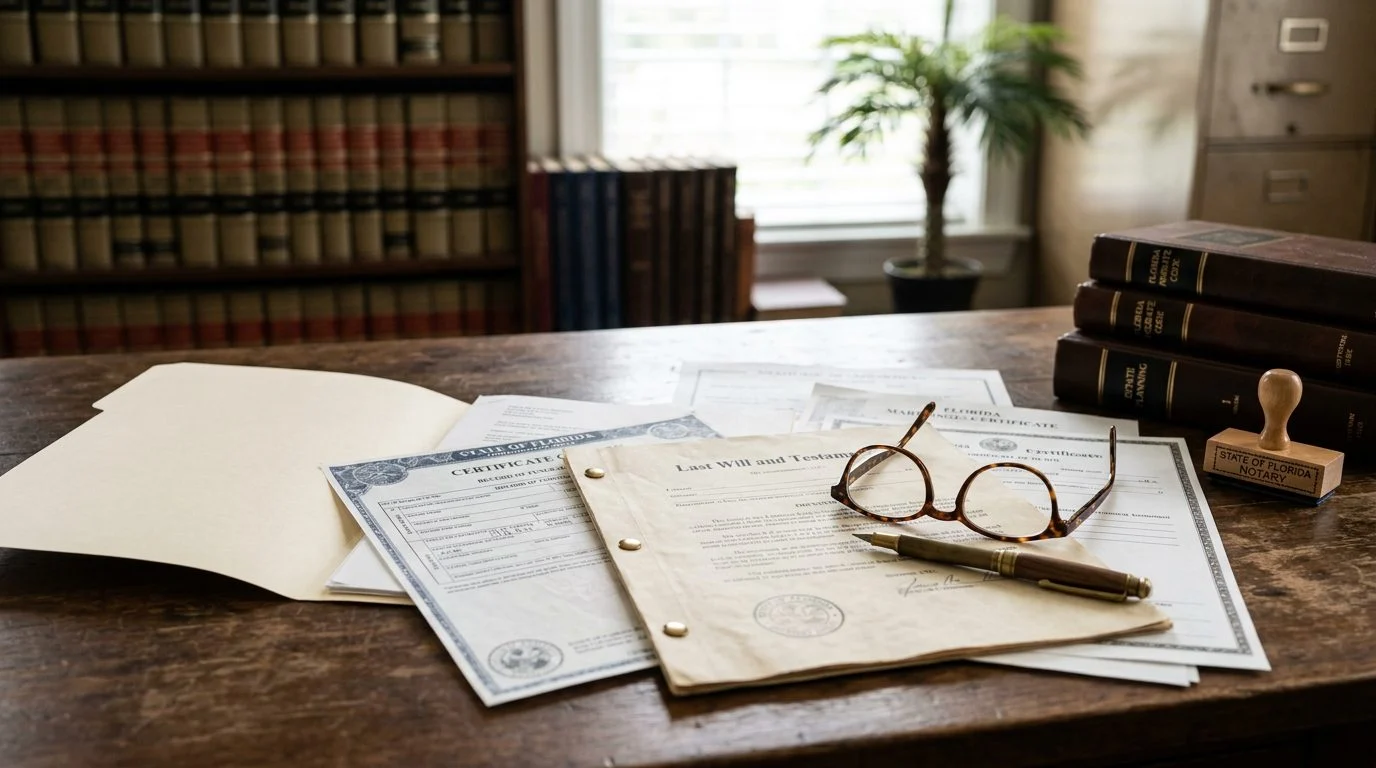
Your proof is a chain of records. You need one link for each generation between you and the decedent. A missing link can stall the claim.
Start with the death certificate. An authenticated copy from the place of death is prima facie proof of the death, its date and place, and the decedent’s identity. Fla. Stat. § 731.103 states this rule.
Next come birth certificates for you and each parent. Marriage and divorce records link spouses and show earlier marriages.
Adoption changes the chain. Section 731.103 sets rules for determining death and status in probate proceedings; it does not address whether an adopted person is a descendant of the adopting or natural parents. Fla. Stat. § 732.108 sets these rules. Keep the adoption decree with the birth records it connects to.
A child born outside marriage follows different proof. The child is a descendant of the mother. The child is also a descendant of the father if a marriage ceremony was attempted, paternity is adjudicated, or the father acknowledges paternity in writing. Section 732.108 covers these paths too.
Name changes can break a paper trail. Keep each name change record with the birth or marriage record it connects to.
Finally, write out the chain. List each generation, the record that proves each link, and every gap. The gap list tells you what to get next.
Have questions about what happened?
Ask our team directly. The first conversation is free, confidential, and there is no obligation to continue.
The Affidavit of Heirship: What It Is and When It Is Used
An affidavit of heirship is a sworn statement that names the decedent’s heirs. It also states the facts behind that list. A title company or bank may ask for one before acting on real property.
Under Section 732.402, the surviving spouse, or, if there is no surviving spouse, the children of a decedent domiciled in this state, have a right to a share of the estate called “exempt property.” Under § 732.402, persons entitled to exempt property are deemed to have waived their rights unless a petition for determination of exempt property is filed by or on their behalf on or before the later of the date that is 4 months after the date of service of the notice of administration or the date that is 40 days after the date of termination of any proceeding involving the construction, admission to probate, or validity of the will or involving any other matter affecting any part of the estate subject to this section.
Whether you need a lawyer depends on the facts. That turns on the title, the estate’s size, and whether relatives disagree.
The affidavit route is not a court ruling. A court can decide heirship in a separate proceeding, covered next.
When Heirs Are Disputed or Missing
When heirs disagree, a court can decide. Florida law provides that when property passes by intestate succession or the will is unclear, and there is doubt about who is entitled to receive any part of the property or about the shares any person is entitled to receive, any interested person may petition the court to determine beneficiaries or their shares.
A separate civil action can also determine beneficiaries when an estate has not been administered.
Timing matters too. A personal representative does not have to pay or deliver a distributive share until 5 months after letters are granted. Fla. Stat. § 733.801 sets this rule.
Missing relatives can slow things down. If a person has been absent from the last known home for a continuous 5 years, and the absence is not satisfactorily explained after diligent search, Florida presumes that person is dead. Fla. Stat. § 731.103 sets this presumption.
If a relative has already taken estate property, that raises a separate issue. Our page on a family member who took estate property in Florida covers that situation.
Talk With Trust Counsel About Your Heirship Question
If your family tree has a gap, a bank wants proof of relationship, or a relative took property before the heirs were confirmed, you do not have to sort it out alone. Trust Counsel, PL’s office is in Coral Gables. We serve clients in Fort Lauderdale and across Florida. Leslie V. Marenco is the responsible lawyer for this page.
The firm advises and represents trustees, personal representatives, and beneficiaries. For next reading, see our pages on intestate heir disputes and trust litigation.
The first discovery call is free, confidential, and without obligation to continue. Call (305) 707-7126 or schedule online.
Frequently asked questions
How do I prove I am an heir in Florida without a will?
Show a documented chain of records linking you to the decedent. Then show that Florida’s intestate rules put you in line to inherit.
Do I need an attorney to file an affidavit of heirship?
That turns on the title, the estate’s size, and whether relatives disagree. A lawyer can review those points with you.
Who qualifies as an heir in Florida?
The order starts with the spouse and descendants. It then moves to parents, siblings, and more distant kin, depending on who survives.
Can an adopted child inherit from a biological parent in Florida?
Generally not, under the adoption rules. Exceptions include adoption by a natural parent’s spouse or by a close relative.
Want to know where you stand?
Tell us what happened and our team will walk you through the options available to you, at no cost.
How Trust Counsel Can Help
Records review
We review the birth, marriage, death and probate records you already have and identify the gaps that need to be filled.
Family relationships
We help you lay out the family line from the decedent to you, so each link is supported by a document.
Heirship disputes
When relatives disagree about who qualifies as an heir, we advise heirs and beneficiaries on their options in probate litigation.
Coral Gables office
Trust Counsel, PL is located in Coral Gables, Florida. We serve clients in Fort Lauderdale, Boca Raton, West Palm Beach, Doral, Kendall, Pinecrest, Key Biscayne and Aventura.
Keep Your Originals Safe
Family records can be hard to replace. Keep original documents in a safe place, make copies for your own files, and speak with an attorney before signing any document about an estate you do not fully understand.
Steps to Start Your Heirship Review
1. Gather what you have
Collect death certificates, birth and marriage certificates, prior court papers, and any letters or notes that mention the family line.
2. Map the family line
Write out how each person connects to the decedent, and note where documents are missing or names do not match.
3. Identify the estate's status
Find out whether a will exists, whether an estate has been opened, and who has already filed paperwork with the court.
4. Get a legal review
Bring your documents to a free first discovery call, which is confidential and carries no obligation to continue.