
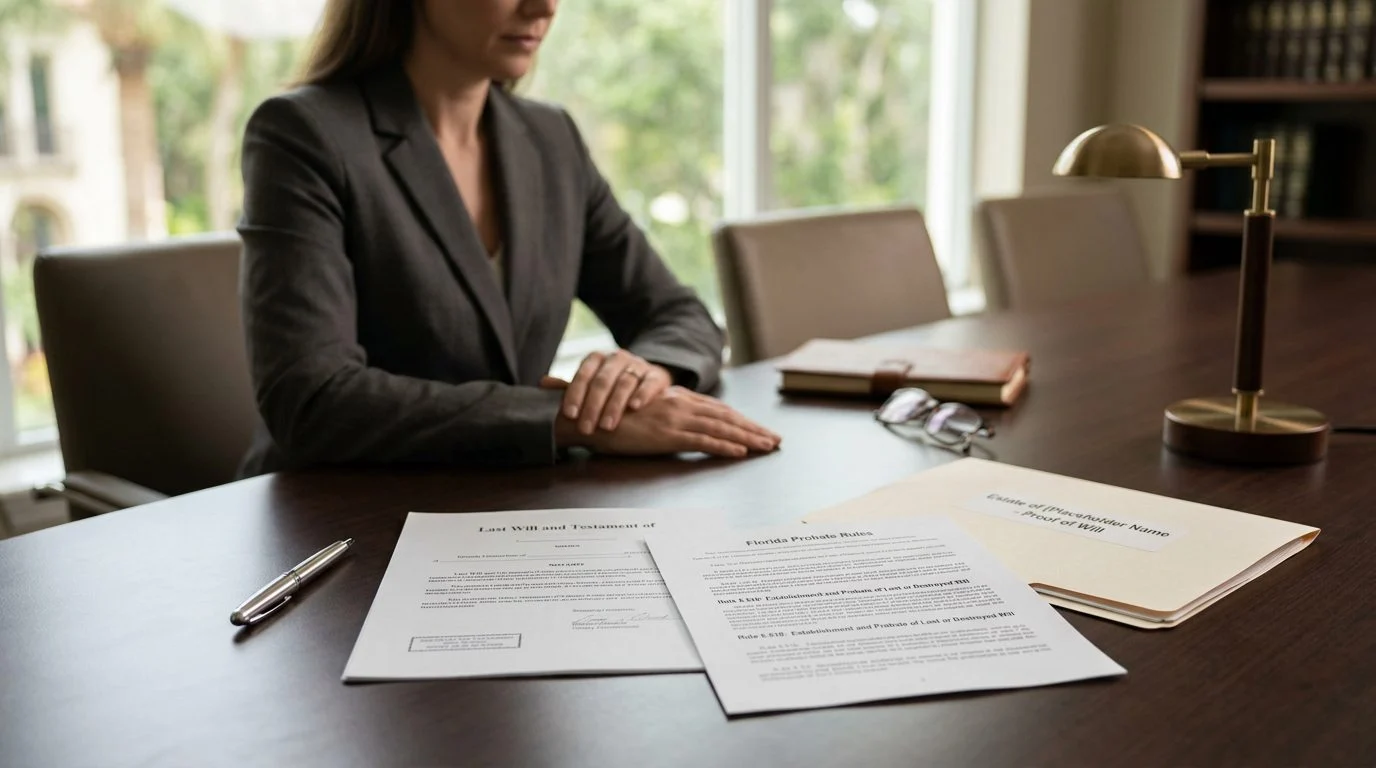
How to Prove a Lost Will in Florida With Only a Copy
By Leslie V. Marenco · Published November 9, 2026
If you need to know how to prove a lost will in Florida with only a copy, the short answer is this: a correct copy can be used, but the court still needs proof. Under Fla. Stat. § 733.207, the will’s terms must be proved by two disinterested witnesses, or, when a correct copy is provided, by one disinterested witness. This guide explains the steps involved, for adult children, heirs and family members facing this for the first time. Leslie V. Marenco is the lawyer responsible for this page.
Why the Original Will Matters So Much in Florida Probate
A Florida court expects to see the original signed will, so a copy shifts the focus from the paper to proof. The original shows the signatures, the pages and any changes made to it. When it’s missing, the court can’t compare it to the document in front of it. That gap is why the process turns to witnesses and other evidence.
Florida also treats revocation as something a person does. Under Fla. Stat. § 732.506, a paper will is revoked by burning, tearing, canceling, defacing, obliterating or destroying it, with the intent and purpose of revoking it. So a will that was last in the maker’s control and can’t be found raises a real question. Did the maker destroy it on purpose? A copy doesn’t answer that. That’s why families with only a copy usually need more than the copy itself.
Not sure what your next step is?
Talk it through with our team — the first discovery call is free, confidential, and carries no obligation.
What If You Only Have a Copy?
A copy can be offered for probate, but it isn’t the original. The person seeking admission must prove what the will said. Any interested person may ask the court to establish the full and precise terms of a lost or destroyed will and offer it for probate. Under Florida law, any interested person may establish the full and precise terms of a lost or destroyed will and offer it for probate. Under Fla. Stat. § 733.207, the will’s exact terms must be established through two disinterested witnesses, or through a single disinterested witness when a correct copy is produced. Fla. Stat. § 733.207
A copy proves what the words said. It doesn’t, by itself, show that the will was signed before witnesses or that it was never revoked. Those are separate questions.
Copies turn up in different places. A drafting attorney may keep a file copy. A family member may have a scan or paper copy in old records. Not every family has one. The copy must also be a correct copy to qualify for the one-witness route.
Where to Look for a Missing Original Will
Families usually start at home, then check the places the person kept important papers. Common places include the home and its papers, a safe deposit box, the drafting attorney’s file, and records held by the person’s accountant or financial advisor.
A safe deposit box needs care. Each person present signs the inventory under penalties of perjury. Florida’s probate rule on lost or destroyed wills does not cover a right to examine documents a decedent left for safekeeping. The order of steps matters, so plan the opening before anyone enters the box.
If someone else holds the will, the custodian must deposit it with the clerk of the court within 10 days after learning the person has died. Fla. Stat. § 732.901 The clerk keeps the original for at least 20 years. Upon petition and notice, a custodian who refuses without just or reasonable cause can be compelled to produce the will, and the court shall award costs, damages and a reasonable attorney’s fee to the petitioner.
Keep a written log of who searched, where and when. Notes like these show what was checked and what wasn’t found.
What You Must Prove to Admit a Lost or Destroyed Will
Under Fla. Stat. § 733.207, any interested person may establish the full and precise terms of a lost or destroyed will and offer the will for probate. The specific content of the will must be proved by the testimony of two disinterested witnesses or, if a correct copy is provided, by one disinterested witness. Florida handles this in one proceeding. The testimony of each witness must be reduced to writing and filed. That testimony may be used as evidence in any contest of the will if the witness has died or moved from the state. Fla. Prob. R. 5.510
Proper signing matters too. Under Fla. Stat. § 732.502, a will must be in writing and signed at the end by the testator, or by another person in the testator’s presence and at the testator’s direction. The testator’s signing or acknowledgment must happen before at least two attesting witnesses. Those witnesses must sign in the testator’s presence and in each other’s presence. That’s why the witnesses’ accounts carry so much weight.
A lost will may be admitted only after formal notice has been given to those who, but for the will, would be entitled to the property it devises (Fla. Prob. R. 5.510(d)). The order admitting it must state its terms in full.
Have questions about what happened?
Ask our team directly. The first conversation is free, confidential, and there is no obligation to continue.
The Presumption of Revocation and How It Is Addressed
When an original can’t be found, the court asks whether the will was revoked. A missing original last held by the maker invites that question. A copy alone doesn’t settle it, so the question turns on evidence.
Evidence on that question can include who had access to the original, where it was kept, what the maker said about the will, and what a documented search turned up. The court weighs each item against the rest of the record. So each matter turns on its own facts.
Families often make the same mistakes. They search once and stop, they clear out a home before anyone checks its papers, or they forget to write down who had access. Small gaps like these can make the revocation question harder to answer.
What the Probate Process Usually Looks Like
The process usually starts with a verified petition for administration. Formal notice follows, and then the court handles the proceeding, where witness testimony is filed. Any interested person may petition for administration. In a testate estate, the petition must identify all unrevoked wills and codicils being presented, and if the petitioner knows of another unrevoked will, it must state why that will is not being probated; it must also state the approximate value and nature of the assets. Fla. Prob. R. 5.200
After that, those objections are forever barred. The three-month period can be extended only in a narrow case, where the personal representative misstated the deadline.
If the court admits the will, the estate moves forward through the court process. A personal representative (often called an executor) is appointed to handle the estate.
Talk Through Your Situation With Trust Counsel
If a loved one’s original will can’t be found, you don’t have to work through the proof alone. Losing track of a will is hard when you’re grieving. Families often sort papers, decide who must be notified and watch deadlines, all at once.
Trust Counsel, PL is a Florida trusts and estates firm whose only office is in Coral Gables, Florida. The firm focuses on probate and trust litigation. It advises and represents trustees, personal representatives and beneficiaries. Trust Counsel’s attorneys can serve individually as trustee or personal representative. We serve clients in Boca Raton and Fort Lauderdale too. Leslie V. Marenco is the lawyer responsible for this page.
Can a copy of a will be admitted to probate in Florida?
Florida law allows a lost or destroyed will to be established, and a correct copy can be used with one disinterested witness. Fla. Stat. § 733.207
How many witnesses does a lost will need in Florida?
For a will that has been lost or destroyed, Fla. Stat. § 733.207 requires two disinterested witnesses to testify to its precise terms, or one such witness when a correct copy is available.
How long do heirs have to object?
Under Fla. Stat. § 733.212, an interested person served with the notice of administration must file any objection to the will’s validity, the venue or the court’s jurisdiction within three months after being served. That period can be extended only for estoppel based on a misstatement by the personal representative about the deadline. In any case, all such objections must be filed no later than the earlier of the order of final discharge of the personal representative or 1 year after service of the notice of administration.
The first discovery call is free, confidential and comes with no obligation to continue. If you’d like to talk through the facts of your family’s situation, call (305) 707-7126 or schedule through the contact page.
Ready to take the next step?
Want to know where you stand?
Tell us what happened and our team will walk you through the options available to you, at no cost.