

Will Contests | Coral Gables, Florida
How Medical Records Can Support a Florida Will Contest
Trust Counsel, PL focuses on probate and trust litigation for beneficiaries and heirs. Learn how medical records are used as evidence when a will's validity is challenged. Responsible lawyer: Leslie V. Marenco.
By Leslie V. Marenco · Published October 29, 2026
Medical records evidence will contest Florida judges weigh most often comes from the months around the signing date. The records matter because a will or trust stands only if the signer had the required mental capacity and was not unduly influenced. This guide explains which records help, what time window they should cover, and what a treating physician can and cannot say about them. It is written for adult children, heirs and beneficiaries in Florida who are facing a contest or thinking about one.
Why Medical Records Matter in a Florida Will or Trust Contest
Medical records usually matter when a contest claims the person lacked capacity or was pressured into signing. A person must be of sound mind and either at least 18 years old or an emancipated minor to make a will, under § 732.501. A revocable trust uses the same capacity standard as a will, under § 736.0601.
Undue influence is the other common ground. A will is void if its execution was procured by undue influence, under § 732.5165. Records can add context to witness accounts about how the person was doing and who was around.
Records do not answer the question alone. They show what a clinician saw and wrote on specific dates. A judge reads them alongside the signing circumstances, witness accounts, and the drafting file. For the wider framework, see our trust litigation overview.
If you cannot yet get the chart from the months around a parent's will or trust signing, our team can talk through your next step. Talk it through with Trust Counsel, PL — the first consultation is free, confidential, and carries no obligation.

Which Medical Records Are Most Useful
The most useful records are those written close to the signing date. Start with the charts from every provider who saw the person around that time.
- Hospital and clinic charts. Admission notes, progress notes, and discharge summaries show how the person was doing and what staff recorded.
- Office notes. Primary care and specialist notes often record memory complaints, mood, behavior, orientation, and medication changes.
- Memory and cognitive evaluations. Neurology, psychiatry, geriatric, and memory-clinic visits may include cognitive screening scores. Note the exact date each test was given.
- Pharmacy records. Dispensing history and medication lists matter, because sedating or cognition-affecting drugs can bear on the analysis. Note start and stop dates.
- Daily-function records. Emergency visits, home health, hospice, and nursing facility notes describe everyday tasks such as managing money, dressing, and recognizing family.
A score or note without a date does little. Ask each provider for the complete chart, not a summary, so entries can be read in order and matched to the signing date.
The Time Window the Records Must Cover
Records should cover the months shortly before and after the signing date, because that period matters most. Earlier records show whether a decline was gradual or sudden. Later records can confirm what the earlier chart recorded.
Deadlines run on their own clocks, and they can start early. For a will, an interested person served with a notice of administration must file objections to the will’s validity within 3 months after service, or those objections are forever barred, under § 733.212. Unless sooner barred by subsection (3), all objections to the validity of a will, venue, or the jurisdiction of the court must be filed no later than the earlier of the entry of an order of final discharge of the personal representative or 1 year after service of the notice of administration (Fla. Stat. § 733.212).
A separate limit can then apply. Under § 736.0604, an action to contest a trust that was revocable at the settlor’s death is barred if not commenced within the earlier of the chapter 95 period or six months after the trustee sent the person a copy of the trust instrument and a notice of the trust’s existence, the trustee’s name and address, and the time allowed for commencing a proceeding.
Because these clocks run on their own terms, request the records as soon as a contest is in view.
How Medical Records Are Requested and Admitted
Medical records are requested from each provider in writing, and they are admitted under the civil rules of evidence. Begin with a wide list of providers, including any second clinic, pharmacy, or hospital stay the family may not recall.
Requests usually go to each provider’s records department. Ask for the full chart, including handwritten notes, test forms, and medication logs. Keep a simple log of when each request went out, when records arrived, and what is still missing.
In proceedings under the Florida Probate Code, the rules of evidence in civil actions apply unless the code changes them, under § 731.1035. Clearly labeling each record makes it easier to explain what it shows. Planning that foundation early saves time later.
Provider response times vary, so send requests as soon as a contest is expected. Follow up in writing on any incomplete production, and note each date.
What a Treating Physician Can and Cannot Say
A treating physician can describe what was observed, tested, diagnosed, and treated at each visit. The physician’s testimony is usually tied to the chart, so the visits and entries matter.
A physician who did not see the person near the signing date has less to build on for that date. Opinions about a date outside the physician’s own visits draw more challenge.
A professional hired only to review the records plays a different role. That reviewer can explain what the chart says and offer an opinion based on the records and the reviewer’s own analysis. Calling a third-party witness an expert witness is accurate, but the label adds nothing without the records behind it.
The difference matters to the court. A treating doctor reports what happened in the room. A reviewer analyzes what was written down.
Common Gaps and Disputes Over Medical Evidence
The most common problems are gaps in the chart, missing providers, and records that point both ways. Each one can change how the evidence reads.
Gaps between visits matter. So do charts from a second provider that never reached the file, and handwritten notes no one can read. A person’s condition can also change from day to day. A note describing a good day can be used to argue the person was lucid at other times, so weigh it with the entries around it.
Medical records sit alongside other proof. Attesting witness accounts, drafting attorney notes, and evidence of who arranged the signing all matter. Where the presumption of undue influence applies, it shifts the burden of proof under § 733.107, because it “implements public policy against abuse of fiduciary or confidential relationships.”
The burden starts with the proponent, who must first establish the will’s formal execution and attestation. After that, the contestant must establish the grounds for opposing probate (Fla. Prob. R. 5.275). Each record should be read in context, not as a single answer to the capacity question.
Not sure what your next step is?
Talk it through with Trust Counsel, PL — the first consultation is free, confidential, and carries no obligation.
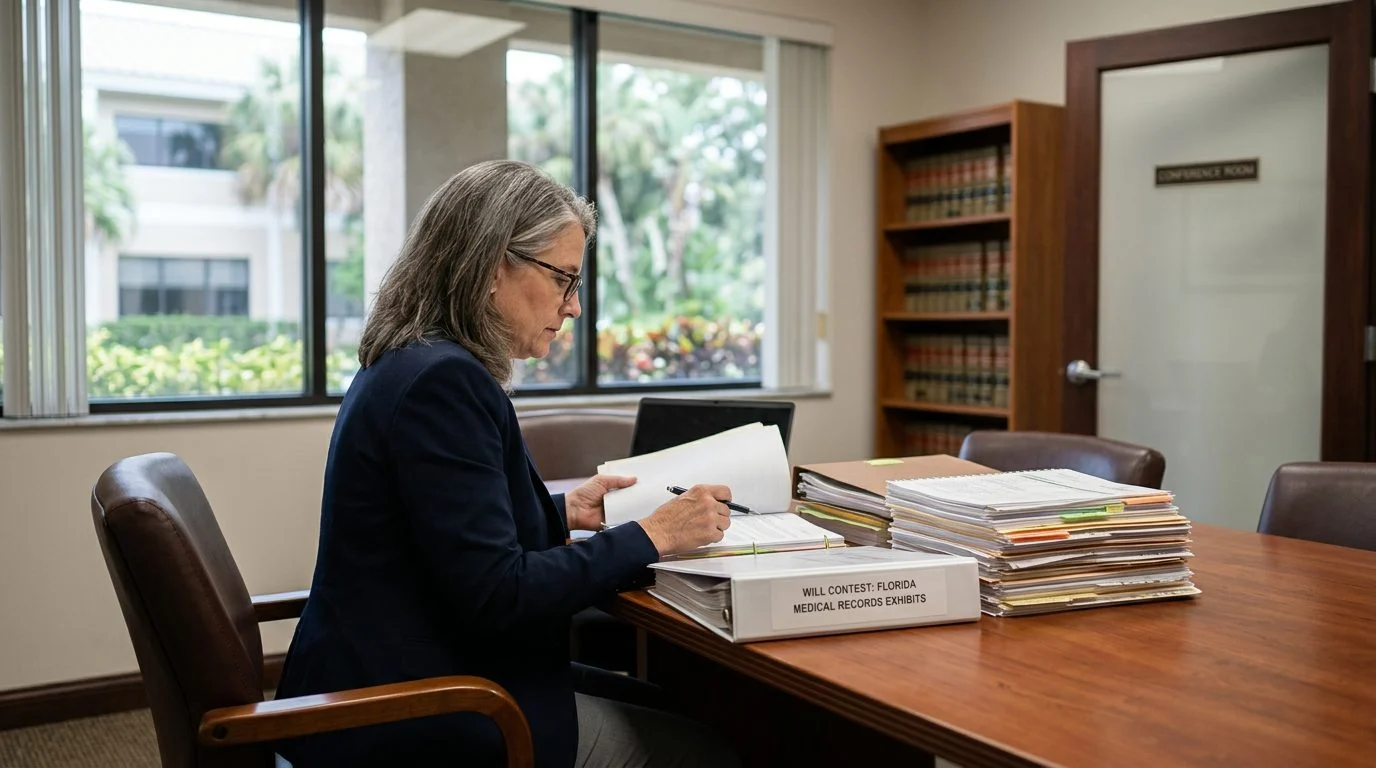
Preparing Records for a Florida Will or Trust Contest
Start with a written list before you call any provider. Put each provider’s name, the dates of care, and the signing date on one page.
- Note any change in medications, living arrangements, or caregivers around the signing date.
- Keep copies of every request, every production, and every gap you still need to fill.
- Bring the list, the will or trust in question, and any chart pages you already have to the consultation.
Leslie V. Marenco is the responsible lawyer for this page.
How far back should medical records go?
Focus on the months before and after the signing date. Earlier and later records help show whether a decline was gradual or sudden.
How long do I have to contest a will in Florida?
Under § 733.212, an interested person served with the notice of administration must file objections to a will’s validity within 3 months after service, or they are forever barred; that 3-month period can be extended only for estoppel based on a misstatement by the personal representative about the time allowed to object, and in any case objections must be filed no later than the earlier of the final discharge order or 1 year after service of the notice.
Who has the burden of proof in a will contest?
The proponent first establishes formal execution, and then the contestant must prove the grounds for opposing probate, under § 733.107.
If the chart from the months around a parent’s will or trust signing is the piece you cannot yet get, Trust Counsel, PL can talk through the next request with you. The firm’s office is in Coral Gables. Call (305) 707-7126 or schedule online. The first consultation is free, confidential, and carries no obligation to continue.
What Medical Records Can Show
Mental capacity at signing
Records from the period around the signing date can help show what the person understood about their property, family and the document they signed.
Changes over time
Records from before and after the signing date can show whether a decline was gradual or sudden, which helps place the signing in context.
Who was involved
Visit notes, medication logs and care-provider entries may identify who attended appointments and who was present when decisions were discussed.
Medications and diagnoses
Prescriptions and diagnoses can be reviewed alongside other evidence to understand how a condition may have affected daily functioning.
Preserve the Evidence
Do not alter, discard or annotate original medical records, and do not destroy emails, texts or notes about the person's health or the will. Keep copies in a safe place and tell your lawyer what you have.
Working With Your Lawyer on Records
Gather what you already have
Collect discharge summaries, prescriptions, appointment letters and facility records you can access without delay.
Identify the providers
List doctors, hospitals, pharmacies, home health agencies and facilities that treated the person in the months around the signing.
Review with counsel
Records are often reviewed with other evidence, such as witness accounts and drafting history, before a decision is made about a challenge.