
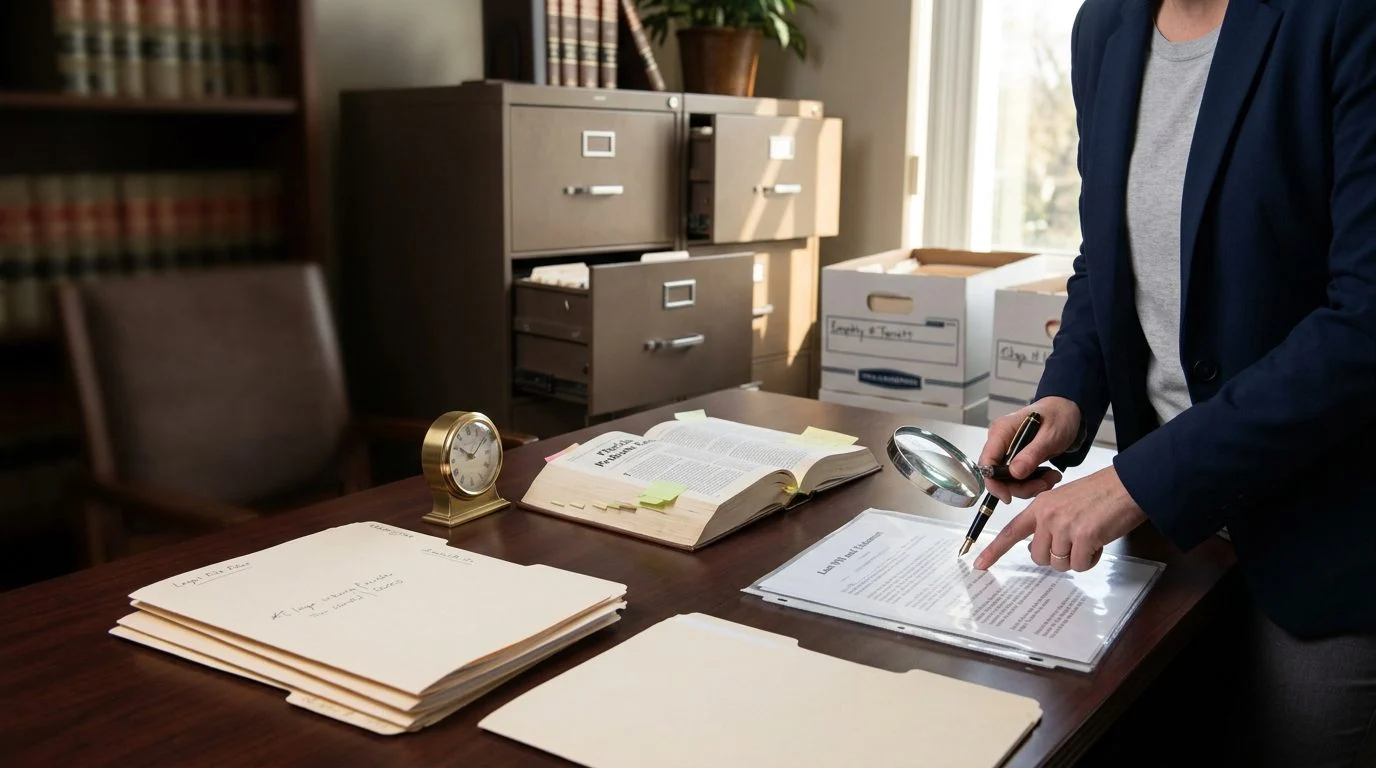
Probate Litigation | Coral Gables, Florida
A Lost Original Will Can Still Be Proved in Florida
Trust Counsel, PL helps heirs, beneficiaries and personal representatives establish a missing will's terms in Florida probate court. Leslie V. Marenco is responsible for this page.
By Leslie V. Marenco · Published October 20, 2026
A lost original will in Florida can still be admitted to probate. Fla. Stat. § 733.207 lets an interested person prove the will’s full terms and ask the court to admit it. This page explains what that proof involves, where families often get stuck, and what the probate steps look like. Leslie V. Marenco is the responsible lawyer for this page.
What Happens When the Original Will Cannot Be Found in Florida
A missing original will does not automatically mean there is no valid will. The terms may still be proved, but the proof has to come from other sources.
A lost will is one that cannot be found after the testator (the person who made it) dies. A destroyed will was torn, burned or otherwise ruined. A revoked will is different, and the difference matters.
An electronic will is revoked by deleting, canceling, rendering unreadable, or obliterating it, with the intent and purpose of revocation proved by clear and convincing evidence. So the question is not only where the paper is. It is also why it is gone.
This can affect adult children, other heirs, beneficiaries, or the person named as personal representative (often called an executor). They often learn of the problem while searching a parent’s home or office.
A copy alone is not the same as proof of the will’s terms. A copy shows what the paper said. The court still needs sworn witness testimony about the will’s content and how it was signed.
If a parent's original will can't be found, you don't have to sort out the court steps alone, and we can help you review the facts. Talk it through with Trust Counsel, PL — the first consultation is free, confidential, and carries no obligation.
Why a Will Does Not Transfer Property by Itself and When Probate Is Required
A will does not move property on its own. A court must admit it to probate first.
Fla. Stat. § 733.103 says that until a will is admitted to probate in Florida or in the state where the decedent lived, the will is ineffective to prove title to the decedent’s property.
Some assets can pass outside probate. These often include property held in a trust, jointly owned property and accounts that name a beneficiary. Each asset depends on how it is titled, so reviewing the records comes first.
A lost will petition is a probate matter. Any part of a decedent’s estate not effectively disposed of by will passes to the decedent’s heirs as prescribed in the following sections of the Florida Probate Code, as Fla. Stat. § 732.101 provides.
Florida’s Rule for Proving a Lost or Destroyed Will (Fla. Stat. 733.207)
An interested person may prove the terms of a lost or destroyed will and offer it for probate.
The will’s specific content must be proved by two disinterested witnesses. If a correct copy is provided, one disinterested witness is enough.
The probate rules add steps. Florida Probate Rule 5.510 requires one combined proceeding. The petition must state the grounds for relief and the will’s contents, or attach a copy if one is available. Each witness’s testimony must be written down and filed.
Formal notice must go to anyone who would take property if the will were not in place. The order admitting the will must state its terms in full.
How the will was lost also shapes the proof. A will lost in storage raises different questions than one the testator destroyed. The facts drive what evidence the court needs.
Evidence That Can Support a Petition to Admit a Lost Will
The strongest petitions pair witness testimony with records that match the disputed terms.
- The drafting attorney’s file, including signed copies and notes on how the will was signed.
- The attesting witnesses and any notary, and whether they are living, reachable and able to describe the terms.
- Conformed or photocopies, scanned images, emails and drafts that match the disputed terms.
- Records of custody, such as safe deposit box access, home or office searches, and prior references to the will.
If the attesting witnesses cannot be found, have become incapacitated after the will was executed, or their testimony cannot be obtained within a reasonable time, Fla. Stat. § 733.201 offers another route. The will may be admitted on the oath of the nominated personal representative, or of a person with no interest in the estate who believes the writing is the true last will.
The court looks at the whole record. A gap can matter as much as a document. A missing witness or an unexplained break in custody can change what the court needs next.
Step-by-Step Process and What to Expect
The process moves from search to documentation to a court hearing, and the timing depends on the facts.
- Search and record the search. Note who had access to the will and where it was kept.
- Locate the drafting attorney, the witnesses and any copies. Preserve emails and records.
- File the petition for administration with the probate court, with the proposed terms and proof.
- The personal representative must promptly serve notice of administration on the known surviving spouse, beneficiaries, certain trustees and trust beneficiaries, and persons who may be entitled to exempt property, and may also serve devisees under a known prior will, heirs, and others who claim an interest in the estate, as Fla. Stat. § 733.212 provides.
- Attend the hearing or review, where witnesses describe the terms and the signing.
- If the court admits the will, administration moves forward with a personal representative. If not, intestacy rules apply.
If someone holds the original, Fla. Stat. § 732.901 says the custodian must deposit it with the clerk within 10 days after learning of the death. The custodian must also give the date of death or the last four digits of the testator’s Social Security number. The Miami-Dade Clerk describes the deposit deadline for a decedent’s will.
Objections, Forgery Claims and Other Disputes That Can Follow
Heirs can challenge a lost will, and each challenge changes the proof and the timeline.
- Heirs may dispute that the will existed, say it was revoked, or say its terms were changed.
- A claim that a copy is forged turns the dispute into a question of authenticity.
- Capacity or undue influence claims ask whether the testator made the will freely and with understanding.
- A relative who blocks access to the original or the estate can create a separate dispute.
Fla. Stat. § 733.107 sets the burden. The proponent must first establish prima facie the will’s formal execution and attestation, Fla. Stat. § 733.107. After that, the contestant must establish the grounds for opposing probate.
Timing matters too. Fla. Stat. § 733.212 requires an interested person served with the notice of administration to object to the will’s validity, venue or jurisdiction within 3 months after service on that person, or the objections are forever barred. All such objections must be filed no later than the earlier of the personal representative’s final discharge or 1 year after service of the notice. That period may be extended only for estoppel based on a personal representative’s misstatement. A person served with formal notice before letters issue, or who has waived notice, may not later challenge the will’s validity, testacy of the decedent, venue, or jurisdiction of the court, except in proceedings before letters, as Fla. Stat. § 733.2123 provides.
Not sure what your next step is?
Talk it through with Trust Counsel, PL — the first consultation is free, confidential, and carries no obligation.
How Trust Counsel, PL Approaches a Lost-Will Matter
Trust Counsel, PL focuses on trust and estate litigation for clients in Florida. The firm’s only office is in Coral Gables, Florida. We serve clients in Florida.
Leslie V. Marenco is the responsible lawyer for this page. The firm’s lawyers include Leslie V. Marenco and Tanya Vega.
Trust Counsel’s attorneys can serve individually as trustee or personal representative. The firm advises and represents trustees, personal representatives and beneficiaries. The firm itself does not act as a trustee or personal representative.
In a lost-will matter, the work can include reviewing the search record and evidence, preparing the petition, and representing parties at hearings and in disputes.
The initial consultation is free, confidential and without obligation to continue. A matter may be referred to another lawyer or firm where that fits the facts better.
Frequently Asked Questions About Lost Wills in Florida
Most questions about a lost original will turn on the proof and on why the will is missing.
Can a lost original will still be admitted to probate in Florida?
Yes. Fla. Stat. § 733.207 lets an interested person establish the full and precise terms of a lost or destroyed will and offer it for probate; the terms must be proved by two disinterested witnesses, or by one disinterested witness if a correct copy is provided. Whether the court admits it depends on the evidence.
What if the drafting attorney has died or retired?
The file may be held by a successor or in storage, so the search should start there. Other witnesses may also be relevant.
Is a photocopy enough?
A correct copy can support proof through one disinterested witness under the statute. The copy still must be tied to testimony about the will’s terms.
What if the testator destroyed the will?
Destruction by the testator, or by another person in the testator’s presence and at the testator’s direction, with intent to revoke counts as revocation under Fla. Stat. § 732.506. The reason for the destruction matters.
Does a will in Florida need to be filed with the court?
The custodian must deposit the original with the clerk within 10 days after learning of the death, under Fla. Stat. § 732.901.
Do I need a lawyer to petition for a lost will?
The petition runs through the probate court, and hiring a lawyer is your choice. A lawyer can review the evidence before you decide how to proceed.

Talk With a Florida Trust Litigation Attorney About Your Lost-Will Question
If you’re trying to prove a lost original will after a parent’s death, you don’t have to work through the court steps alone. Contact Trust Counsel, PL to review your facts before you decide what comes next. Call (305) 707-7126 or schedule online.
How a Lost Will Matter Is Approached
Reviewing the Available Copies
We look at every copy, draft and related record to understand what the will said and how it was kept.
Identifying Witnesses
We help gather the testimony needed to establish the will's full and precise terms.
Protecting Interested Parties
Heirs, beneficiaries and fiduciaries each have different interests, and we advise each client on their position.
Clear Communication
We explain each step of the process so you know what to expect before any filing is made.
Do Not Discard Anything Yet
A missing original is not the end of the matter. Keep every copy, envelope, letter and record related to the will, and speak with counsel before making decisions about the estate.
Common Questions We Address
Can a lost will be admitted?
Florida law allows an interested person to ask the court to establish a lost or destroyed will. Whether the court admits it depends on the evidence presented.
What if only a copy exists?
A copy can play an important role in the proof. We review its accuracy and how it fits with the other evidence.
Who can bring the request?
Heirs, beneficiaries and other interested persons may have standing. We evaluate each client's relationship to the estate.
Who can serve as personal representative?
Trust Counsel's attorneys can serve individually as trustee or personal representative. The firm advises and represents trustees, personal representatives and beneficiaries.