
Trust and Probate Litigation | Coral Gables, Florida
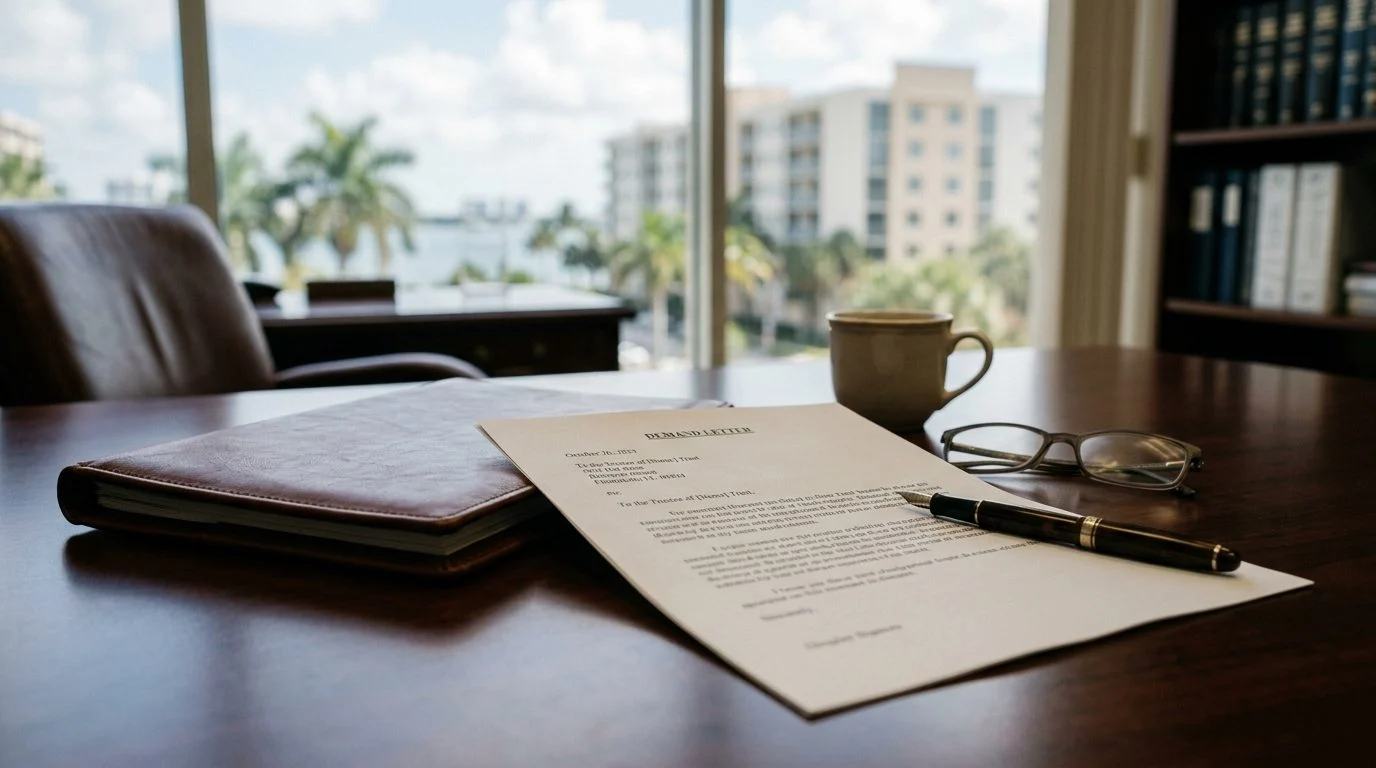
Before You File Suit Against a Trustee, Consider a Demand Letter
A well-written demand letter can state your concerns clearly, request the records you need, and open a path to resolution. Leslie V. Marenco and the Trust Counsel team focus on trust and probate disputes for beneficiaries, heirs and fiduciaries.
By Leslie V. Marenco · Published November 2, 2026
Short Answer: Is a Demand Letter Required Before Suing a Trustee in Florida?
A demand letter is often a useful first step, but it isn’t always required. Whether you must send one depends on the claim, the trust terms, and the timing. A written demand gives the trustee a clear chance to respond before you go to court.
Florida’s Trust Code, Chapter 736 of the Florida Statutes, sets out a trustee’s duties and the remedies a beneficiary can use. The duty to inform and account is set out in Fla. Stat. § 736.0813(1). Under § 736.0813, a trustee must keep qualified beneficiaries reasonably informed about the trust and how it is run, but while a trust is revocable these duties extend only to the settlor.
Some situations call for court action sooner. The sections below explain when that is true and where a letter fits.
Not sure what your next step is?
Talk it through with Trust Counsel, PL — the first consultation is free, confidential, and carries no obligation.

What a Pre-Suit Demand Letter Is Meant to Accomplish
A demand letter puts the trustee on written notice of a specific concern. It also asks for a specific response. It does three jobs at once.
First, it creates a record. The letter shows what you asked for, when you asked, and how the trustee answered. That record matters if the dispute reaches a judge.
Second, it gives the trustee a fair chance to fix the problem. Some problems are simple gaps in paperwork. A letter can bring out information that was never sent, such as a missing accounting or an unexplained payment.
Third, it narrows the dispute. A clear letter separates what is agreed from what is contested. That focus helps if the parties later sit down to settle or go to mediation.
A letter also gives you a statutory starting point. Under the same section, a trustee must provide a qualified beneficiary with a complete copy of the trust instrument, and relevant information about assets and administration, upon reasonable request; while a trust is revocable, these duties extend only to the settlor.
What a Strong Demand Letter Should Contain
A strong letter names the trust, states your connection to it, describes the concern, lists what you want, and sets a response date. Vague complaints are easy to ignore.
Start with the basics. Give the trust’s full name and date. Name the trustee and the trustee’s role. Explain your relationship to the trust, such as beneficiary, heir, cotrustee, or other interested person.
Next, describe the conduct or omission in plain facts. Include dates and dollar amounts where you know them. Stick to what you can prove. An overstated letter can weaken your position later.
List the documents you want. Common requests include the trust instrument, amendments, account statements, and records of distributions. A trustee of an irrevocable trust must give qualified beneficiaries an accounting at least once a year, and when the trustee changes or the trust ends, under § 736.0813, unless the trustee is a family trust company whose trust terms permit accounting only at termination, upon removal, resignation, or other event resulting in a trustee ceasing to serve, or upon a beneficiary’s demand. An accounting must be reasonably understandable and, to the extent feasible, identify and value trust assets on hand, as § 736.08135 explains.
Set a response date that fits the request. Write it down so there is no confusion later.
Finally, state the relief you want. Say you may take further legal action if the matter is not resolved. Ask the trustee in writing to keep relevant records, emails, and bank statements.
Documents to Gather Before Writing the Letter
Gather your papers before you write anything. A letter built on solid records is harder to brush aside.
Start with the trust agreement and every amendment or restatement you can find. If you only have a summary, say so in the letter and request the full document.
Next, collect account statements, distribution records, and any accountings the trustee has sent. Compare the dates and amounts. Gaps between what you received and what you expected often sit at the center of the dispute.
Keep every message you have exchanged with the trustee. That includes emails, letters, and texts. Write down the date and a short summary of each phone call while you still remember it.
Finally, document your own interest in the trust. Keep copies of the will, the trust’s beneficiary provisions, or other papers showing you are a beneficiary or heir. Without that link, the trustee can question your right to information.
When a Demand Letter Can Backfire or Is the Wrong First Step
A letter is the wrong first step when waiting could put trust property at risk. Timing and tone matter as much as content.
A letter gives the trustee advance notice. If you fear assets will be moved, sold, or retitled, the trustee gets time to act. In that case, ask the court for protection rather than wait. Under § 736.0706, the court may order relief to protect trust property while a removal request is pending.
Timing is the second risk. Florida limits on suing a trustee are tied to chapter 95 and to the disclosure rules in § 736.1008. A limitation notice may start a 6-month clock for matters disclosed in a trust accounting. Waiting for a reply can use up time you need.
The trust’s own wording does not change these limits. Under § 736.0105, the terms of a trust give way to the periods of limitation for starting a judicial proceeding. Don’t assume the trust’s language gives you extra time.
Tone is the third risk. Threats you can’t back up, or inaccurate statements, can weaken your credibility later. Keep the letter calm, factual, and specific.
Letter First or File First: How Small Claims and Court Actions Differ
Whether a demand must come before a filing depends on the claim, the amount, and the court rules that apply. Check those rules before you file.
Florida’s mediation statute shows how courts handle civil cases. Under § 44.102, a court must refer a filed civil action for monetary damages to mediation when one party asks, provided the requesting party is willing and able to pay the costs or the costs can be equitably divided between the parties, with listed exceptions. Under Fla. Stat. § 44.102(2)(a), a court must, upon request of one party, refer to mediation any filed civil action for monetary damages, provided the requesting party is willing and able to pay the costs of the mediation or the costs can be equitably divided between the parties, unless an listed exception applies, such as an action governed by the Florida Small Claims Rules. A small claims case therefore follows different rules than a larger action.
Trust disputes often ask for more than money. A beneficiary may want an accounting, a removal of the trustee under § 736.0706, or an order protecting trust property. Those remedies come from § 736.1001.
Mediation can also be a voluntary step. Under § 44.102(3), all written communications in a mediation proceeding, other than an executed settlement agreement, are exempt from chapter 119. That matters when you decide what to put in settlement letters.
A letter can still help after a filing. You can use it to request an accounting or open settlement talks while the case is pending.
Not sure what your next step is?
Talk it through with Trust Counsel, PL — the first consultation is free, confidential, and carries no obligation.
Where a Demand Letter Fits in the Trust Dispute Timeline
A demand letter usually fits early, after informal requests have gone unanswered and before any petition. Each stage has its own clock.
In the early stage, make a simple written request for the trust instrument and an accounting. If the trustee does not respond, send the formal demand.
In the middle stage, talks may move toward negotiation or mediation. Keep records of what you offered and what the trustee said. If a trustee sends a discharge notice, watch the deadline. Under § 736.10081, for trusts that are irrevocable or become irrevocable on or after the act’s effective date, a written objection received by the trustee within 60 days after the trustee sends the trust disclosure document prevents discharge under this section. The objection doesn’t need to state grounds or follow a set form.
In the later stage, a petition to remove the trustee may follow if the dispute is not resolved. Under § 736.0706, a beneficiary can ask the court to remove a trustee. The court may remove a trustee who has committed a serious breach of trust. A related page on what happens after a petition to remove a trustee in Florida covers the next steps.
Common Questions
Do I have to send a demand letter before suing a trustee in Florida?
Not always. The answer turns on the claim, the trust terms, and how urgent the problem is.
Can a beneficiary ask a trustee for the trust document?
Yes. Under § 736.0813, a trustee must provide a qualified beneficiary with a complete copy of the trust instrument upon reasonable request, but while a trust is revocable the trustee’s duties under this section extend only to the settlor.
When does mediation apply in a filed civil action? Not always. Under § 44.102, a court must refer a filed civil action for money damages to mediation when one party asks, provided the requesting party is willing and able to pay the costs of the mediation or the costs can be equitably divided between the parties, unless a listed exception applies.

Talk With Leslie V. Marenco in Coral Gables About Your Trust Dispute
If a trustee has not answered your requests, you can talk through whether a letter, a filing, or both fit your situation. Leslie V. Marenco is the responsible lawyer for this page. Trust Counsel, PL’s only office is in Coral Gables, Florida, and we serve clients in Fort Lauderdale. The firm’s trust litigation attorney page gives more background on trust disputes.
A free first consultation is offered: it is confidential, with no obligation to continue. Call (305) 707-7126 or schedule online.
What a Demand Letter Can Do
Put your concerns in writing
A demand letter sets out the problem, the facts behind it and what you are asking the trustee to do, creating a clear record from the start.
Request trust information
A letter can formally request the trust documents, accountings and information you need to understand how the trust is being administered.
Open a path to resolution
Many disputes are narrowed or settled through direct communication. A letter can invite a response before a court case is considered.
Prepare for litigation if needed
If the matter must go to court, a demand letter documents your good-faith effort to resolve it and helps shape the next steps.
Do Not Wait on Urgent Problems
If trust assets are at risk, or a trustee is acting in a way that may cause immediate harm, a demand letter may not be the right first step. Contact the firm promptly so your options can be reviewed.
How the Process Typically Works
1. Review the facts
We review the trust terms, your relationship to the trust, and the events that prompted your concern.
2. Gather your documents
Statements, correspondence, accountings and prior requests help build a clear and accurate letter.
3. Draft a targeted letter
The letter identifies specific concerns and requests, written to be firm, factual and easy for the trustee to answer.
4. Evaluate the response
Once the trustee replies, we discuss whether negotiation, further information requests or litigation is the better path.