
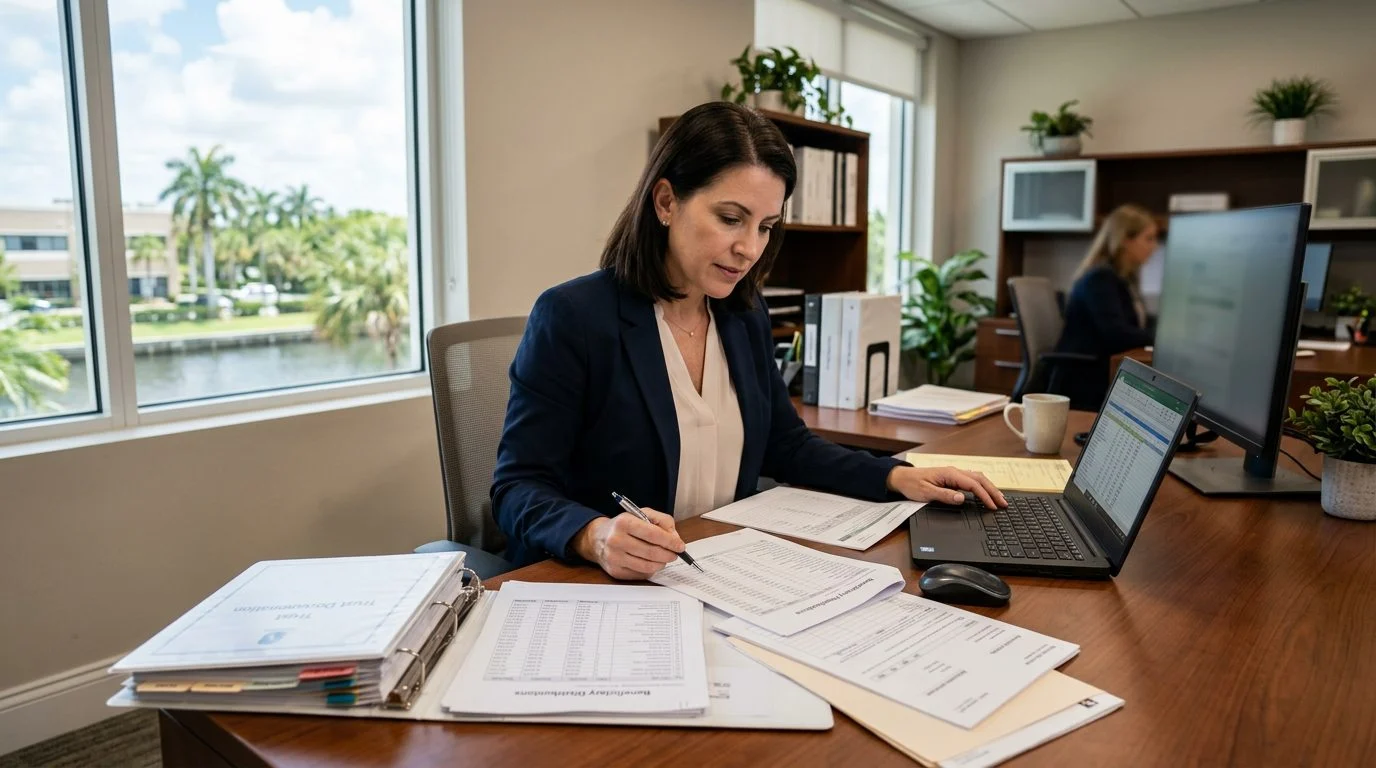
Trust Administration | Coral Gables, Florida
Trust Administration When the Trustee Lives Out of State and the Property Is in Florida
Florida real estate held in a trust can bring recording, title and court steps that differ from the trustee's home state. Trust Counsel, PL focuses on trust administration and related fiduciary matters for families, trustees and beneficiaries.
How Trust Counsel, PL can help
Florida property review
We review the trust, the deed and the Florida property records to identify which Florida steps apply to the property.
Advice for trustees and beneficiaries
The firm advises and represents trustees, personal representatives and beneficiaries. Trust Counsel's attorneys can serve individually as trustee or personal representative.
Coral Gables office
Our office is in Coral Gables. We serve clients in Fort Lauderdale, Boca Raton, West Palm Beach, Doral, Kendall, Pinecrest, Key Biscayne and Aventura.
Start with a free discovery call
The free discovery call is confidential and carries no obligation to continue.
By Leslie V. Marenco · Published November 17, 2026
If you live outside Florida and a trust you oversee holds Florida property, Florida law may still apply to part of your work. A trust administration attorney can help an out-of-state trustee sort out which Florida rules apply, what to do first, and how Florida property gets managed or transferred. When the trustee, a beneficiary or the trust records are in another state, this page explains step by step how Florida property is handled and which Florida questions it raises.
Not sure what your next step is?
Talk it through with our team — the first discovery call is free, confidential, and carries no obligation.
Who This Service Is For
This service fits people who must administer a trust that holds Florida property while living somewhere else.
- Trustees who live in another state and were named in a trust holding Florida real estate, bank accounts or other Florida assets.
- Successor trustees who took over a trust they did not create and must manage it from a distance.
- Beneficiaries and family members who need to understand what the trustee must do and how Florida law applies.
Trust Counsel’s attorneys can serve individually as trustee or personal representative. The firm advises and represents trustees, personal representatives and beneficiaries.
A person named as trustee accepts by substantially complying with the method stated in the trust’s terms or, if the trust gives no method or does not make its method exclusive, by accepting delivery of the trust property, exercising powers, performing duties, or otherwise indicating acceptance. One who does not accept within a reasonable time after knowing of the designation is treated as having declined (§ 736.0701).
Once a trustee accepts, the trustee must administer the trust in good faith, under its terms and purposes, in the interests of the beneficiaries, and under the Florida Trust Code (§ 736.0801).
What Trust Administration Covers for an Out-of-State Trustee
Trust administration covers managing the trust’s assets, keeping records, informing beneficiaries and closing out the trust. Here’s what that looks like in practice:
- Reviewing the trust document and listing every asset, including Florida real estate, with how each asset is titled.
- Keeping clear, accurate records and keeping trust property separate from the trustee’s own property.
- Giving qualified beneficiaries notice, a copy of the trust on reasonable request, and an accounting at least once a year for an irrevocable trust, though for a family trust company serving as trustee the trust terms may limit accounting to termination, a change of trustee, or a beneficiary’s demand (§ 736.0813).
- Using a certification of trust with banks and title companies, which can show the trustee’s authority without handing over the full trust instrument (§ 736.1017).
- Coordinating with Florida title companies, banks and recording offices when Florida property must be managed, sold or transferred.
- Reviewing accountings and distributions before they go to beneficiaries.
A trustee of an irrevocable trust must provide a trust accounting, in the form another section of the Florida Trust Code sets out, to each qualified beneficiary at least annually (§ 736.0813).
Under Florida law, a trustee holding Florida real property received from a settlor or estate does not have to obtain title insurance or proof of marketable title until a sale or conveyance requires it (§ 736.08105).
One mistake to avoid is waiting until a bank or title company asks for proof of authority before reading the trust closely. Tax reporting can involve other professionals, and the firm can advise on the trust-law questions that come up along the way.
When Florida Law Applies to Florida Property
Florida law can apply to a trust’s Florida property, and the trust’s terms and location help decide which state’s law controls.
Florida’s governing-law statute lists the location of real property held by a trust as one example of the connection needed when a trust names a governing state (§ 736.0107). Even a chosen governing state does not control every matter. A designation fails on any matter contrary to a strong public policy of Florida. In the absence of a controlling designation in the terms of the trust, the law where the settlor lived when the trust was created applies.
Where the trust is administered matters too. Unless the trust says otherwise, the principal place of administration is the trustee’s usual place of business where trust records are kept, or the trustee’s residence if there is no place of business; for cotrustees, it is the usual place of business of the corporate cotrustee if there is only one, otherwise the usual place of business or residence of the sole individual professional fiduciary, or otherwise that of any cotrustee as agreed by the cotrustees (§ 736.0108).
Moving that place takes notice. A trustee must give qualified beneficiaries at least 60 days’ notice before starting the transfer. A timely lawsuit filed by a qualified beneficiary objecting to the transfer suspends the trustee’s power to move it without court approval (§ 736.0108).
A foreign trustee does not need local qualification to receive a distribution from a local estate, unless it is otherwise doing business in Florida (§ 736.0112). Some questions may follow another state’s law.
Have questions about what happened?
Ask our team directly. The first conversation is free, confidential, and there is no obligation to continue.
How the Process Works, Step by Step
The process moves from document review to asset mapping, notices, Florida institution work and final accountings.
- Review the documents. Gather the trust instrument, the death certificate if the settlor has died, and a list of known assets.
- Confirm the trustee’s authority. Check for any co-trustees or successor trustees named in the trust.
- Map every asset. List Florida and out-of-state assets and note how each one is titled.
- Send required notices. Notice to qualified beneficiaries is due within 60 days after the trustee learns that an irrevocable trust was created, or that a revocable trust has become irrevocable, for example at the settlor’s death (§ 736.0813).
- Work through Florida institutions. Some steps can be handled by phone, mail and email. Some Florida filings or signatures may need a notary or a local title company. Bank and recording steps can take time, so start early.
- Prepare accountings and distributions. Deliver them to beneficiaries, then close out the trust’s records.
How long this takes depends on the assets, the number of beneficiaries and whether a dispute arises.
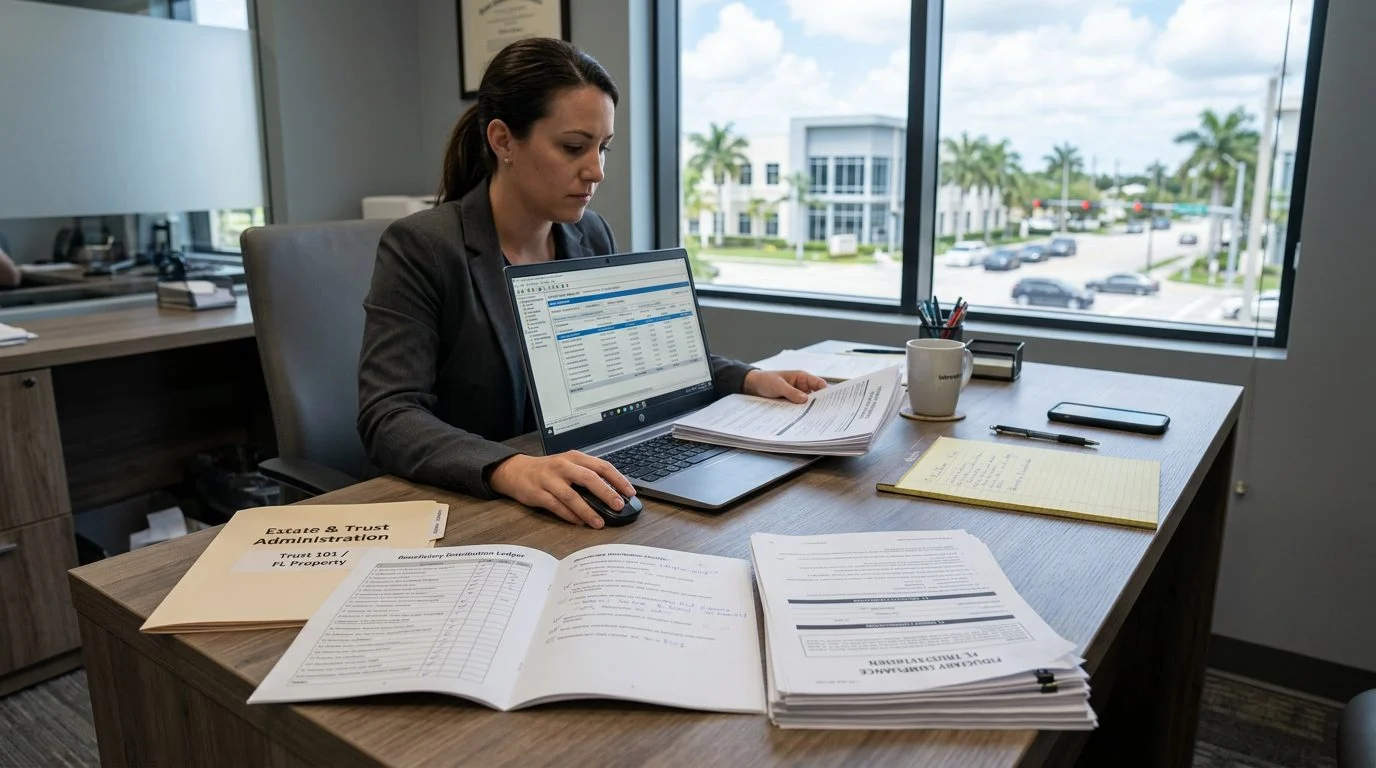
Trustee Compensation and Costs to Plan For
A trustee is paid what the trust specifies, subject to court adjustment, or a reasonable amount when the trust is silent.
- If the trust does not specify compensation, the trustee is entitled to compensation that is reasonable under the circumstances (§ 736.0708).
- If the trust specifies compensation, the trustee is entitled to that amount. A court may allow more or less if the duties differ substantially from those expected, or if the amount is unreasonably low or high (§ 736.0708).
- Payments to the trustee and the trustee’s agents appear in the trust accounting.
Costs a trustee may face include recording fees, appraisals and court filing fees, when they apply to the trust’s assets and filings. Compensation questions start with the trust’s own language, so bring the trust document to any review.
How Trust Counsel Approaches This Matter
Trust Counsel, PL is a Florida trusts and estates law firm with its only office in Coral Gables, Florida.
The firm focuses on trust and estate matters, including trust administration, trust litigation, probate litigation, estate tax planning and business succession planning. It represents beneficiaries, heirs and fiduciaries, and advises professional trustees and personal representatives.
The firm plans for domestic and foreign families, including families with Florida property, and reviews each matter on its own facts. The firm advises and represents trustees, personal representatives and beneficiaries, and in each matter it represents the client who engages the firm.
Leslie V. Marenco is the responsible lawyer for this page. Tanya Vega is also one of the firm’s lawyers.
We serve clients in Fort Lauderdale, Boca Raton and West Palm Beach, among other Florida communities.
Frequently Asked Questions
Can a Florida trust own property in another state?
Yes, a trust can hold property in more than one state. Each location may have its own title and recording steps, so check both.
Can a lawyer from Florida represent you in another state?
Questions governed by another state’s law may be referred to a lawyer licensed in that state.
Do I need to travel to Florida to administer the trust?
Many steps can be handled by phone, mail and email. Some Florida filings or signatures may need a notary or a local title company.
Can an out-of-state trustee be paid?
Yes. A trustee is entitled to reasonable compensation when the trust is silent, and to the specified amount when the trust specifies one, subject to court adjustment (§ 736.0708).
What is a certification of trust?
A certification of trust states that the trust exists and names the trustee and its powers, without the dispositive terms. It can be given to a non-beneficiary in place of a copy of the trust instrument (§ 736.1017).
Must a trustee tell beneficiaries about the trust?
Yes. A trustee must keep qualified beneficiaries reasonably informed about the trust and its administration (§ 736.0813).
Want to know where you stand?
Tell us what happened and our team will walk you through the options available to you, at no cost.
Next Step: Bring Your Trust Questions to a Free Discovery Call
If you’re running a trust with Florida property from another state, the work can feel unfamiliar and time-sensitive, especially after a death in the family.
A free discovery call gives you a private place to review the trust and the Florida property questions in front of you. The call is confidential and carries no obligation to continue.
Call (305) 707-7126 or schedule online at our contact page.
Referral note
Questions governed by another state's law may be referred to a lawyer licensed in that state. Trust Counsel, PL will tell you if a matter should be referred.
Common questions about out-of-state trustees
Can a trust own Florida property if the trustee lives elsewhere?
Yes, a trust can hold property in more than one state. Each location may have its own title and recording steps, so check both.
Can a Florida lawyer help with another state's requirements?
Questions governed by another state's law may be referred to a lawyer licensed in that state. Florida matters can be addressed directly by the firm.
How do I start?
Call (305) 707-7126 or schedule online for a free discovery call. The call is confidential and carries no obligation to continue.