
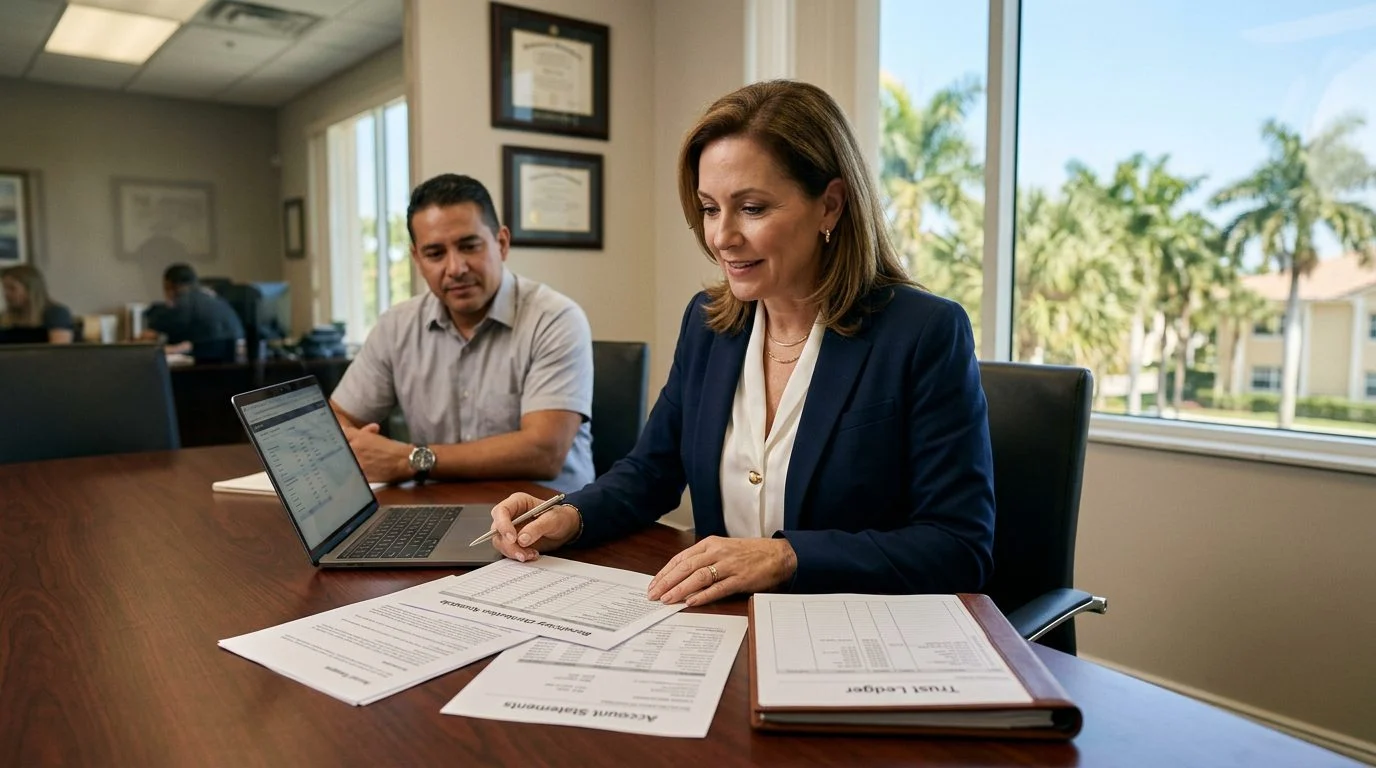
Trust Administration Attorney | Coral Gables, Florida
Trust administration guidance for Florida beneficiaries
Plain-language help with how a trust is run, the information you may request, and how to protect your interests while the trustee does the work.
By Leslie V. Marenco · Published November 17, 2026
If you’re a beneficiary of a Florida trust, you may be waiting on answers, documents, or a payment. If you want to see the trust document itself, a trustee must give you a copy on reasonable request. If you are a beneficiary trying to understand where you stand, this guide explains your rights, what a trustee can and cannot do, and when a trust administration attorney for beneficiaries in Florida can help.
What trust administration means for a beneficiary in Florida
Trust administration is the work a trustee does after a trust becomes irrevocable, usually when the settlor dies. The trustee finds the trust’s assets, pays valid debts and taxes, and distributes property under the trust terms.
A beneficiary is the person entitled to benefit from the trust. The trustee is the person who manages it. A beneficiary’s rights come from the trust document and from Chapter 736, Florida Statutes, the Florida Trust Code.
Beneficiaries who need a trust administration attorney usually fall into three groups. Some are heirs waiting on distributions. Some suspect the trustee is mismanaging assets. Others live outside Florida while the trust holds Florida property.
Trust Counsel, PL is a trusts and estates law firm in Coral Gables, Florida, and its only office is in Coral Gables. The firm focuses on trust administration, trust litigation, probate litigation, and estate planning. We serve clients in Fort Lauderdale, Boca Raton, West Palm Beach, Doral, Kendall, Pinecrest, Key Biscayne, and Aventura.
Not sure what your next step is?
Talk it through with our team — the first discovery call is free, confidential, and carries no obligation.
Do you need an attorney to handle a trust in Florida?
Often a trust is handled privately by the trustee, outside court. A will generally goes through probate, which is court-supervised.
Disputes still happen. A beneficiary may disagree with an accounting, a distribution amount, or a trustee’s decision. That is when many beneficiaries seek legal advice. Attorney review often makes sense when:
- the trustee is not responding to letters or calls
- a request for the trust document has been refused
- the value of trust assets is unclear
- a distribution does not match the trust terms
Whether a matter calls for document review, negotiation, or litigation depends on the facts. The free discovery call is where those facts get reviewed.
Your rights as a beneficiary under the Florida Trust Code
A trustee must keep qualified beneficiaries reasonably informed about the trust and its administration. For an irrevocable trust created on or after the effective date of the Florida Trust Code, or a revocable trust that becomes irrevocable on or after that date, the trustee must notify qualified beneficiaries within 60 days after the trustee learns the trust was created or has become irrevocable. Fla. Stat. § 736.0813 That notice covers the trust’s existence, the settlor’s identity, your right to request the trust instrument, your right to accountings, and that the fiduciary lawyer-client privilege in s. 90.5021 applies with respect to the trustee and any attorney employed by the trustee, but does not affect the crime or fraud exception to the lawyer-client privilege in s. 90.502(4)(a). Fla. Stat. § 736.0813
On reasonable request, the trustee must give you a complete copy of the trust instrument. The trustee must also share relevant information about trust assets, liabilities, and administration. Fla. Stat. § 736.0813
The trustee of an irrevocable trust must also account to each qualified beneficiary at least once a year, unless the trustee is a family trust company, licensed family trust company, or foreign licensed family trust company, in which case the trust terms may permit accounting only at termination, upon removal, resignation, or other event resulting in the trustee ceasing to serve, or upon demand of a qualified beneficiary or the representative of a qualified beneficiary. The same duty applies when the trust ends or the trustee changes. You can waive this duty, but only in writing. Fla. Stat. § 736.0813
A trust accounting should be easy to follow. It starts by identifying the trust, the trustee, and the period covered. It must show all cash and property transactions and all significant transactions affecting administration, including compensation paid to the trustee and the trustee’s agents. Fla. Stat. § 736.08135
Trust terms generally control, but not everything. Several notice, copy, accounting, and information duties are on a list that trust terms cannot override. Fla. Stat. § 736.0105
A written request is a common first step. It creates a clear record of what you asked for and when.
What a trustee can and cannot do with trust property
A trustee may use the powers the trust gives. A trustee may also use other powers needed to invest, manage, and distribute trust property, without court approval. Those powers remain subject to fiduciary duties. Fla. Stat. § 736.0815
The main duties are these:
- Loyalty: the trustee must administer the trust solely in the beneficiaries’ interests. Fla. Stat. § 736.0802
- Impartiality: with two or more beneficiaries, the trustee must act impartially. Fla. Stat. § 736.0803
- Prudence: the trustee must use reasonable care, skill, and caution. Fla. Stat. § 736.0804
Ask to see every payment in the accounting.
If a trustee breaches a duty, a court may order an accounting, order money or property restored, reduce or deny compensation, or remove the trustee. Fla. Stat. § 736.1001
Have questions about what happened?
Ask our team directly. The first conversation is free, confidential, and there is no obligation to continue.
What Trust Counsel’s attorneys help beneficiaries with
Trust Counsel’s attorneys help beneficiaries with:
- reviewing the trust instrument, amendments, and related estate planning documents
- sending written requests for the trust document, information, and accountings, with follow-up if the trustee does not reply
- reviewing proposed distributions against the trust terms
- objections, negotiation, and litigation when informal steps do not resolve the matter
- questions about Florida trust property and beneficiaries who live outside Florida, reviewed case by case
Trust Counsel’s attorneys can serve individually as trustee or personal representative, and the firm advises and represents trustees, personal representatives and beneficiaries. The firm itself does not act as a fiduciary.
How a trust administration matter typically proceeds
Most matters move through five steps, though timing varies.
- Free discovery call. You describe the trust, the parties, your role, and your concern. Book a free discovery call.
- Document review. The attorney reads the trust, any amendments, and your statements or letters from the trustee.
- Written request. The trustee receives a request for information you’re entitled to under Chapter 736, with a response date.
- Evaluation. You and the attorney weigh the response and choose whether to negotiate, mediate, or file in court.
- Updates. The responsible attorney explains each step before it is taken.
Watch the clock. A trustee seeking settlement and discharge under this section must send a trust disclosure document that includes a notice in at least 12-point type stating that any claim or cause of action against the trustee arising from a matter disclosed in that document may be barred unless a written objection is received by the trustee within 60 days after the beneficiary’s receipt of the document and notice. A written objection received within 60 days stops that discharge process. Fla. Stat. § 736.10081
Timelines depend on the trust’s complexity, the trustee’s cooperation, and court schedules.
Why work with Trust Counsel, PL for trust administration
Leslie V. Marenco is the responsible attorney for this page. Tanya Vega is also one of the firm’s lawyers. The firm has more than one lawyer, along with support staff for office work.
The firm’s practice covers:
- probate litigation and trust litigation
- trust administration
- professional trustee and personal representative services, provided by the firm’s attorneys individually
- estate tax planning and business succession planning
- asset protection, guardianship, and estate planning
The firm represents beneficiaries, heirs, and fiduciaries in probate and trust disputes. It also advises professional trustees and personal representatives (often called executors) on administration.
Frequently asked questions about trust administration for beneficiaries
Do you need an attorney to probate a will in Florida?
Probate is the court process for a will. A trust is generally handled by the trustee outside court, but a disputed trust can still reach court.
What are the powers of a trustee under the Florida Trust Code?
A trustee may use the powers the trust gives, plus other powers to invest, manage, and distribute property. Those powers remain subject to fiduciary duties.
What type of attorney handles wills and trusts?
An estate planning attorney drafts wills and trusts. A trust litigation attorney handles disputes once they arise.
Can a beneficiary who lives outside Florida still get help?
Yes, beneficiaries outside Florida with Florida trust property can seek advice. Each matter is reviewed on its facts.
Is there a cost for the first conversation?
The free discovery call is free, confidential, and carries no obligation to continue.
Want to know where you stand?
Tell us what happened and our team will walk you through the options available to you, at no cost.
How Trust Counsel helps
Trust administration advice
We advise beneficiaries, heirs and fiduciaries on the duties that arise as a trust is administered, from the initial trust documents to final distributions.
Representation for beneficiaries and fiduciaries
The firm advises and represents trustees, personal representatives and beneficiaries. Trust Counsel's attorneys can serve individually as trustee or personal representative.
Protecting your interests
When a trust administration becomes a dispute, our trust litigation and probate litigation attorneys can review the options with you.
Coral Gables office
Our only office is in Coral Gables. We serve clients in Doral, Kendall, Pinecrest, Key Biscayne, Aventura, Fort Lauderdale, Boca Raton and West Palm Beach.
Start with a free discovery call
The first call is free, confidential and comes with no obligation to continue. Bring the trust document and any notices you have received.
Common questions beneficiaries raise
Reading the trust document
We help you understand the trust terms, who the trustee is, and which parts of the document affect you.
Requesting information
We discuss what information about the trust and its assets you may request from the trustee and how to make that request.
Questions about accountings
We review trust accounts and reports with you so you can see how assets are being managed and spent.
When a dispute arises
If communication breaks down, our trust litigation team can evaluate the matter and explain the paths available.