
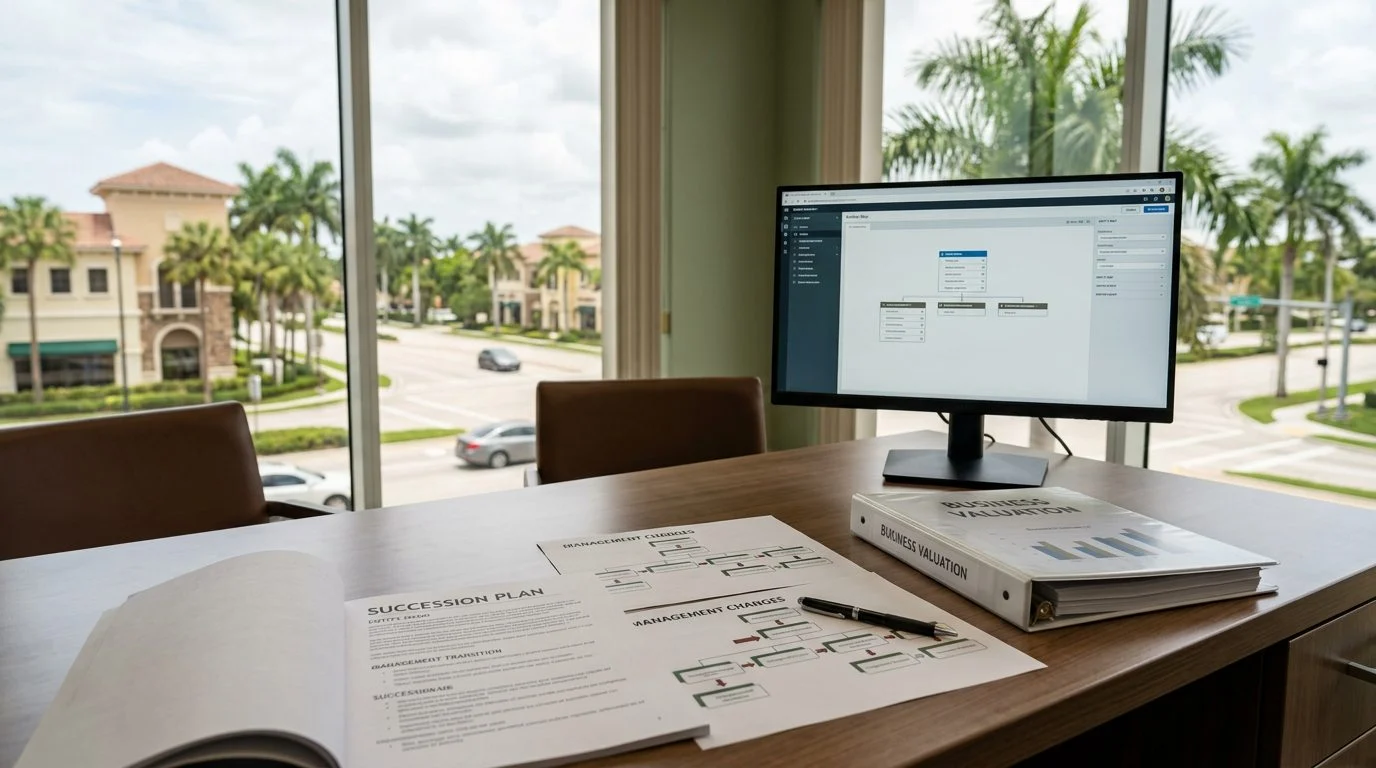
Estate Planning | Coral Gables, Florida
Florida Estate Plan: From First Meeting to Signed Documents
Responsible attorney Leslie V. Marenco walks through how planning with Trust Counsel, PL typically moves from a first conversation to documents ready for signing.
By Leslie V. Marenco · Published November 24, 2026
If you’re gathering information for a parent, a spouse, or your own family, you probably want to know how long this takes. The answer depends on what you own and how many documents you need.
How long does it usually take to complete a Florida estate plan, from initial meeting to executed documents?
There is no single number. The time from first meeting to signed documents changes with the family, the assets and the documents needed. A simple plan and a plan with business interests or property abroad can take very different amounts of time.
The process usually runs in order. It starts with a free discovery call. Next comes information gathering, then drafting, then client review and revisions, and finally signing.
Most delays come from paperwork. You’ll need account statements, deeds, business agreements, beneficiary designations and any existing wills or trusts. Assets held outside Florida or abroad add steps. Changes requested during review can send part of the draft back for rework.
Signing has its own rules. Under Fla. Stat. § 732.502, the testator (the person making the will) must sign at the end, or another person may subscribe the testator’s name at the end in the testator’s presence and at the testator’s direction. Two attesting witnesses must be present, and they must sign in the presence of the testator and of each other. Plan the signing date around the witnesses. For the wider framework, read our estate tax planning guide.
Not sure what your next step is?
Talk it through with Trust Counsel, PL — the first discovery call is free, confidential, and carries no obligation.
What documents make up a Florida estate plan?
A typical Florida estate plan includes a will, a durable financial power of attorney, a health care advance directive and beneficiary designations. Many plans also use a revocable living trust. Each document does a different job, which is why several documents take longer than one.
A will names who receives property that passes through probate. A durable financial power of attorney lets someone handle money matters if you can’t. That authority continues after incapacity when the document contains specific wording, or similar words showing that intent, under Fla. Stat. § 709.2104.
An advance directive covers health care decisions. In each proceeding in which a guardian is appointed, the court must determine whether the ward signed a valid advance directive before becoming incapacitated, under Fla. Stat. § 744.3115.
A trust can be created by transferring property to a trustee during the settlor’s lifetime or by will or other disposition taking effect on the settlor’s death, by the owner declaring that he or she holds property as trustee, or by exercising a power of appointment in favor of a trustee, under Fla. Stat. § 736.0401. Unless the trust says it is irrevocable, the settlor can revoke or amend it, but this rule does not apply to a trust created under an instrument signed before the Florida Trust Code took effect, under Fla. Stat. § 736.0602. Titling matters too.
Is an estate plan different from a will?
Yes. A will is one document. An estate plan is the full set of documents and beneficiary designations that work together.
Florida defines a will as a document that disposes of property at death. The definition also covers an instrument that revokes or revises another will, under Fla. Stat. § 731.201. Until a will is admitted to probate in Florida or in the state where the decedent was domiciled, it cannot prove title to the testator’s property, under Fla. Stat. § 733.103. A will alone does not control every asset.
A trust or a beneficiary designation can move property outside probate, depending on how it is set up. A beneficiary named on an account or policy receives that asset under the designation, even if the will says something different. That is why these documents need to be reviewed together.
Florida’s term for the person who administers a probate estate is personal representative. Readers often call this role an executor.
Do you pay estate tax in Florida?
Federal estate tax is the estate tax rule that can reach large estates. It applies to the taxable estate of a decedent who is a citizen or resident of the United States, under IRC § 2001. The basic exclusion amount is $15,000,000 under IRC § 2010(c)(3), as amended by Pub. L. 119-21 (July 4, 2025). A credit tied to that exclusion offsets the tax, under IRC § 2010.
Under IRC § 2038(a)(1), the value of the gross estate includes, to the extent of the interest transferred, property the decedent transferred, by trust or otherwise, if the enjoyment of it was subject at death to a change through a power (in whatever capacity exercisable) to alter, amend, revoke, or terminate, held by the decedent alone or together with any other person (no matter when or from what source the decedent got the power), or if such a power was relinquished during the 3-year period ending on the date of death, unless the transfer was a bona fide sale for an adequate and full consideration in money or money’s worth (IRC § 2038). Families with assets abroad should plan around that rule.
Business owners should also check how company interests are titled.
What mistakes commonly delay or undermine an estate plan?
Three mistakes can slow or undo a plan. Beneficiary designations can conflict with the will or trust. A trust can go unfunded. Documents can be signed or witnessed incorrectly.
A beneficiary designation can override a will. If an account names an old beneficiary, that person may receive the asset. Check every account and policy against the plan.
Signing rules matter. A will that skips the steps in Fla. Stat. § 732.502 does not meet the statute’s requirements.
Life changes need a review. A later marriage, or the birth or adoption of descendants, does not revoke an existing will, but a pretermitted child or spouse shall inherit as set forth in ss. 732.301 and 732.302, regardless of the prior will, under Fla. Stat. § 732.507. When a person marries after making a will and the spouse survives the testator, the surviving spouse shall receive a share in the estate equal in value to the intestate share, unless provision has been made for or waived by a prenuptial or postnuptial agreement, the spouse is provided for in the will, or the will discloses an intention not to make provision for the spouse. Section 732.507(3) of the Florida Statutes applies to wills of decedents who die on or after June 29, 2021.
What to do next if you are gathering information for a Florida estate plan
If you’re gathering information for a Florida estate plan, start by listing your accounts, deeds, policies, business papers and any existing wills or trusts. You may be doing this for a parent after a health change, or sorting through a family member’s papers after a death. You may not be ready to choose a lawyer yet, and that is a normal place to start.
On a free discovery call, you can talk through those papers and your questions. Leslie V. Marenco is the responsible lawyer for this page. The firm’s office is in Coral Gables, Florida.
The free discovery call is confidential and carries no obligation to continue. La llamada inicial es gratuita, confidencial y sin compromiso de continuar.
If you’re weighing these steps for your own family, call (305) 707-7126 or schedule online to book your free discovery call.
Not sure what your next step is?
Talk it through with Trust Counsel, PL — the first discovery call is free, confidential, and carries no obligation.

Frequently Asked Questions
What does a Florida estate plan usually include?
A Florida estate plan often includes a will, a durable power of attorney, a health care surrogate designation, and beneficiary designations on accounts and policies. Some plans also add a revocable trust, and the right mix depends on your assets, family, and goals.
Does Florida have a state estate tax?
Florida does not impose its own separate estate tax, but the federal estate tax can still apply to larger estates, and federal rules change over time. A Florida estate plan should be reviewed against current federal law and any business or foreign-asset issues that apply to you.
Does a will alone keep my estate out of probate in Florida?
No. A will does not avoid probate by itself, since assets titled in the decedent’s name usually pass through the probate court under the will. A valid Florida will must be in writing, signed by the person making it, and witnessed by two people (Fla. Stat. 732.502).
Can my Florida estate plan name a professional trustee or personal representative?
Yes. Trust Counsel’s attorneys can serve individually as trustee or personal representative, and the firm advises and represents trustees, personal representatives and beneficiaries. To discuss how these roles might fit your plan, you can book a free discovery call at (305) 707-7126, which is confidential and carries no obligation to continue.
How the planning process unfolds
Gathering the facts
We start with your family, your assets, any business interests and your goals, so the plan fits your actual situation.
Choosing the right tools
Wills, revocable trusts, powers of attorney and beneficiary designations each do a different job. We explain how they work together.
Reviewing drafts together
You review every draft and can ask questions about each provision before anything is finalized.
Signing with confidence
Documents are signed only after you are satisfied that the plan reflects your decisions.
Who serves as trustee or personal representative
The firm advises and represents trustees, personal representatives and beneficiaries. Trust Counsel's attorneys can serve individually as trustee or personal representative, but the firm itself does not serve as a fiduciary.
Planning areas we focus on
Estate planning
Wills, revocable trusts, powers of attorney and health care surrogate designations for Florida families.
Estate tax planning
Planning that addresses federal and Florida estate tax questions for families with significant assets.
Business succession planning
Plans for transferring ownership and management of a business to the next generation or to other owners.
Asset protection
Planning strategies that help owners and families organize assets with their long-term goals in mind.