
Asset Protection Attorney | Boca Raton
Plan Your Assets Before Problems Reach Your Door
Trust Counsel, PL helps business owners and families in Boca Raton and across South Florida organize their wealth with planning that fits their goals, their businesses and their estate.
By Leslie V. Marenco · Published November 13, 2026
Asset Protection Attorney Boca Raton | Trust Counsel, PL
If a creditor’s letter or a business dispute has you wondering what you can still protect, you’re asking the right question early. Asset protection planning means organizing how you own your assets under Florida law before a claim arrives. It does not hide assets from people you already owe, and Florida law can undo transfers made for that purpose.
This page explains the Florida rules that apply to homes, trusts and business interests, along with their limits. An asset protection attorney in Boca Raton can match those rules to your own holdings on a free discovery call.

Not sure what your next step is?
Talk it through with our team — the first discovery call is free, confidential, and carries no obligation.
Asset Protection Planning for Boca Raton Residents and Business Owners
Readers in Boca Raton often face one of four situations: home equity they want to keep, an ownership stake in a company, a professional practice with personal exposure, or trust assets meant for family members.
Trust Counsel, PL has its only office in Coral Gables, and we serve clients in Boca Raton. Leslie V. Marenco is the responsible lawyer for this page. The firm’s lawyers include Leslie V. Marenco and Tanya Vega.
The firm focuses on asset protection alongside trust litigation, business succession planning and estate tax planning. These areas overlap. A trust dispute, a company sale or an estate tax question can change how an asset is protected, so the planning is reviewed as one picture.
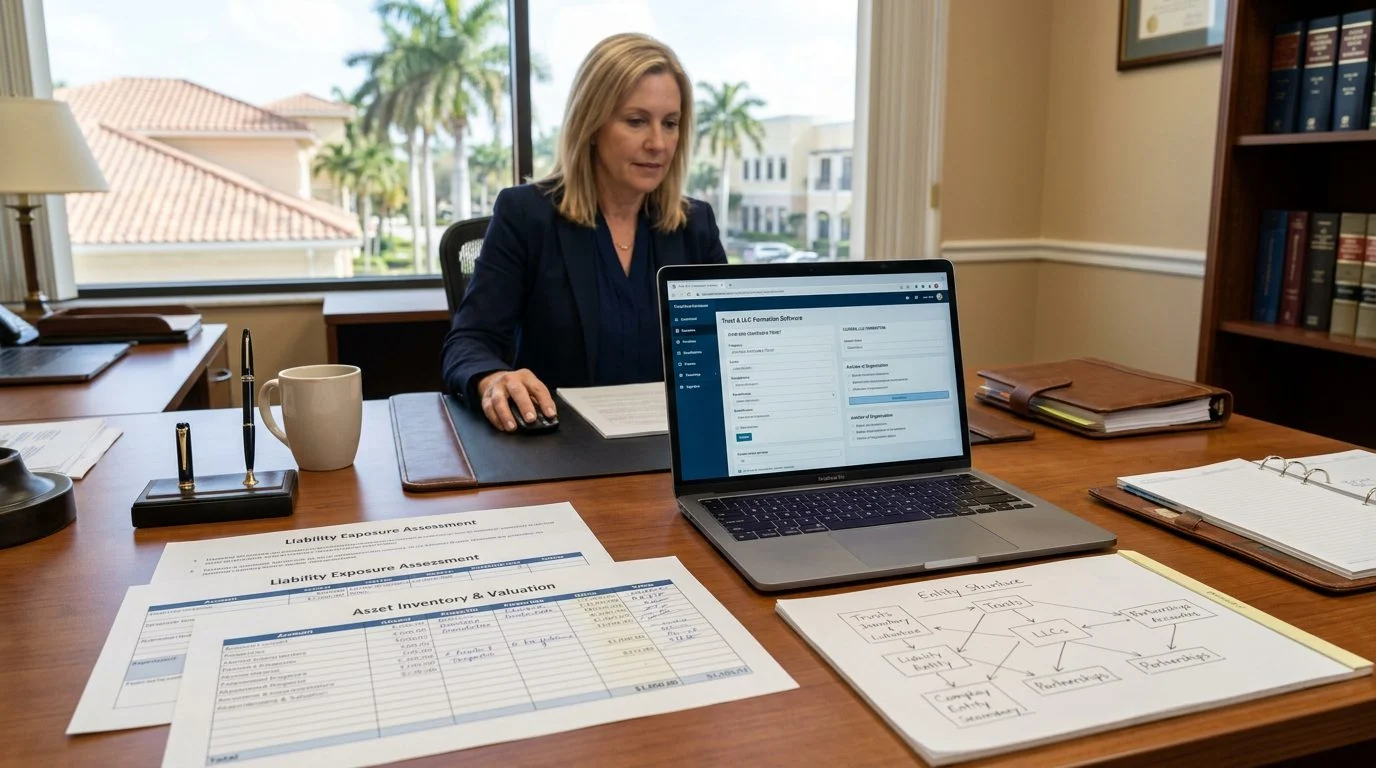
Start with an honest list. Note what you own, how each asset is titled, which entities you hold and what debts or claims you already face. That list is the starting point for any plan.
How Florida Law Protects Your Home and Personal Property
The Florida Constitution exempts a homestead from forced sale under process of any court. Inside a municipality, the exemption covers one-half acre of contiguous land and is limited to the residence of the owner or the owner’s family. Personal property to the value of one thousand dollars is also exempt under the same provision, except for the payment of taxes and assessments thereon, obligations contracted for the purchase, improvement or repair thereof, or obligations contracted for house, field or other labor performed on the realty.
The protection has exceptions. The constitution does not shield a home from taxes and assessments, from obligations for buying, improving or repairing the property, or from debts for labor performed on the land. The exemption also passes to the surviving spouse or heirs of the owner.
Whether your home is covered turns on how you own it and how you use it. A second home or rental property is not the owner’s residence, so the homestead exemption does not reach it. Property held outside your own name may also fall outside the exemption, because the exemption covers property owned by a natural person.
Does Florida Allow an Asset Protection Trust?
Yes, a Florida trust can protect some assets, but how far that protection reaches depends on how the trust is written, funded and timed.
A trust with a valid spendthrift provision can limit a beneficiary’s creditors. Fla. Stat. § 736.0502 says a valid provision must restrain both voluntary and involuntary transfers of the beneficiary’s interest. A creditor generally cannot reach that interest, or a distribution from the trustee, before the beneficiary receives it.
The protection has limits. Fla. Stat. § 736.0503 lists claims against which a spendthrift provision is unenforceable. These include a child, spouse or former spouse holding a support judgment or court order, and a judgment creditor who provided services protecting the beneficiary’s interest. For a support claimant or such a judgment creditor, a court may attach distributions only as a last resort, upon an initial showing that traditional methods of enforcing the claim are insufficient. State or federal claims are also covered where a law provides for them.
Trusts you create for yourself work differently. Fla. Stat. § 736.0505 says the property of a revocable trust is subject to the settlor’s creditors during the settlor’s lifetime, to the extent it would not be exempt if owned directly. For an irrevocable trust, a creditor of the settlor may reach the maximum amount that can be distributed to or for the settlor’s benefit, but the trust’s assets may not be reached solely because the trustee has a discretionary power to pay or reimburse the settlor for tax on trust income or principal; and if a trust has more than one settlor, a creditor of a particular settlor may not reach more than that settlor’s interest in the portion of the trust attributable to that settlor’s contribution.
Timing matters too. A trust funded to hide assets from a known claim can be challenged under the fraudulent transfer statutes. An IRS warning on abusive trusts cautions against asset protection trusts marketed to cut federal income or employment taxes.
How Can I Protect My Assets If Someone Sues Me?
The most important step is to avoid moving assets to get out of a creditor’s reach, because Florida law lets a creditor challenge those transfers in court.
Fla. Stat. § 726.105 makes a transfer fraudulent when the debtor made it with actual intent to hinder, delay or defraud any creditor. That rule applies whether the creditor’s claim arose before or after the transfer. Courts may weigh signs such as a transfer to an insider, the debtor keeping control of the property, and a lawsuit or threat filed before the transfer.
Transfers can be challenged under Fla. Stat. § 726.105 if made with actual intent to hinder, delay, or defraud any creditor of the debtor, or if made without reasonably equivalent value and the debtor was left with unreasonably small assets for the business or transaction, or intended to incur, or reasonably should have believed it would incur, debts beyond his or her ability to pay as they became due. Fla. Stat. § 726.106 covers a transfer made without reasonably equivalent value when the debtor was insolvent at that time or became insolvent because of it. That rule protects a creditor whose claim arose before the transfer.
A creditor whose claim arose before a transfer can challenge it under Fla. Stat. § 726.106 when the debtor made the transfer without receiving a reasonably equivalent value in exchange and was insolvent at that time or became insolvent as a result of it, and the court can then avoid the transfer to the extent needed to satisfy the claim under Fla. Stat. § 726.108. Fla. Stat. § 726.108 also allows, subject to applicable principles of equity and in accordance with applicable rules of civil procedure, an injunction against further transfers and the appointment of a receiver.
A common mistake is moving a home or account to a relative after a demand letter arrives. That move can look like the kind of transfer these statutes target. Review any planned transfer against these rules before you make it.
A review covers existing exposure, insurance coverage, entity ownership and the timing of any transfer.
Have questions about what happened?
Ask our team directly. The first conversation is free, confidential, and there is no obligation to continue.
What Type of Lawyer Handles Asset Protection?
An asset protection attorney needs to understand estate planning, trust law, creditor rights and business law together.
A plan that ignores one of these areas can miss a rule that applies. A homestead exemption, a spendthrift clause and an LLC charging order each follow a different statute. The rules also overlap, so they should be reviewed as one plan.
The firm focuses on asset protection, estate planning, trust administration, trust litigation, probate litigation, guardianship, business succession planning and estate tax planning.
The firm’s lawyers include Leslie V. Marenco and Tanya Vega. The firm advises and represents trustees, personal representatives and beneficiaries. Trust Counsel’s attorneys can serve individually as trustee or personal representative.
If another kind of counsel fits your issue better, the attorney will tell you on the free discovery call.
Protecting Business Interests and Succession for Boca Raton Owners
Business owners protect company interests mainly through entity ownership, buy-sell terms and written succession documents.
Florida’s LLC rules limit what a creditor can take. Fla. Stat. § 605.0503 says a charging order is generally the sole way a judgment creditor of a member can reach that member’s LLC interest. In a company with more than one member, foreclosure on that interest is not available. With a single member, a court may order foreclosure if distributions will not satisfy the judgment within a reasonable time.
Owners should not assume a company shields them automatically.
A succession plan sets out who runs the company and who receives ownership if an owner becomes ill, becomes disabled or dies. Written terms reduce guesswork when an owner’s health or life changes.
For families with business interests and ties outside the United States, estate tax planning and asset protection can be reviewed together. The right mix is shaped by each family’s own facts.
What a Free Discovery Call Covers
The firm offers a free discovery call that is confidential and carries no obligation to continue.
Bring a list of your assets, the entities you own, any existing trust or will, and any demand letter, lawsuit or threatened claim. Those documents let the attorney explain the available options and their limits.
Common Questions
Is my Boca Raton home protected from creditors?
Florida’s Constitution exempts a homestead from forced sale, within size limits and with exceptions for taxes and some other obligations.
Does Florida allow an asset protection trust?
Florida trusts can offer some protection, mainly through spendthrift terms. A trust you create for your own benefit offers limited protection from your own creditors.
Who is responsible for this page?
Leslie V. Marenco is the responsible lawyer, and Trust Counsel’s only office is in Coral Gables.

Talk With Trust Counsel About Your Boca Raton Assets
Trust Counsel can review how your Boca Raton assets are held on a free discovery call. If a creditor’s letter or a planned move of a home or account is in front of you, bring those facts before you act. Schedule online or call (305) 707-7126.
Want to know where you stand?
Tell us what happened and our team will walk you through the options available to you, at no cost.
Why Clients Work With Trust Counsel
Asset protection focus
Trust Counsel, PL focuses on asset protection planning for business owners and high-net-worth domestic and foreign families.
Planning tied to your estate
Asset protection is coordinated with estate tax planning, business succession planning and trust administration.
Attorneys who can serve individually
Trust Counsel's attorneys can serve individually as trustee or personal representative. The firm advises and represents trustees, personal representatives and beneficiaries.
Coral Gables office
Our only office is in Coral Gables. We serve clients in Boca Raton and throughout South Florida. Leslie V. Marenco is the responsible attorney for this page.
Plan before a dispute arises
Moving assets in response to a claim or dispute can draw scrutiny from courts and creditors. Talk with an attorney before making transfers.
Asset Protection Services
Asset protection planning
Review your assets, liabilities and goals to identify planning options that may help protect what you have built.
Trust-based strategies
Discuss how trust terms, including spendthrift provisions, may fit within your overall plan.
Business succession planning
Coordinate ownership transfers and continuity for your company with the protection of your personal assets in mind.
Estate tax planning
Align asset protection with estate tax planning for Florida residents and families with cross-border holdings.