
Asset Protection | We Serve Clients in Doral
Asset Protection in Florida: What Florida Law Allows
Florida law gives families and business owners real planning options, and it also limits what a transfer can accomplish. Here is how the rules work, where the risks sit, and how to plan with those limits in mind.
By Leslie V. Marenco · Published November 13, 2026
Doral Asset Protection Attorney: What Florida Law Allows
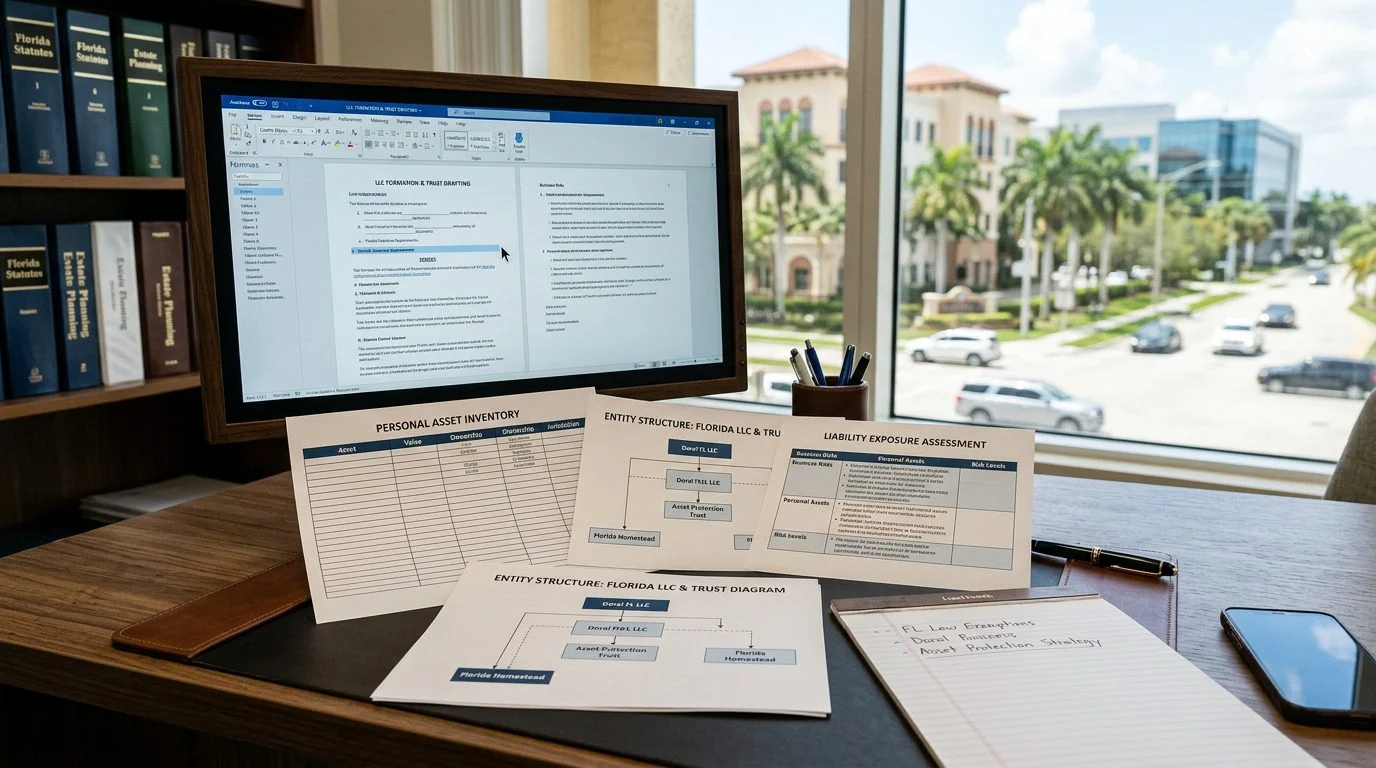
If you own a home, a rental property or a business in Doral, you may be asking whether those assets can stay safe from a future lawsuit. Asset protection planning organizes how property is owned and titled before a claim arises.

Not sure what your next step is?
Talk it through with our team — the first discovery call is free, confidential, and carries no obligation.
What Asset Protection Planning Does and Does Not Do
Asset protection planning is advance planning that sets how you hold property, title assets and write trust terms before a problem appears. It works forward, not backward. It cannot move assets out of reach of a creditor who already has a claim.
Florida law treats some transfers as fraudulent. Under Fla. Stat. § 726.105, a transfer is fraudulent as to a creditor if the debtor made it with actual intent to hinder, delay or defraud that creditor. The statute applies whether the creditor’s claim arose before or after the transfer.
A court may weigh several factors when deciding intent. Those include whether the transfer went to an insider, whether the debtor kept control of the property, and whether the debtor had been sued or threatened with suit before the transfer.
A transfer can also fail under Fla. Stat. § 726.106. Timing and intent are legal questions. Bring them to a lawyer before you move anything.
Why Doral Households and Business Owners Ask About Asset Protection
Asset protection planning may be worth reviewing when a family home, an investment property or a company interest sits in one name and a new risk appears. The question often comes up after a contract dispute or a business expansion.
Common ownership mixes include a primary residence, rental or investment real estate, a closely held company, and retirement or brokerage accounts held at several institutions. Each one is titled and transferred differently. Each needs its own review.
A homeowner who moves a house into a new name should understand the transfer rules first. A transfer that looks routine today can become a court issue if a claim follows. The questions usually center on who should own the property, who should receive it, and where a trust or company fits.
We serve clients in Doral.
Florida Tools Lawyers Review: Homestead, Spendthrift Provisions and Entities
Florida law offers several tools, and each one has limits set by the state constitution or by statute.
Homestead. The Florida Constitution exempts a homestead owned by a natural person from forced sale, except for taxes and assessments, obligations contracted for its purchase, improvement or repair, and obligations for house, field or other labor performed on the realty. The exemption is limited to the residence of the owner or the owner’s family. Inside a municipality, it covers one-half acre of contiguous land. See Fla. Const. art. X, § 4.
Spendthrift trusts. A spendthrift provision is valid only if it restrains both voluntary and involuntary transfers of a beneficiary’s interest. Under Fla. Stat. § 736.0502, a creditor generally cannot reach that interest or a trustee’s distribution before the beneficiary receives it. Exceptions exist, including certain support judgments under Fla. Stat. § 736.0503.
Revocable trusts. A revocable trust often gives less protection than people expect. Under Fla. Stat. § 736.0505, its property is subject to the settlor’s creditors during the settlor’s lifetime, to the extent it would not be exempt if owned directly.
LLCs. Under Fla. Stat. § 605.0304, a company’s debt is solely the company’s. A member is not personally liable for it only because he or she is a member. Under Fla. Stat. § 605.0503, a judgment creditor of a member may obtain a charging order. With more than one member, foreclosure on that member’s interest is not available.
Have questions about what happened?
Ask our team directly. The first conversation is free, confidential, and there is no obligation to continue.
Coordinating Asset Protection With Business Succession and Estate Tax Planning
Asset protection, business succession and estate tax planning often use the same trust and ownership documents. They should be reviewed together.
For owners of a closely held company, a buy-sell agreement, a change of ownership and the timing of a succession step all affect who controls the business and who holds its value. Each step should be checked against the others before it is signed.
Federal figures set the scale of estate and gift planning. IRC § 2010 sets the basic exclusion amount at $15,000,000, and that amount is inflation-adjusted for any decedent dying in a calendar year after 2026, per the IRC § 2010 text.
The IRS also warns about abusive asset protection trusts marketed to reduce federal income or employment taxes. It states that courts may disregard such trusts and order property sold to satisfy federal liabilities. See IRS guidance on abusive trusts.
Federal rules and Florida law apply together. A plan should be built with both in view.
How the Planning Process Typically Begins
The planning process usually starts with a written list of what you own and how each asset is titled.
Gather these items before a first meeting: a list of real estate and accounts, the names on each title or account, company operating agreements, any existing trusts or wills, and a note of any known claim, threatened suit or dispute. Rough notes are enough to start.
The first step is a free discovery call, which is confidential and carries no obligation to continue.
Trust Counsel’s attorneys can serve individually as trustee or personal representative. The firm advises and represents trustees, personal representatives and beneficiaries.
Can a creditor reach property I moved to my children?
A transfer made to hinder, delay or defraud a creditor can be challenged under Fla. Stat. § 726.105. The answer turns on whether the debtor acted with actual intent to hinder, delay, or defraud, or made the transfer without receiving a reasonably equivalent value in exchange while in certain financial circumstances, and the facts of the transfer matter in each case.
Does a revocable trust protect my assets from my creditors?
Under Fla. Stat. § 736.0505, revocable trust property can be reached by the settlor’s creditors to the extent it would not be exempt if owned directly.
Who Is Responsible for This Page at Trust Counsel, PL
Leslie V. Marenco is the responsible lawyer for this page. The firm’s lawyers include Leslie V. Marenco and Tanya Vega.
This page covers asset protection planning, estate planning, trust administration and related trust and probate matters within the firm’s practice. The firm’s only office is in Coral Gables, Florida. The firm also has support staff who handle scheduling and office work.

Talk Through Your Doral Situation on a Free Discovery Call
If you’re deciding how a home, a rental property or a company interest should be held before a transfer or succession step, a free discovery call is a direct next step. Bring what you already have, even if the list is incomplete. A rough inventory is a workable starting point.
Call (305) 707-7126 to book your free discovery call, or schedule online at a time that suits you.
Want to know where you stand?
Tell us what happened and our team will walk you through the options available to you, at no cost.
How Trust Counsel, PL approaches asset protection
Florida law, Florida focus
The firm focuses on Florida trust, estate and asset protection law for clients in Doral, Kendall and across South Florida. Our only office is in Coral Gables.
Planning before a dispute
Questions about moving property are easier to address before a creditor claim exists. We review your assets, debts and goals before recommending any step.
Business and family planning
Asset protection often overlaps with business succession and estate planning. The firm advises owners and families on how these pieces fit together.
Attorney-led advice
Each matter is handled by a Florida attorney who reviews the facts of your situation, the documents involved and the applicable statutes.
Important: do not move assets in response to a claim
Transfers made to hinder, delay or defraud a creditor can be challenged in court.
Related planning areas
Estate planning
Wills, revocable trusts and beneficiary planning that work together with your asset protection strategy.
Business succession planning
Planning for ownership transfers, family businesses and what happens to company interests over time.
Trust litigation
Representation for beneficiaries, heirs and trustees when a trust or transfer is disputed in court.