
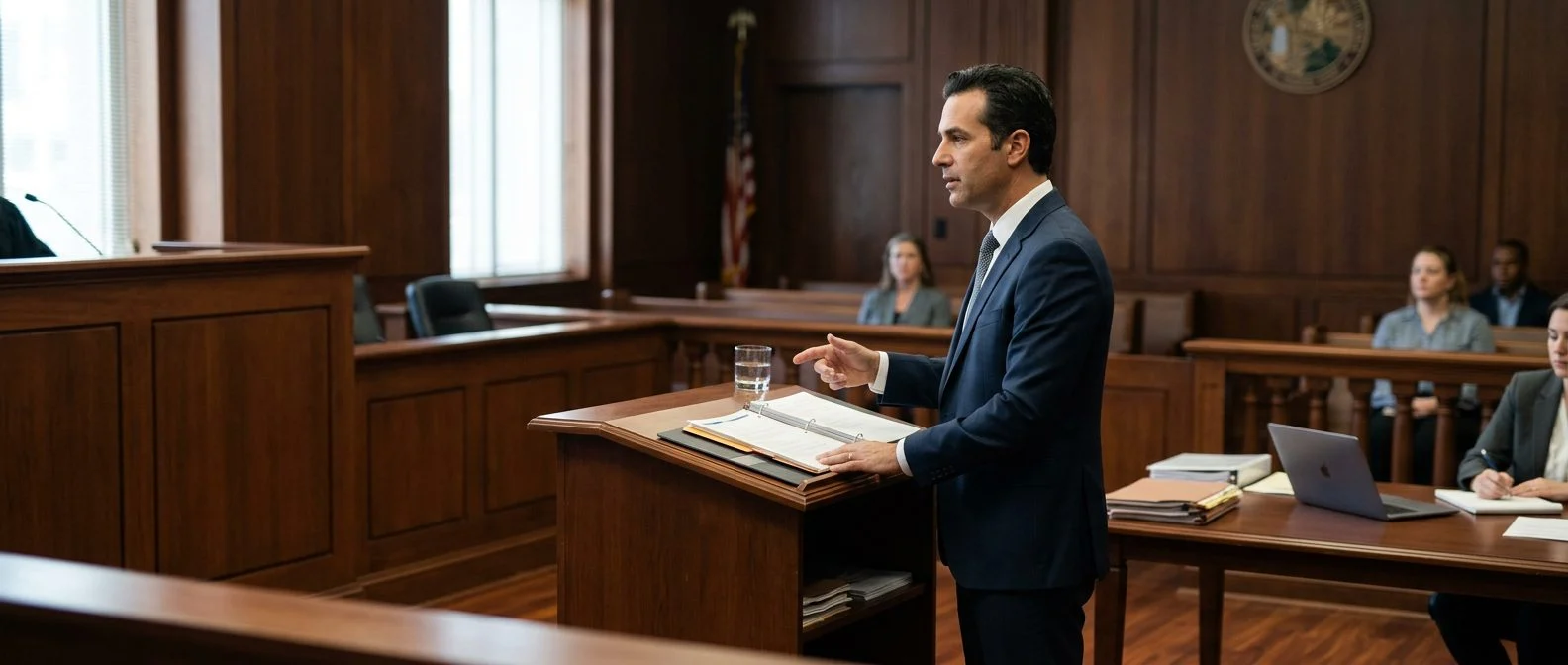
Probate and Trust Disputes | Coral Gables, Florida
Litigation Attorney vs. Trial Attorney: Which Role Does Your Florida Dispute Need?
Trust Counsel, PL focuses on probate and trust litigation for beneficiaries, heirs and fiduciaries. Here is how the two roles differ and what to ask before you choose.
By Leslie V. Marenco · Published November 1, 2026
The short answer: a litigation attorney manages the dispute, and a trial attorney presents it in court
A litigation attorney handles a dispute from the first filing until it ends. A trial attorney focuses on presenting that dispute to a judge or jury. The two titles describe the focus of the work. They are not a separate license or a ranking. One lawyer can do both.
The word “litigation” covers the whole fight. It includes the paperwork, the questions exchanged between the sides, the motions, the talks about settlement, and, if needed, the trial. The word “trial” points to one stage: the courtroom event where evidence is presented and a decision is made.
If you’re trying to understand a lawsuit about a will or trust, this difference matters. You may need someone who can handle every stage. You may also need someone who is ready to stand up in front of a judge. Many lawyers do both jobs.
If a will or trust is being challenged and you're not sure what comes next, you don't have to sort it out alone; call (305) 707-7126 or reach out through https://trustcounsel.com/contact/ to talk it through. Talk it through with Trust Counsel, PL — the first consultation is free, confidential, and carries no obligation.
What a litigation attorney does across the life of a dispute
A litigation attorney runs the dispute from start to finish. The work begins long before anyone talks about a courtroom.
Early on, the lawyer reviews the governing documents. For an estate, that means the will, any codicils, and the court file. For a trust, it means the trust instrument and its amendments. The lawyer gathers bank records, property records, and communications. Then the lawyer drafts the complaint or the response and identifies the claims and defenses.
Next comes discovery. This is the stage where each side learns what the other knows. In Florida probate cases, the Florida Rules of Civil Procedure on discovery apply. Fla. Prob. R. 5.080 makes depositions, written questions, requests for documents, and requests for admission available in probate and guardianship matters. The court can also limit discovery to conserve the estate’s assets.
Motion practice follows. A motion may ask the court to dismiss a claim or decide part of the case without a trial. Mediation is common too. A litigation attorney negotiates throughout. Many disputes settle before a trial date is set. That means much of the work happens before anyone enters a courtroom.
What a trial attorney does in the courtroom
A trial attorney’s work centers on the day the case is heard. The most visible part is the trial itself. The preparation behind it is just as demanding.
Before trial, the lawyer organizes exhibits and prepares witnesses. The lawyer decides which witnesses to call and what each one will say. If a jury is used, the lawyer helps select jurors and drafts jury instructions. If a judge decides the case alone, the lawyer may prepare proposed findings instead.
In the courtroom, the trial attorney gives an opening statement. The attorney questions witnesses on direct examination and then cross-examines the other side’s witnesses. The attorney makes objections when evidence breaks the rules. The trial ends with a closing argument that ties the evidence to the law.
These skills are most visible at trial. Still, trial work starts early. A case that reaches trial was usually shaped months earlier by careful discovery and clear preparation.
Is litigation the same as going to court?
Not exactly. Litigation includes court filings and hearings. It does not always mean a trial. Many disputes never reach a trial date.
Going to court can mean several different things. It can mean a hearing on one motion. It can mean a conference where the judge sets deadlines and a schedule. It can also mean a full trial. Each one asks different things of the lawyer and the client.
A case can be litigated in court without ever being tried. It can also be tried by a lawyer who sees the whole case as one continuous fight. For a reader, the key point is simple. A court filing is a sign that litigation has started. It is not a sign that a trial is coming.
Why probate and trust disputes call for a litigation attorney
Probate and trust disputes often begin in court before anyone knows how the case will end. A litigation attorney helps the reader understand which steps come first and which deadlines apply.
Common disputes in Florida include will contests, challenges to a trust amendment, claims against a personal representative (often called an executor) or trustee, and disputes over an accounting or a distribution. Each one follows its own procedure and its own clock.
Deadlines can be short. Fla. Stat. § 733.212 says an interested person served with a notice of administration must file an objection to the will’s validity, the venue, or the court’s jurisdiction within 3 months after service. The 3-month period may only be extended for estoppel based on a misstatement by the personal representative.
In a will contest, an interested person served with a notice of administration must file any objection that challenges the validity of the will within 3 months after the date of service of that notice (Fla. Stat. § 733.212). Fla. Stat. § 733.107 says the contestant then must prove the grounds for opposing probate. In a trust contest, Fla. Stat. § 736.0207 places the burden on the contestant to establish the grounds for invalidity.
Trust Counsel focuses on probate litigation and trust litigation. The firm advises and represents trustees, personal representatives, and beneficiaries. Trust Counsel’s attorneys can serve individually as trustee or personal representative. The firm itself does not serve as a fiduciary.
How the two roles overlap, and which one a dispute needs
Neither title ranks above the other. A litigation attorney’s role is broader. A trial attorney’s role is narrower but concentrated on the courtroom. The right fit depends on the facts of the dispute.
The facts that matter most include the claims, the documents, and whether a settlement is realistic. A matter that turns on a few clear documents may move quickly through motions. A matter with many disputed transactions may need long discovery and, later, a full trial.
Timing can also decide the matter. Under Fla. Stat. § 736.1008, a beneficiary who receives a trust disclosure document may be barred from suing over matters it adequately discloses. The bar applies unless a proceeding starts within 6 months after receipt of that document or a limitation notice, whichever is received later. A reader who waits to ask questions can lose time.
The first conversation with a lawyer often clarifies the stage. It also clarifies the next steps and the deadlines that may already be running.
Not sure what your next step is?
Talk it through with Trust Counsel, PL — the first consultation is free, confidential, and carries no obligation.
Talking through a contested estate or trust
If you’re worried about a will or trust dispute, you can talk it through before you decide anything. Many readers come to this question because a parent’s will was changed late in life. Others learn that a sibling controls a trust they did not expect. Some are the fiduciary, facing a demand they did not see coming.
Those situations can feel urgent and confusing. Each side in a probate or trust dispute usually has its own concerns and questions. A notice of administration served on you can start a clock: any objection challenging the validity of the will, the venue, or the jurisdiction of the court must be filed within 3 months after the date of service of a copy of the notice of administration on you. A short conversation can show which deadlines may apply to your facts.
This page is the responsibility of Leslie V. Marenco, one of the firm’s lawyers. Trust Counsel, PL is located in Coral Gables, Florida. You can call (305) 707-7126 or schedule online through Trust Counsel’s contact page. The first consultation is free, confidential, and without obligation to continue.

Frequently Asked Questions
What is the difference between a litigation attorney and a trial attorney?
A litigation attorney manages the entire dispute, from reviewing documents and taking depositions to motions, settlement talks, and trial if needed. A trial attorney focuses on presenting the case in court, including jury selection, witness questioning, and arguments to a judge or jury.
Does a litigation attorney always take a probate or trust dispute to trial?
No. Many probate and trust disputes are resolved through negotiation, mediation, or settlement before a trial date. A litigation attorney prepares the case so it can move forward toward trial if a fair resolution cannot be reached.
When might a beneficiary or heir need a probate or trust litigation attorney?
A beneficiary, heir, or fiduciary may need a probate or trust litigation attorney when a disagreement arises over a will, a trust, how assets are distributed, or how a trustee or personal representative is handling the estate. A lawyer can explain which court procedures apply to the specific dispute.
Can the same attorney handle both the litigation and the trial?
Often, yes. The attorney who manages the litigation may also present the case at trial, depending on the matter and the court’s rules. Reviewing how the case will be handled at each stage is a good question to ask at the start.
How the two roles differ
The litigation attorney runs the whole dispute
From reviewing trust and estate documents and taking depositions to filing motions, handling settlement discussions and preparing for trial if needed, the litigation attorney manages the case from start to finish.
The trial attorney focuses on the courtroom
A trial attorney concentrates on presenting the case before a judge or jury, including jury selection, questioning witnesses and making arguments at trial.
Many probate and trust disputes stay in one lawyer's hands
Beneficiaries, heirs and fiduciaries often need one lawyer who understands the file from the first document to the final hearing. Whether a separate trial lawyer is needed depends on the facts of your matter.
Ask who will handle each stage
Before you hire any lawyer for a probate or trust dispute, ask who will handle each stage of the case, how you will be kept informed, and whether a separate trial lawyer may be needed. If your matter may be referred to another lawyer or firm, we will tell you so before you proceed.
Questions to bring to your first consultation
Who manages the whole dispute?
Ask which lawyer will review your documents, handle filings and communicate with you from day one.
Who will present the case in court?
Ask whether the same attorney will appear at hearings and trial, or whether a separate trial lawyer is recommended.
How will decisions be made?
Ask how strategy, settlement options and costs will be discussed with you before any step is taken.
What does the first meeting cover?
Your first consultation is free, confidential and comes with no obligation to continue.
Discuss your Florida probate or trust dispute with Leslie V. Marenco. Call (305) 707-7126.
Related practice areas
- Probate Litigation Attorney
- Probate Litigation Attorney in Florida
- Probate Litigation Attorney in Fort Lauderdale