
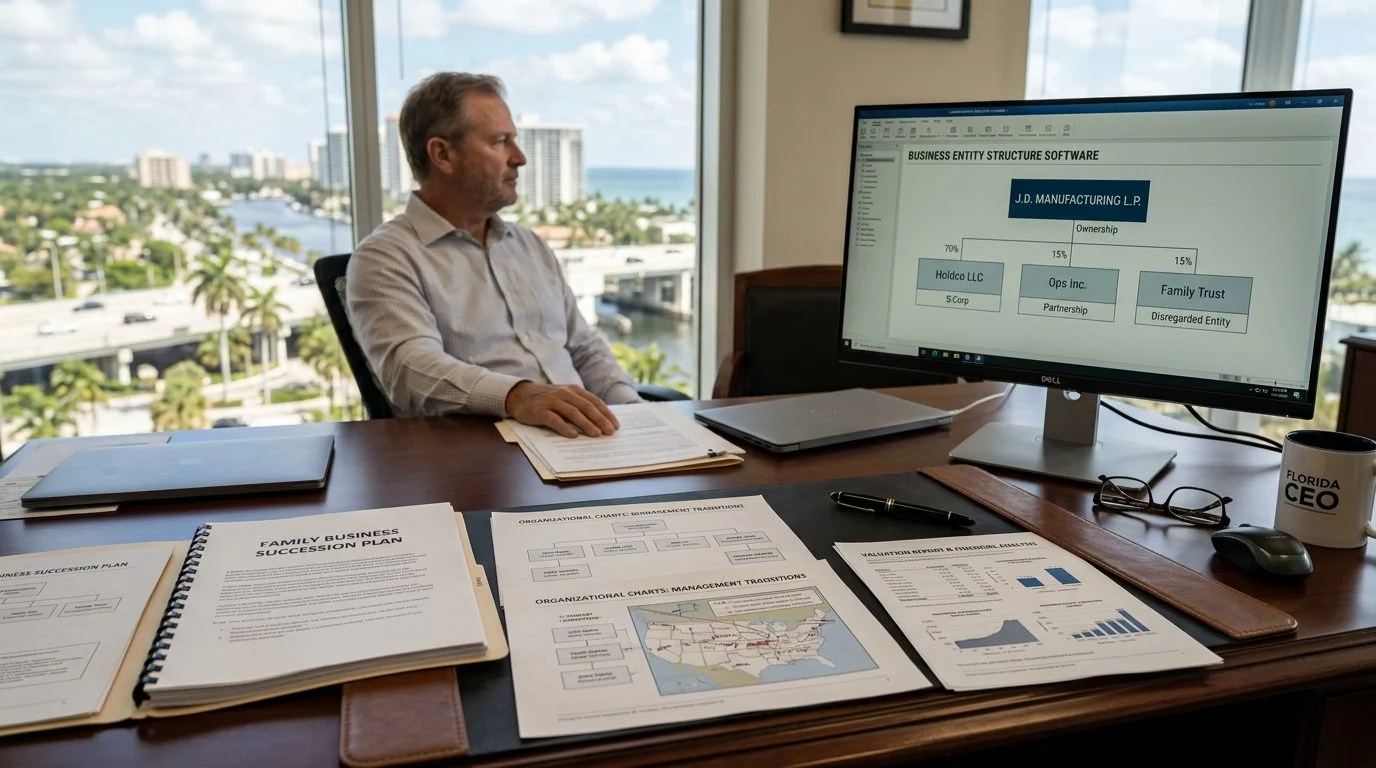
Business Succession and Estate Tax Planning | Coral Gables, Florida
Planning Taxes Before a Family Business Sale Starts
Trust Counsel, PL helps business owners and their families think through the tax, trust and succession questions that come before a sale.
By Leslie V. Marenco · Published November 24, 2026
A future sale can change a family business owner’s tax picture long before the closing date. Many owners only start asking about it once a buyer or heir is already interested.
Florida trusts and estates attorneys who handle estate tax, business succession and asset protection help family business owners plan taxes for a future sale. Trust Counsel, PL focuses on that work from its office in Coral Gables, Florida. This page explains what a sale does to the tax picture and what planning usually comes first.
How a future sale changes the tax picture for a family business
A future sale can raise income tax questions and estate tax questions at the same time. Each one depends on different facts, so each needs its own review.
Income tax turns on how the sale is structured. A sale of stock, a sale of assets and a gradual transfer of ownership each lead to different results. The owner’s basis in the business and each owner’s percentage also shape the questions. A business owner who sells during life may face a different income tax result than an heir who inherits the same interest.
Estate tax looks at what the owner still holds at death. Under federal valuation rules, the fair market value of a business interest is the net amount a willing buyer would pay a willing seller. The appraisal considers the business’s assets, including goodwill, and its earning capacity.
Timing matters. A sale before death, a sale after death and a gradual transfer each open different options. If the owner becomes incapacitated before a sale, some choices may close. Planning early, while the owner can still make decisions, keeps more options open.
Not sure what your next step is?
Talk it through with Trust Counsel, PL — the first discovery call is free, confidential, and carries no obligation.

Why a succession plan and an estate plan need to work together
A succession plan decides who runs the company, when, and how ownership changes hands. An estate plan decides how assets pass at death and who manages them. The two work best as one project.
The ACTEC guidance for business owners describes succession plans and buy-sell agreements as tools to designate successors, address ownership and asset distribution, and plan for continuity.
A plan that covers only one side leaves gaps. The estate plan might send shares to a child who has no role in the company. The succession plan might name a manager who has no authority over trust assets. Ownership, control and tax treatment can then point in different directions.
A common order is to settle governance and buy-sell terms first. That gives the family one set of rules before any buyer or heir asks questions. Governance papers, trust terms and buy-sell terms should all tell the same story.
Practice areas this planning draws on
Trust Counsel, PL focuses on trusts and estates law for business owners and for high-net-worth domestic and foreign families. Its work covers estate tax, asset protection and business succession.
Bring a short list of questions to a first call. Ask how the attorney coordinates with your accountants and valuation professionals. Ask how the attorney explains the tradeoffs of each option. Ask which lawyer will handle your file.
Before that call, gather your business records, ownership documents and a simple family list. Clear information helps the attorney spot planning questions early. Some owners also ask whether one firm can handle the estate side and the business side together. That question matters, because the two sides overlap in nearly every section of this page.
Structuring ownership before a sale: entities, trusts, and transfer timing
A family business interest is often held through an entity. A trust can hold that interest as part of the estate or succession plan.
Florida law lets a settlor change a trust. Under Fla. Stat. § 736.0602, unless the trust’s terms expressly say it is irrevocable, the settlor may revoke or amend it.
That flexibility has a tax cost at death. A revocable trust gives control during life. It does not take the business out of the taxable estate.
Gradual transfers to family members need their own planning. Under IRC § 2511, subject to the limitations contained in this chapter, the gift tax applies whether a transfer is in trust or otherwise, and whether the gift is direct or indirect; for a nonresident who is not a U.S. citizen, it applies only if the property is situated within the United States. The transfer method and current law both matter.
Asset protection and family business interests
Asset protection planning uses legal structures to separate business interests from personal exposure. It has to be set up in advance and within the law.
Timing is the main limit.
Under Fla. Stat. § 726.105, when determining actual intent to hinder, delay, or defraud a creditor, a court may consider whether the debtor had been sued or threatened with suit before the transfer. Ask early, before creditors or disputes appear.
Asset protection does not come with a promise of any result. No attorney can promise one. The outcome turns on the entity type, the timing and the owner’s circumstances.
Asset protection often works alongside estate tax and succession planning rather than as a separate step. The same entity and trust choices can serve several goals at once.
Planning for heirs, minors, and incapacity
A plan should cover what happens if the owner becomes incapacitated before a sale. Without it, decisions about the business can stall.
A durable power of attorney can keep authority in place. Fla. Stat. § 709.2104 reads: “Except as otherwise provided under this part, a power of attorney is durable if it contains the words: “This durable power of attorney is not terminated by subsequent incapacity of the principal except as provided in chapter 709, Florida Statutes,” or similar words that show the principal’s intent that the authority conferred is exercisable notwithstanding the principal’s subsequent incapacity.”
If no power of attorney exists, a court process may be needed. Under Fla. Stat. § 744.3201, a petition to determine incapacity may be executed by an adult person. The petition must be verified.
Guardianship can also reach a trust. Under Fla. Stat. § 736.0602, a guardian of the property may use the settlor’s powers to revoke, amend or distribute trust property only as section 744.441 provides.
Heirs who are minors need a plan too. Florida guardianship law governs who manages an inherited interest for a minor or an incapacitated heir. Name successors who will run the business during the transition, and match those choices to the trust and estate documents.
Not sure what your next step is?
Talk it through with Trust Counsel, PL — the first discovery call is free, confidential, and carries no obligation.
Trustees, personal representatives, and who can act
A trustee holds and manages trust property under the trust’s terms. A personal representative (often called an executor) administers an estate after death. Both can hold or transfer business interests.
Under Fla. Stat. § 733.302, any person who is sui juris and a Florida resident at the time of death is qualified to act as personal representative, subject to the limits in the probate code.
Trust Counsel’s attorneys can serve individually as trustee or as personal representative. Under Florida law, a person who is sui juris and a Florida resident at the time of the decedent’s death is qualified to serve as personal representative, subject to the limitations in the probate code, and certain nonresidents may also qualify. The firm advises and represents trustees, personal representatives and beneficiaries.
The firm advises and represents trustees, personal representatives and beneficiaries, and Trust Counsel’s attorneys can serve individually as trustee or as personal representative, subject to the qualification rules in the Florida Probate Code. The firm’s role is advice and representation. For a family business, that difference shapes who signs documents and who answers to the beneficiaries.
Disputes that arise during a family business transition
Disputes during a family business sale usually center on value, control, distributions and buyout terms. Each one can grow when the documents are unclear.
Valuation is often the first fight. Two heirs can hold very different views of the same business. Federal valuation rules look at what a willing buyer would pay, so an appraisal sits at the center of the discussion.
Some documents require arbitration. Under Fla. Stat. § 731.401, a will or trust provision requiring arbitration of disputes between beneficiaries and a fiduciary is enforceable. Disputes over the validity of all or part of the will or trust are excluded. Unless the document says otherwise, binding arbitration under chapter 682 is presumed.
Planning to reduce disputes is different from litigation after a dispute starts. Trust litigation attorney and probate litigation attorney work covers the second. Choices made before a sale often decide how easily disagreements get resolved.
Talk through your family business plan with Trust Counsel
Trust Counsel, PL can help you see how taxes and succession planning fit together before a sale. The firm’s office is in Coral Gables, Florida.
We serve clients in Fort Lauderdale, Boca Raton, West Palm Beach, Doral, Kendall, Pinecrest, Key Biscayne, Aventura and across Florida.
Leslie V. Marenco is the responsible lawyer for this page. The firm’s lawyers include Tanya Vega.
La llamada inicial es gratuita, confidencial y sin compromiso de continuar. In English: the first discovery call is free, confidential and carries no obligation to continue.
If you’re planning a future sale and want to know how the taxes and your succession plan fit together, call (305) 707-7126 or book online to set up a free discovery call. Bring your ownership documents and your questions.

Frequently asked questions
Can an estate pay estate tax in installments?
Yes, in some cases. Under IRC § 6166, the personal representative (called the executor in the statute) may elect to pay in two or more, but not more than 10, equal installments. This applies when the decedent was a U.S. citizen or resident at death and a closely held business interest exceeds 35 percent of the adjusted gross estate.
Can a trust hold a family business interest?
Yes. A trust can hold business interests as part of an estate or succession plan. A revocable trust can be changed during the owner’s life unless its terms say otherwise.
What if the owner becomes incapacitated before a sale?
A durable power of attorney may keep authority in place. Without one, a court petition may be needed.
How Trust Counsel, PL Approaches a Family Business Sale
Business Succession Planning
Trust Counsel focuses on business succession planning, reviewing how ownership will pass, who will manage the company and how the transition will be documented.
Estate Tax Planning
The firm concentrates on estate tax planning for owners of closely held businesses, looking at how a sale fits within the family's broader estate.
Trust and Estate Administration
Trust Counsel's attorneys can serve individually as trustee or personal representative, and the firm advises and represents trustees, personal representatives and beneficiaries.
Asset Protection
The firm also reviews asset protection structures that may matter to a family and its business interests during a transition.
Plan Early
Tax questions are easier to address before a buyer's offer is accepted and terms are set. Early review gives the family more room to choose its approach.
Where the Firm Can Help
Estate Tax Planning
Review of how a business interest affects the size and timing of the family's estate.
Business Succession
Planning for ownership transfer, management continuity and family roles in the business.
Trust Administration
Guidance for trustees, personal representatives and beneficiaries as a trust or estate is administered.
Probate and Trust Litigation
Representation of beneficiaries, heirs and fiduciaries when disputes arise over an estate or trust.