
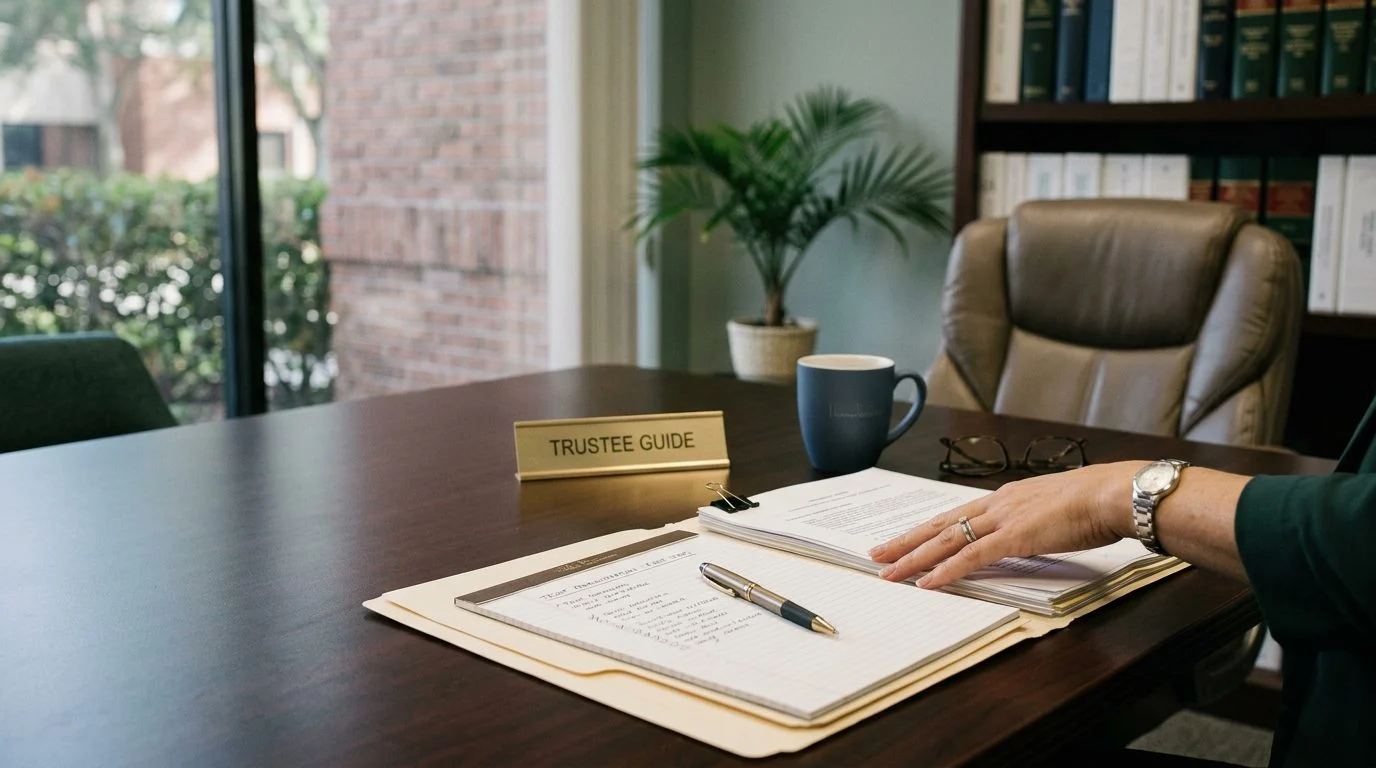
Trust Administration | Coral Gables, Florida
Successor Trustee First Steps in Florida
Named as successor trustee? Learn what to gather, who to notify and what to avoid in the first weeks. Trust Counsel, PL is based in Coral Gables and focuses on trust administration and trust litigation.
By Leslie V. Marenco · Published November 1, 2026
What is the first thing a successor trustee should do? Read the full trust document before you sign anything, move money, or tell anyone what the trust says. The trust’s terms decide who serves, what authority they have, and what comes next. It’s written for adult children, relatives, and friends who were just named successor trustee after a death or incapacity.
The short answer: read the trust document before you act
The first thing a successor trustee should do is read the complete trust document. Focus on the successor trustee clause, the trustee’s powers, and any instructions about distributions or notice. The trust’s terms control who serves and what they must do next. Start with the signed trust and every amendment. If you don’t have the original, ask the person who kept it or the attorney who prepared it. Hold off on moving or distributing anything until you’ve read the whole document. Write down the date of the death or incapacity and the date you first learned of the trust. Those dates matter for deadlines later. A common mistake is relying on a family member’s memory of what the trust says. Memory often misses an amendment or a condition that changes the answer.
If you were just named successor trustee and don't know where to begin, you don't have to sort out the trust alone. Trust Counsel can talk it through with you. Talk it through with Trust Counsel, PL — the first consultation is free, confidential, and carries no obligation.

Confirm the death or incapacity and gather your records
Start by confirming the event that opens the role, then collect the records banks will ask for. Florida treats a trustee’s death, resignation, removal, or adjudicated incapacity as a vacancy. A vacancy must be filled if the trust has no remaining trustee, but it need not be filled while a cotrustee stays in office (Fla. Stat. § 736.0704). Order several certified copies of the death certificate. Banks, title companies, and other institutions often ask for one. Find out whether the trust became irrevocable at the settlor’s death and whether a cotrustee is named. Then build a working file. Include the trust and amendments, any will, recent account and property statements, and a list of beneficiaries with current contact details. A complete file makes every later step faster.
Decide whether to accept the role before you act
A successor trustee can accept or decline, and that choice should be deliberate. You accept a trusteeship by substantially complying with any method of acceptance the trust sets out, and if that method is not expressly made exclusive, you can also accept by taking delivery of trust property, exercising powers, performing duties, or otherwise indicating acceptance. If the trust sets no method, or sets one that is not expressly made exclusive, you accept by taking delivery of trust property, exercising powers, performing duties, or otherwise showing that you accept (Fla. Stat. § 736.0701). That means acting can count as accepting. A designated trustee who doesn’t accept within a reasonable time after learning of the role is treated as having declined. If you need to protect property first, the statute allows limited action, but you must send a qualified beneficiary a written statement declining the role within a reasonable time after acting. If the role must be filled, the trust’s named successor comes first. For a noncharitable trust, if the role must be filled, the trust’s named successor comes first, then a person chosen by unanimous agreement of the qualified beneficiaries, and then a person the court appoints (Fla. Stat. § 736.0704). For a charitable trust, the unanimous agreement is of the charitable organizations expressly designated to receive distributions.
Notify the qualified beneficiaries within 60 days
Florida’s trust code sets a 60-day notice deadline for trustees in defined situations. Within 60 days after accepting the trust, the trustee must notify qualified beneficiaries of the acceptance, the trustee’s full name and address, and that the fiduciary lawyer-client privilege applies (Fla. Stat. § 736.0813). For an irrevocable trust, the 60-day clock starts when the trustee learns the trust exists or has become irrevocable. The statute excludes certain older trusts from these notice deadlines, so the trust’s history matters. Section 90.5021 makes communications between a lawyer and a client acting as a fiduciary privileged, to the same extent as if the client were not acting as a fiduciary. The privilege does not limit a trustee’s duty to give a qualified beneficiary a complete copy of the trust instrument upon reasonable request, under Fla. Stat. § 736.0813(1)(c). Keep a dated copy of every notice you send. Beneficiaries who learn of a trust late often have many questions. A clear written notice answers them faster.
Secure and identify the trust property
Secure the trust property first, then make a complete list of it. A trustee must take reasonable steps to control and protect trust property (Fla. Stat. § 736.0809). Start with an inventory. List bank and brokerage accounts, real estate, business interests, vehicles, digital assets, and personal property the trust owns. Check how each asset is titled. Property still in the decedent’s name may need to be addressed through the trust. Keep trust property separate from your own money. Florida law also requires clear, accurate records of the administration (Fla. Stat. § 736.0810). Common early mistakes include depositing trust checks into a personal account, letting insurance lapse on a home, and paying personal bills from trust funds. Questions about whether a successor trustee can access an account in the trust’s name are worth raising with a lawyer before you try.
What a successor trustee owes beneficiaries after the first steps
A trustee must administer the trust in good faith, in line with its terms and the beneficiaries’ interests (Fla. Stat. § 736.0801). The trustee must also act solely in the beneficiaries’ interests (Fla. Stat. § 736.0802). If the trust doesn’t set pay, a trustee is entitled to reasonable compensation under the circumstances (Fla. Stat. § 736.0708). The financial risk is real. A trustee who commits a breach of trust is liable for the greater of the amount needed to restore the trust, or the profit the trustee made from the breach (Fla. Stat. § 736.1002). Write down each major decision and the reason for it.
Common questions
Can a successor trustee refuse to serve in Florida? Yes. A designated trustee may decline, and a designated trustee who does not accept within a reasonable time is treated as having declined (Fla. Stat. § 736.0701).
Is a successor trustee paid in Florida? If the trust doesn’t set compensation, the trustee is entitled to reasonable compensation under the circumstances (Fla. Stat. § 736.0708).
Not sure what your next step is?
Talk it through with Trust Counsel, PL — the first consultation is free, confidential, and carries no obligation.
When a dispute can arise during trust administration
A dispute often starts when a beneficiary questions how the trustee handled money or property. Common triggers include a disagreement over an accounting, questions about the trust’s terms, or a long delay in distributions. A successor trustee has some statutory protection against a prior trustee’s actions, but only in listed circumstances. Under Fla. Stat. § 736.08125, a successor trustee is not personally liable for certain prior-trustee actions. One listed circumstance involves an eligible beneficiary who does not send a written request within 6 months after the successor trustee accepts. That applies only if the successor trustee gave written notice of acceptance warning of that deadline. The statute does not affect the prior trustee’s own liability, but under s. 736.10085 a successor trustee’s claim against a prior trustee is barred to the same extent it would be barred if brought by the beneficiary whose interests the successor trustee represents. Read that protection as narrow and fact-specific. Avoid major distributions while questions remain open.
Talk with Trust Counsel about your next steps
If you were just named successor trustee, you may be grieving and making decisions you never expected to make. You don’t need to work through the trust alone. Trust Counsel, PL is a trusts and estates law firm with its only office in Coral Gables, Florida. Leslie V. Marenco is the responsible lawyer for this page. Trust Counsel’s attorneys can serve individually as trustee or personal representative. The firm advises and represents trustees, personal representatives and beneficiaries. Your first consultation is free, confidential, and comes with no obligation to continue. To talk through your trust document and next steps, call (305) 707-7126 or schedule online.
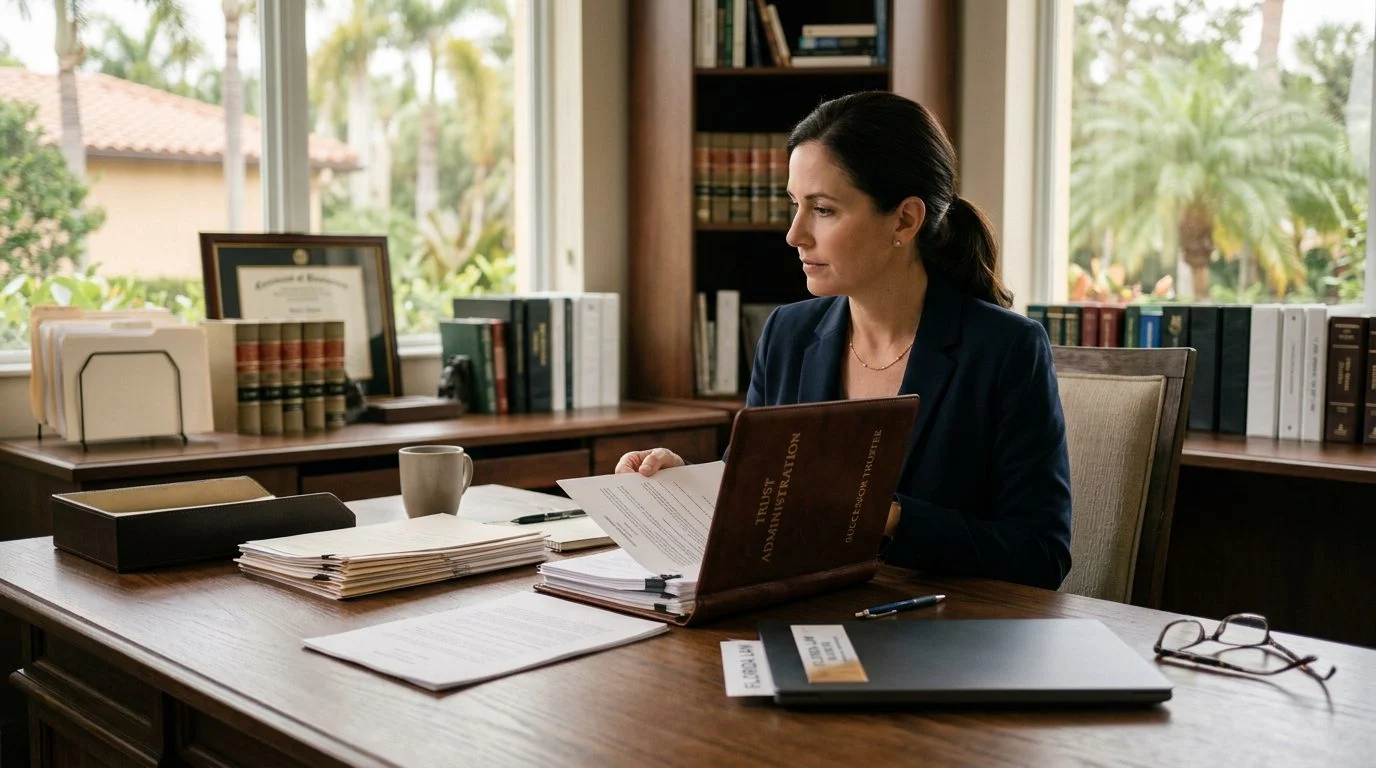
Frequently Asked Questions
What is the first thing a successor trustee should do?
Read the trust document carefully to confirm you are the named successor trustee and to see what it requires before you act. Then gather certified copies of the death certificate and the trust, because banks and other institutions usually ask for both.
Do I have to notify the beneficiaries of the trust?
Yes.
Should a successor trustee protect the trust’s assets right away?
Yes.
When should a successor trustee talk to an attorney?
A successor trustee may want legal guidance early, especially if the trust language is unclear, a beneficiary disputes the trust, or the trustee is unsure of their duties. The firm advises and represents trustees, personal representatives and beneficiaries, and offers a free first consultation that is confidential and has no obligation to continue. Call (305) 707-7126 or schedule online to book one.
Your First Steps, in Order
1. Read the trust document
Confirm that you are the named successor trustee and see what the trust requires before you act. The document controls many of the steps that follow.
2. Gather certified records
Banks and other institutions usually ask for a certified death certificate and a copy of the trust. Collect these early so routine requests are not delayed.
3. Secure and inventory trust assets
List bank accounts, real estate, investments, business interests and personal property held by the trust. Protect assets while you work out the full picture.
4. Get legal guidance on your duties
A successor trustee has duties to the beneficiaries. Talk with an attorney before you make distributions, sell property or respond to a beneficiary demand.
How Trust Counsel Can Help
Trust administration guidance
We help successor trustees work through document review, asset inventory, notices and accounting from start to finish.
Protection for trustees and beneficiaries
The firm advises and represents trustees, personal representatives and beneficiaries when questions or disputes arise.
Attorneys who can serve individually
Trust Counsel's attorneys can serve individually as trustee or personal representative. The firm itself does not serve as a fiduciary.
Coral Gables office
Our office is in Coral Gables, and we serve clients in Fort Lauderdale, Boca Raton and West Palm Beach.
Pause Before You Distribute
Do not distribute trust property or sign off on final accounts until you have reviewed the trust document and received legal advice on your duties. Early mistakes are often harder to correct later.