
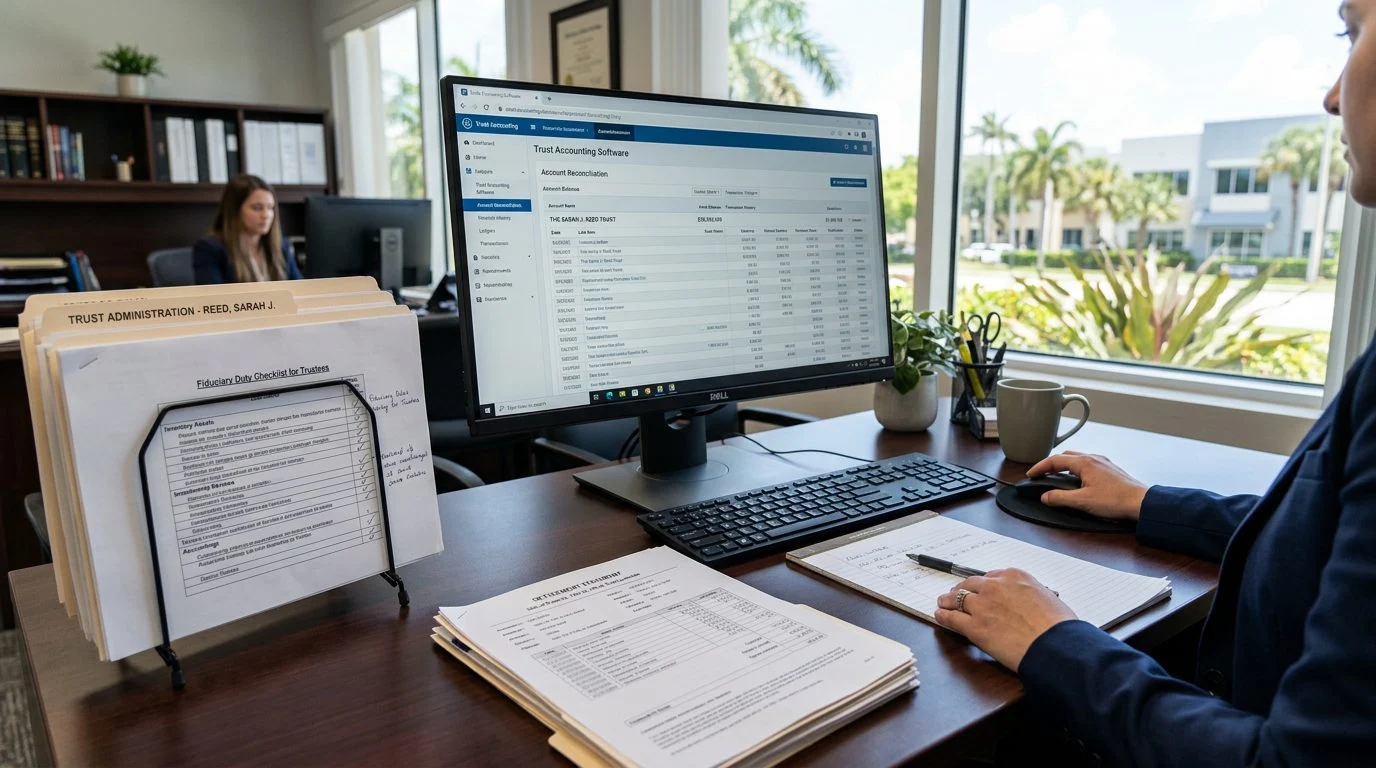
Trustee Surcharge Lawsuit Florida: Recovering Trust Losses
By Leslie V. Marenco · Published November 17, 2026
A trustee surcharge lawsuit asks a Florida court to order a trustee to pay money back to a trust. The claim applies when a trustee breaks a duty owed to a beneficiary and the trust loses value. This guide explains what you must show, how losses are measured, which records matter, and how the case moves forward. Trust Counsel, PL is a Coral Gables firm that focuses on trust litigation.
What a trustee surcharge lawsuit is and who it is for
A trustee surcharge lawsuit is a claim that a trustee must repay the trust for losses caused by a breach of trust. Florida law defines the breach in plain terms. A trustee’s violation of a duty owed to a beneficiary is a breach of trust (Fla. Stat. § 736.1001).
The court has several tools to fix a breach. It can compel the trustee to redress the breach by paying money or restoring property. It can also order an accounting, suspend or remove the trustee, or reduce the trustee’s pay. The money-repayment order is the core of a surcharge.
Current and former beneficiaries usually bring these claims. In some matters, co-trustees or successor fiduciaries bring them too. A surcharge differs from a request for an accounting or removal. Those requests can be filed alongside a surcharge claim or on their own.
Not sure what your next step is?
Talk it through with our team — the first discovery call is free, confidential, and carries no obligation.
What a beneficiary must show to bring the claim
The trust instrument and the Florida Trust Code set the duties.
- Duty. A trustee must act solely in the beneficiaries’ interests (Fla. Stat. § 736.0802). A trustee must also manage the trust as a prudent person would (Fla. Stat. § 736.0804).
- Breach. This is a specific act or failure to act. Examples include self-dealing, imprudent investing, improper distributions, or failing to protect trust property.
- Causation. The breach must connect to the loss. Records should show that link.
- Loss. The beneficiary must identify a measurable amount the trust lost because of the breach.
The trust instrument matters a lot. A trustee who reasonably relies on its terms is not liable for a breach to the extent that reliance caused it (Fla. Stat. § 736.1009).
How losses are measured in a surcharge claim
The basic measure is what it takes to restore the trust to where it would have been without the breach. A trustee who commits a breach of trust is liable for the greater of the amount required to restore the trust property and trust distributions to what they would have been without the breach, including lost income, capital gain, or appreciation that would have resulted from proper administration, or the profit the trustee made by reason of the breach.
The first figure restores the value of trust property and distributions. It includes lost income, capital gain, or appreciation that proper administration would have produced. The second figure is the profit the trustee made because of the breach. The court uses whichever amount is greater.
Common loss categories include:
- Lost principal or property value
- Lost income or growth
- Distributions that were too small or too large
- Improper fees or expenses paid from the trust
- Costs to correct the problem
Financial comparisons often matter. A benchmark might show what a prudently managed portfolio or property would have produced. These calculations depend on the facts and usually rely on financial evidence. Among persons liable for the same breach of trust, a court bases each person’s pro rata share of contribution on relative degrees of fault (Fla. Stat. § 736.1002).
Records and accountings needed to prove the claim
Start with the trust instrument, every amendment, and the trustee’s periodic accountings. These documents show what the trust should do and what the trustee reported.
A trust accounting must show all cash and property transactions in the period. It must include compensation paid to the trustee and the trustee’s agents. Where feasible, it identifies the trust assets on hand and, for each asset reasonably capable of valuation, shows its acquisition or carrying value and estimated current value (Fla. Stat. § 736.08135). Compare that report to bank, brokerage and custodial statements.
Other records to gather:
- Distribution and disbursement records
- Appraisals, leases and closing statements for real estate or business interests
- Tax returns filed for the trust
- Invoices for trustee and professional fees paid from trust assets
- Letters and emails with the trustee
A trustee must keep clear, distinct and accurate records. The trustee must also keep trust property separate from their own (Fla. Stat. § 736.0810). A qualified beneficiary can request, and on reasonable request the trustee must provide, a complete copy of the trust instrument and relevant information about assets and administration (Fla. Stat. § 736.0813).
Send a written request for a full accounting and the records. Keep proof of the date you received each report, because that date can matter for deadlines.
Have questions about what happened?
Ask our team directly. The first conversation is free, confidential, and there is no obligation to continue.
Defenses, timing limits and co-trustee issues
Timing is often the biggest issue in these cases. A trust disclosure document can start a short clock. For a matter that was adequately disclosed, a claim must be started within 6 months after the beneficiary receives the disclosure document or a limitation notice that applies to it, whichever is received later (Fla. Stat. § 736.1008).
Matters not adequately disclosed follow a different rule. If the trustee has not issued a final accounting or the required notice, chapter 95 governs the claim. The claim accrues when the beneficiary has actual knowledge of the facts, shown by clear and convincing evidence, or upon the trustee’s repudiation of the trust or adverse possession of trust assets (Fla. Stat. § 736.1008).
Trustees often raise these defenses:
- Exculpation terms. A trust term relieving a trustee of liability is unenforceable to the extent it covers a breach committed in bad faith or with reckless indifference to the purposes of the trust or the interests of the beneficiaries, and it is also unenforceable if it was inserted into the trust instrument as the result of an abuse by the trustee of a fiduciary or confidential relationship with the settlor (Fla. Stat. § 736.1011).
- Consent, release or ratification. A beneficiary’s consent can bar a claim, unless the consent was induced by improper trustee conduct or the beneficiary did not know their rights or the material facts (Fla. Stat. § 736.1012).
Co-trustees have their own duties. Each cotrustee must use reasonable care to prevent a co-trustee’s breach and to compel redress of one, subject to the directed-trustee rules (Fla. Stat. § 736.0703).
How a trustee surcharge case proceeds, step by step
A surcharge case usually moves from document review to a written demand. If the issue is not resolved, it moves to court. Each step builds on the records.
- Free discovery call. Bring the trust documents and reports you have. The free discovery call is confidential, with no obligation to continue.
- Document review and loss analysis. The attorneys identify the alleged breach, the affected assets, and a working estimate of the loss.
- Written demand. The demand asks the trustee for records, an accounting, and correction where appropriate.
- Court petition. If the matter is not resolved, a petition can be filed in the appropriate Florida circuit court. It can seek a surcharge and related relief, such as an accounting or removal.
- Discovery and resolution. Discovery may include depositions and subpoenas for financial institutions. The case may then move to mediation, settlement talks, or trial.
How long a case takes depends on how complex the trust is and on the court’s schedule. No timeline or result can be promised.
Why Trust Counsel, PL for trustee surcharge matters
Trust Counsel, PL is a Coral Gables, Florida trusts and estates law firm. Its only office is in Coral Gables. We serve clients in Fort Lauderdale, Boca Raton, West Palm Beach, Doral, Kendall, Pinecrest, Key Biscayne and Aventura.
The firm advises and represents trustees, personal representatives and beneficiaries. Trust Counsel’s attorneys can serve individually as trustee or personal representative. The firm itself does not serve as a fiduciary.
Leslie V. Marenco is the responsible lawyer for this page. Tanya Vega is also a lawyer at the firm. The firm’s practice areas include trust litigation, probate litigation, and trust administration. The firm advises and represents trustees, personal representatives (often called executors) and beneficiaries, and Trust Counsel’s attorneys can serve individually as trustee or personal representative.
Some matters may be referred to another lawyer or firm. If that happens, we will tell you.
Want to know where you stand?
Tell us what happened and our team will walk you through the options available to you, at no cost.
Common questions about trustee surcharge claims in Florida
Here are short answers to common questions about these claims.
Can a beneficiary sue a trustee if the trustee acted in good faith?
Bad faith affects contribution: under Fla. Stat. § 736.1002, a person who committed the breach of trust in bad faith is not entitled to contribution from other liable persons. Whether it helps depends on the trust terms and the facts.
Does a surcharge claim remove the trustee?
No. A removal request is separate. Florida law lets a court remove a trustee.
Does a trust accounting start the deadline?
It can. For a disclosed matter, the 6-month period starts on the later of receiving the disclosure document or a limitation notice (Fla. Stat. § 736.1008).
How do I begin?
Gather the trust document and any accountings you have before your free discovery call.
If a trustee’s decisions have cut into a trust you are named in, you may have a claim worth reviewing. Call (305) 707-7126 or schedule online to start with the papers you already have.
Ready to take the next step?
Related practice areas
- Trust Litigation Attorney
- Trust Construction Lawsuit in Florida
- How Far Back Can a Will Be Contested in Florida?