
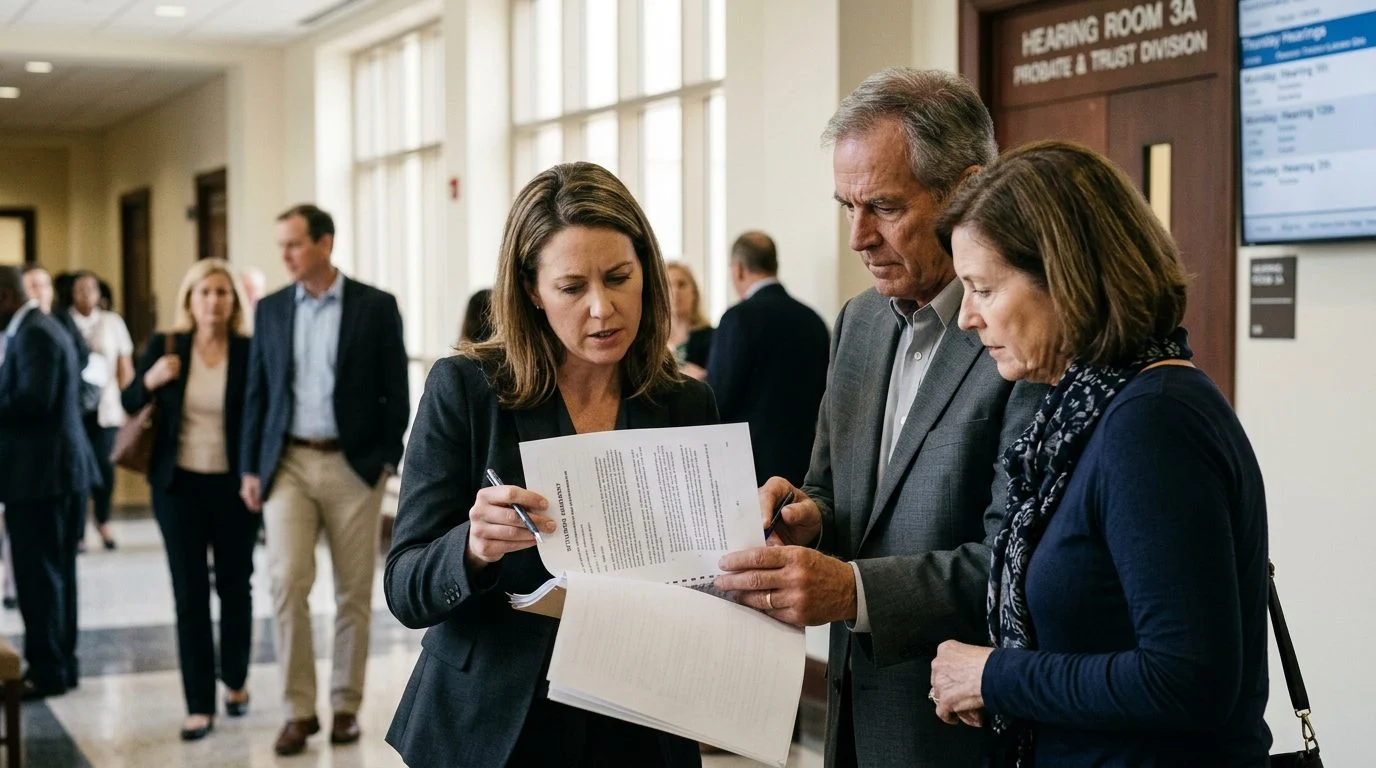
Trust Litigation | Coral Gables, Florida
Have Questions About a Joint Trust After a Spouse's Death?
Trust Counsel, PL focuses on trust and probate litigation in Florida, including disputes over joint trusts. Leslie V. Marenco is the responsible attorney for this page. Our only office is in Coral Gables. Your free first consultation is confidential and comes with no obligation to continue.
By Leslie V. Marenco · Published November 5, 2026
A joint revocable trust doesn’t always settle everything at the first death. In Florida, a person who wants to contest a joint trust after a spouse dies must show a legal ground and act within the time limits the statute sets. This guide explains what changes at the first death, which challenges Florida law recognizes, and how the timing works.
What Happens to a Joint Revocable Trust When the First Spouse Dies?
At the first death, the trust document decides how the trust divides, who manages the assets, and who must receive notice. Married couples often sign one joint trust that holds property from both spouses. The terms may split the trust into a share for the survivor and a share for the deceased spouse. Your starting point is always the signed document.
Florida law adds a notice rule. Fla. Stat. § 736.0813 requires a trustee who learns that a formerly revocable trust has become irrevocable, whether by the settlor’s death or otherwise, to notify the qualified beneficiaries within 60 days after the trustee acquires that knowledge, stating the trust’s existence, the identity of the settlor or settlors, the right to request a copy of the trust instrument, the right to accountings, and that the fiduciary lawyer-client privilege applies to the trustee and any attorney the trustee employs. That notice covers the trust’s existence, the settlor’s identity, the right to request a copy, and the right to accountings.
Amendment rules also depend on the property involved. Under Fla. Stat. § 736.0602, community property in a joint trust can be amended only by both spouses acting together. If you are an adult child who just learned of a trust that seems changed, get the document and any amendments in writing first.
If a parent's joint trust changed in ways you didn't expect, you don't have to sort it out alone; our team can talk through your questions by phone or online. Talk it through with Trust Counsel, PL — the first consultation is free, confidential, and carries no obligation.

Why Is a Joint Trust Challenged in Florida?
A joint trust or an amendment can be challenged for lack of capacity, undue influence, fraud, duress, or mistake. Each ground has its own proof needs, so the facts decide which issues matter.
- Capacity: The capacity needed to create, amend, or revoke a revocable trust is the same as the capacity needed to make a will (Fla. Stat. § 736.0601).
- Fraud, duress, mistake, or undue influence: A trust or part of a trust procured this way is void. The rest stays valid if it isn’t invalid for other reasons (Fla. Stat. § 736.0406).
- Improper amendment: A revocable trust may generally be amended by substantially complying with a method the trust sets out. If the trust sets no method, a later will or codicil that expressly refers to the trust, or another method showing clear and convincing evidence of the settlor’s intent, may be used.
A change made shortly before death, or one that favors a single child, can raise questions. Questions are not proof of wrongdoing. The person challenging the trust carries the burden. Under Fla. Stat. § 736.0207, the contestant must establish the grounds for invalidity.
How Long Do You Have to Contest a Trust in Florida?
Fla. Stat. § 736.0604 bars an action to contest the validity of a trust that was revocable at the settlor’s death unless it is commenced within the earlier of the time provided in chapter 95 or six months after the trustee sent the person a copy of the trust instrument and a notice of the trust’s existence, the trustee’s name and address, and the time allowed for commencing a proceeding. The first is the time provided in chapter 95. The second is six months after the trustee sends you a copy of the trust and a required notice.
That means a trustee’s notice can start a short six-month clock. Don’t assume you have unlimited time. Separately, a beneficiary’s breach-of-trust claim about matters adequately disclosed in a trust disclosure document must be filed within 6 months of receiving that document or a limitation notice, whichever is later (Fla. Stat. § 736.1008). Fla. Stat. § 736.1008 reads: “(2) Unless sooner barred by adjudication, consent, or limitations, a beneficiary is barred from bringing an action against a trustee for breach of trust with respect to a matter that was adequately disclosed in a trust disclosure document unless a proceeding to assert the claim is commenced within 6 months after receipt from the trustee or a trust director of the trust disclosure document or a limitation notice that applies to that disclosure document, whichever is received later.”
Gather the trust, all amendments, trustee notices, and any accountings you have. Bring them to a consultation soon.
How Do You Contest a Joint Trust After a Spouse Dies in Florida?
A contest usually moves through five steps: request records, review the documents, file in court, handle the case while it’s pending, and then negotiate or litigate.
- Request the records. On reasonable request, the trustee must give a qualified beneficiary a complete copy of the trust instrument (Fla. Stat. § 736.0813).
- Review the documents. Compare the trust terms, amendments, and signing details.
- File in court. A contest of a revocable trust can’t start until the trust becomes irrevocable by its terms or by the settlor’s death (Fla. Stat. § 736.0207).
- Handle the case while it’s pending. The trustee may continue administering the trust, but no distribution may go against the rights of people affected by the outcome. A court can allow exceptions for good cause (Fla. Stat. § 736.08165).
- Negotiate or litigate. Discovery exchanges documents and testimony. Mediation is a process that may resolve a dispute faster than litigation. Florida’s ADR handbook notes that mediation confidentiality rules may apply.
The stages have no fixed length. The facts and the court’s calendar decide how long each step takes.
Can a Contest Also Address Trust Language or Assets Moved Before Death?
Some joint trust disputes ask what the trust language means, while others involve assets moved before death. Interpretation disputes ask how the survivor’s share and the deceased spouse’s share should be divided. Asset disputes ask whether property was wrongfully taken.
Under Fla. Stat. § 736.1001, a trustee’s violation of a duty owed to a beneficiary is a breach of trust. The court can order the trustee to restore money or property. Subject to s. 736.1016, which protects certain people who dealt with the trustee in good faith, it can also trace wrongly disposed property and recover it or its proceeds. These claims can be raised alongside a validity challenge. The right mix depends on your goals.
What Can a Court Do If a Trust Is Challenged?
To remedy a breach of trust that has occurred or may occur, a court can void an act of the trustee (subject to s. 736.1016), order an accounting, reduce or deny a trustee’s compensation, or remove a trustee as provided in s. 736.0706, among other relief. Florida law lists these remedies in Fla. Stat. § 736.1001. The settlor, a cotrustee, or a beneficiary may ask the court to remove a trustee. A serious breach of trust is one ground (Fla. Stat. § 736.0706).
The firm cannot predict how a particular matter will turn out, and no result is promised. Some contests end in a negotiated settlement. You decide whether to accept any settlement offered.
Not sure what your next step is?
Talk it through with Trust Counsel, PL — the first consultation is free, confidential, and carries no obligation.
How Does Trust Counsel, PL Approach These Matters?
Trust Counsel, PL focuses on trust litigation, probate litigation, and trust administration from its only office in Coral Gables, Florida. We serve clients in Florida, including Fort Lauderdale, Boca Raton, and West Palm Beach.
Leslie V. Marenco is the responsible lawyer for this page. Tanya Vega is also a lawyer at the firm.
The firm does not serve as trustee or personal representative. The firm advises and represents trustees, personal representatives and beneficiaries. Trust Counsel’s attorneys can serve individually as trustee or personal representative. If a matter may be referred to another lawyer or firm, the firm will say so. Support staff, including assistants and office staff, help with office work.
Frequently Asked Questions About Contesting a Joint Trust in Florida
Can a child of the first spouse contest a joint trust in Florida?
Whether a child can contest depends on the trust terms and on whether the child has a legal interest in the trust. A consultation can review that question with the documents.
Does the surviving spouse’s amendment automatically stand?
No. An amendment can be reviewed for capacity, undue influence, fraud, duress, and whether it followed the trust’s amendment method.
Do I need the original trust document to start?
Not always. On reasonable request, a trustee must provide a complete copy of the trust instrument to a qualified beneficiary.
Will a contest always go to court?
No. Some matters resolve through negotiation or mediation. No outcome is promised in any matter.
Is the first consultation free?
The first consultation is free, confidential, and carries no obligation to continue.
Talk With a Coral Gables Trust Litigation Team About Your Joint Trust
Reading a trust written by someone else, often during a hard season, is difficult. You may be trying to understand changes you did not expect while handling a parent’s or spouse’s affairs. Bring the trust, any amendments, and any trustee notices you received to a first conversation. Call (305) 707-7126 or schedule online.
What a first consultation can cover
Review of the trust documents
We can look at the joint trust, any amendments, and related estate records to understand how the trust is written and what changed after the first spouse died.
Your role in the trust
We can discuss whether you are a beneficiary, heir or fiduciary, and what that position means for the questions you may raise.
Questions about the surviving spouse's actions
We can talk through concerns about amendments, transfers, or how the trust is being administered after the death.
Options explained in plain language
We explain the possible paths, including litigation, negotiation, or no action, so you can decide what fits your situation.
Gather your records before you call
Collect the trust agreement, every amendment you can find, the deceased spouse's will and any correspondence about the trust. Bring a list of dates and the names of the people involved. Missing documents do not stop a consultation, but they help us review your question more quickly.
Matters we handle in Florida
Trust litigation
Disputes among beneficiaries, heirs, trustees and surviving spouses over the terms, validity or administration of a trust.
Probate litigation
Contests and other disputes that arise while an estate is open before the probate court.
Trust administration
Guidance for trustees and personal representatives on carrying out their duties and responding to beneficiary concerns.
Estate and succession planning
Planning for estate tax, asset protection and business succession for Florida and international families.