
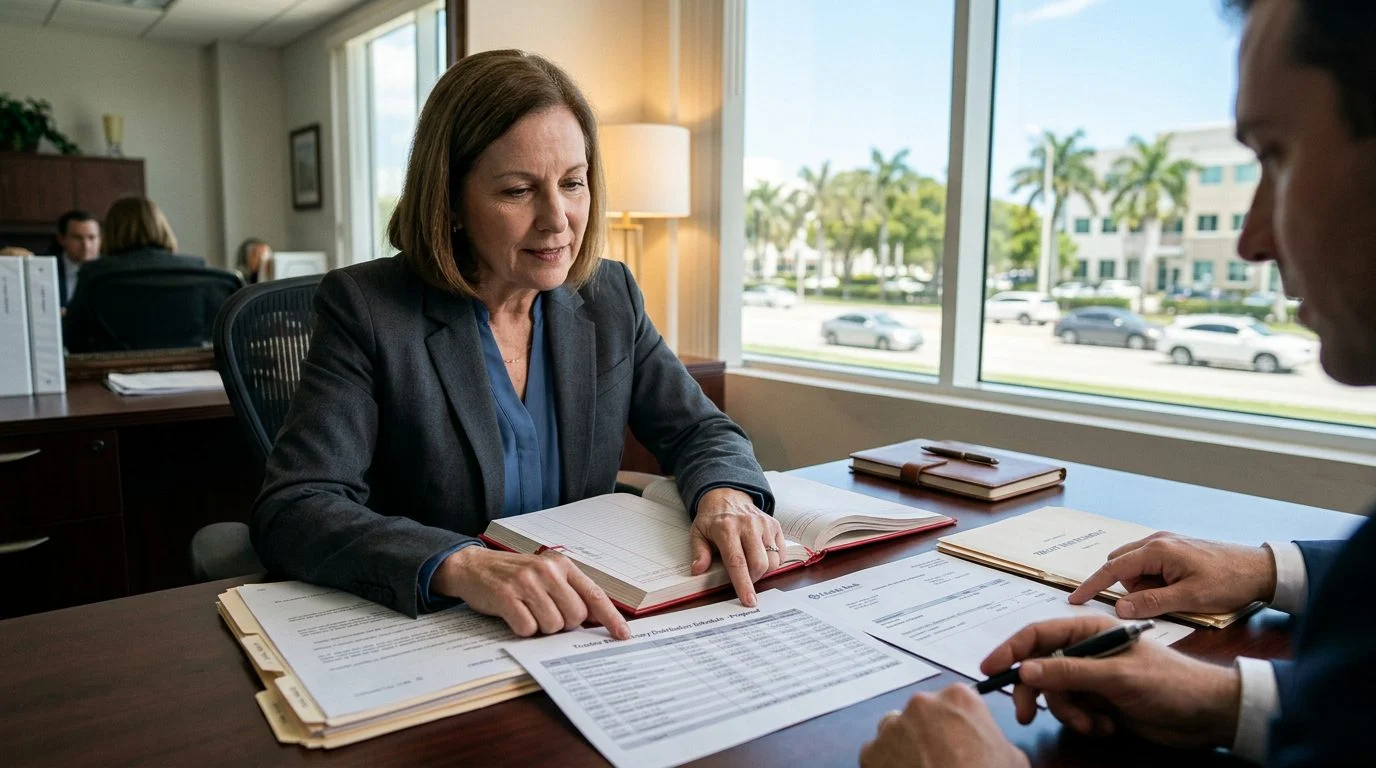
Trust Administration Attorney in Doral
Serving as a trustee in Doral? Know your first steps before you act.
Trust administration involves document review, asset control, careful recordkeeping and clear communication. Here is how a trustee can approach each stage with counsel.
By Leslie V. Marenco · Published November 13, 2026
You may have just been named successor trustee of a family trust. Or a letter may have arrived saying the trust is now being administered. Either way, you need to know what happens next.
Trust administration is the work of gathering trust assets, paying valid debts and taxes, keeping records, and distributing property as the trust directs. Florida’s Trust Code sets the duties along the way. Here is how a trust administration attorney approaches each step for families in Doral.
What does a trust administration attorney do for Doral families?
A trust administration attorney advises the trustee and beneficiaries on how to meet their legal duties. Trust Counsel’s attorneys can serve individually as trustee or personal representative, and the firm advises and represents trustees, personal representatives and beneficiaries. The firm itself does not serve as a fiduciary. The duties stay with the individual trustee, and the lawyer advises that person at each step.
Leslie V. Marenco is the responsible lawyer for this page. Tanya Vega is also a lawyer at the firm. The firm’s only office is in Coral Gables, Florida. We serve clients in Doral and in other Miami-Dade communities.
If you were just named successor trustee of a Doral family trust, you don't have to take the first steps alone. Book a free discovery call with Trust Counsel. Talk it through with Trust Counsel, PL — the first discovery call is free, confidential, and carries no obligation.

When does a Doral trust move into administration?
A trust moves into administration when a life event or the trust’s own terms start the trustee’s work. Often the trigger is the death of the person who created the trust, called the settlor.
A successor trustee is the person the trust names to take over. Florida law looks at how that person accepts the role. A designated trustee accepts by substantially complying with the method in the trust or, if the trust does not provide a method or does not make its method exclusive, by accepting delivery of trust property, exercising powers or performing duties as trustee, or otherwise indicating acceptance (Fla. Stat. § 736.0701). A designated trustee who doesn’t accept within a reasonable time is treated as having declined. A person can also act to preserve trust property without accepting, if they then send a qualified beneficiary a written statement declining the role.
Before any money moves, gather the core papers. That means the signed trust and any amendments, a pour-over will if one exists, deeds, account statements and beneficiary designations. Distributing too early can cause problems, so confirm the trust terms, the beneficiaries and any pending claims first.
What are a Florida trustee’s main duties?
A trustee must administer the trust in good faith, in line with its terms and the interests of the beneficiaries (Fla. Stat. § 736.0801). The standard is that of a prudent person. The trustee must consider the trust’s purposes and terms, and must exercise reasonable care, skill and caution (Fla. Stat. § 736.0804).
Loyalty is another core duty. As between the trustee and the beneficiaries, the trustee must run the trust solely in the beneficiaries’ interests (Fla. Stat. § 736.0802). A conflict between the trustee’s own interests and the trust’s is serious, so get advice before acting.
Records matter just as much. The trustee must also keep trust property separate from the trustee’s own property (Fla. Stat. § 736.0810). If a former trustee or another person holds trust property, the trustee must take reasonable steps to get it back (Fla. Stat. § 736.0812).
How do trust administration and probate differ for Doral families?
Trust administration follows the trust document. Probate is the court process for property that was never moved into the trust. ACTEC’s guide to probate explains that probate disputes can require court involvement.
Assets left in the decedent’s name may still need a probate estate. Many Doral families use both a trust and a pour-over will, and the two processes can run at the same time.
The probate code calls the fiduciary appointed by the court to administer an estate the personal representative (often called an executor). It treats that person as an interested person in estate proceedings (Fla. Stat. § 731.201).
Florida limits who can take that role. Under Florida’s general rule, any sui juris person who was a Florida resident at the time of the death of the person whose estate is to be administered can qualify, subject to the limitations in this part (Fla. Stat. § 733.302).
How do foreign, out-of-state and family-business assets change the work?
Foreign, out-of-state and family-business assets add steps, but the trustee’s core duties stay the same. A bank account or property abroad may need help from local counsel in that country. Out-of-state real estate may need its own transfer or filing in that state.
Family companies and LLC interests need a close read. The trust terms and the company’s operating agreement should be read together, since each can control who has authority and how an interest passes. That overlap is where business succession planning and trust administration meet.
For each asset, the trustee should record how it entered the trust and who has authority over it. Good records support the accounting the trustee must later give, which must be a reasonably understandable report. Tax questions depend on each family’s facts, so review them with the trust’s accountant and lawyer before filing.
What disputes come up during trust administration?
Disputes often start with an accounting, a trustee’s decision, or questions about the trust itself. Upon reasonable request, a trustee must provide a qualified beneficiary with a complete copy of the trust instrument (Fla. Stat. § 736.0813).
Trust contests have their own rules. In a contest over a trust’s validity, the person challenging it must establish the grounds for invalidity (Fla. Stat. § 736.0207). A contest over a revocable trust generally can’t start until the trust becomes irrevocable by its terms or the settlor dies. If all of a revocable trust has been revoked, a contest over the revocation can’t start until after the settlor dies. This does not prohibit such action by the guardian of the property of an incapacitated settlor (Fla. Stat. § 736.0207).
A trust litigation attorney represents a trustee, beneficiary or fiduciary when a matter reaches the court. Trust Counsel handles probate litigation and trust litigation matters. Not every trust dispute ends in court. Clear written requests and a dated timeline can help a question get resolved before it grows.
Not sure what your next step is?
Talk it through with Trust Counsel, PL — the first discovery call is free, confidential, and carries no obligation.
What should a Doral trustee do in the first months?
In the first months, a trustee should confirm the trust is in effect, secure the assets and give the required notices. Start by confirming who the trustee is and what the trust says.
Within 60 days after accepting the trust, the trustee must notify the qualified beneficiaries. The notice must give the trustee’s full name and address (Fla. Stat. § 736.0813). For an irrevocable trust created on or after the effective date of this code, notice is due within 60 days after the trustee learns the trust exists or has become irrevocable, and it must give the identity of the settlor or settlors, the right to request a copy of the trust instrument, the right to accountings, and that the fiduciary lawyer-client privilege applies (Fla. Stat. § 736.0813).
A trustee must keep trust property separate from the trustee’s own property. Begin an inventory of trust property. Gather the decedent’s final tax filings and the trust’s returns, and review them with the trust’s accountant and lawyer. Pause distributions until the terms and claims are confirmed.
Keep records from day one. Under Fla. Stat. § 736.08135, a trust accounting must be a reasonably understandable report. It must open with a statement identifying the trust, the trustee furnishing the accounting and the time period covered by the accounting. It must also show all cash and property transactions and all significant transactions affecting administration during the accounting period, including compensation paid to the trustee and the trustee’s agents.
How does Trust Counsel help clients in Doral?
The firm’s only office is in Coral Gables, and it serves clients in Doral. Its practice covers trust administration, trust litigation, probate litigation, estate planning, estate tax planning, business succession planning, asset protection, guardianship, and professional trustee services.
Florida law lets a trustee employ attorneys to advise on the trust’s powers. The trustee may pay reasonable compensation and costs for that work from trust assets (Fla. Stat. § 736.0802).
The free discovery call gives you a first conversation about your trust document, your role and your questions. Each trust is different, so that conversation starts with your facts.

Should you talk with a trust administration attorney now?
Yes, if you hold a trust document and face the first decisions after a death or incapacity, an early conversation makes sense. If you were just named successor trustee of a Doral family trust, you don’t have to work out the first steps alone. Book a free discovery call, call (305) 707-7126, or schedule online. The firm’s free discovery call is confidential and carries no obligation to continue.
Can a law firm serve as personal representative in Florida?
Trust Counsel’s attorneys can serve individually as personal representative, while the firm advises and represents personal representatives and beneficiaries.
What is a trust accounting?
A trust accounting is a reasonably understandable report. A trust accounting must be a reasonably understandable report, running from the date of the last accounting or, if there is none, from the date the trustee became accountable, that adequately discloses the information the statute requires (Fla. Stat. § 736.08135).
How Trust Counsel supports trustees and beneficiaries
Trust administration guidance
The firm focuses on trust administration, including review of the trust instrument, asset identification and the duties a trustee carries through each stage.
Attorneys who can serve individually
Trust Counsel's attorneys can serve individually as trustee or personal representative. The firm advises and represents trustees, personal representatives and beneficiaries.
Clients in Doral
Our only office is in Coral Gables. We serve clients in Doral and throughout Miami-Dade County.
Clear communication
We explain options in plain language so trustees and beneficiaries understand the next step before any decision is made.
Get advice before you distribute
Distributing trust assets or signing documents before you have reviewed the trust terms and your duties can create problems that are hard to undo. Ask questions first.
Common trustee steps in Doral
1. Review the trust document
Read the trust terms, identify the trustee's powers and note any instructions about distributions, successor trustees or beneficiary communication.
2. Secure and identify assets
Gather account statements, real estate records and business interests so the trust property is clearly identified and protected while administration continues.
3. Keep records and account
Maintain organized records of receipts, payments and transactions, and prepare the accounting that the trust and its beneficiaries need to see.
4. Pay obligations and distribute
Address debts, expenses and taxes, then make distributions in line with the trust terms and applicable Florida law, with counsel reviewing each step.