
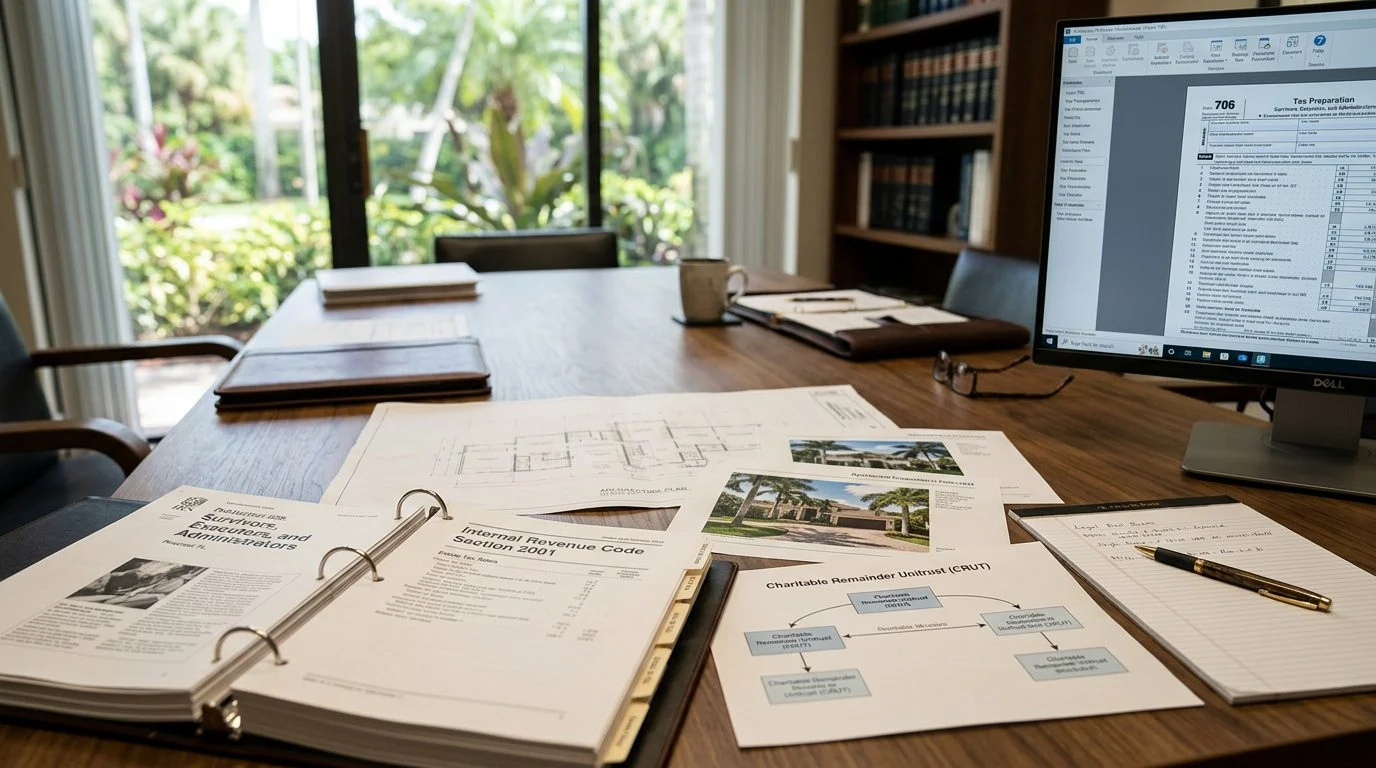
Estate Tax Planning | Pinecrest, FL
Estate Tax Planning for Pinecrest Families and Business Owners
Trust Counsel, PL focuses on estate tax planning, trusts and business succession for families and business owners in Pinecrest. Our office is in Coral Gables. Start with a free first consultation: it is confidential and carries no obligation to continue.
By Leslie V. Marenco · Published October 19, 2026
An estate tax planning attorney helps families plan how property passes at death and how federal estate tax may apply. For Pinecrest families, that question often involves a home, investment accounts, and a family business. This guide explains what an estate tax planning attorney in Pinecrest, FL considers, and how Trust Counsel approaches each point. The firm focuses on estate tax planning and trusts and estates matters. Its only office is in Coral Gables, and we serve clients in Pinecrest.
Estate Tax Planning for Pinecrest Families
Estate tax planning for Pinecrest families starts with a clear list of what you own. Pinecrest is a Miami-Dade village, and many households hold more than one kind of asset. A primary home, brokerage accounts, a family or closely held business, and property in another state or country can each pass differently at death. Many families assume a will covers everything. A will may not control a home held in trust or an account with a named beneficiary.
Leslie V. Marenco is the responsible attorney for this page. Trust Counsel focuses on estate tax planning, and the firm’s only office is in Coral Gables. We serve clients in Pinecrest.
Here is the fiduciary rule in plain terms. Trust Counsel’s attorneys can serve individually as trustee or personal representative. The firm advises and represents trustees, personal representatives and beneficiaries. For the broader guide, read estate tax planning in Florida.
Not sure what your next step is?
Talk it through with Trust Counsel, PL — the first consultation is free, confidential, and carries no obligation.

Is an Estate Attorney the Same as a Tax Attorney?
No, the two roles overlap but are not the same. An estate attorney focuses on who receives property, through which documents, and who manages it. Estate tax planning focuses on how those transfers interact with federal estate tax rules.
Many family plans need both views. A drafting plan that ignores tax effects can surprise heirs. A tax review that ignores family goals can miss what the family actually wants. The practical test is simple: who signs the documents, and who will carry them out later? Coordinating both keeps the documents and the tax analysis consistent.
For a fuller comparison, see estate lawyer versus estate planner.
How Federal Estate Tax and Florida Law Interact
Federal estate tax uses a basic exclusion amount of $15,000,000, which is increased for inflation only for decedents dying in a calendar year after 2026. According to IRS guidance, federal law amends § 2010(c)(3) to set the basic exclusion amount at $15,000,000, and that amount is increased for inflation for decedents dying in calendar years after 2026.
Owning property in a revocable trust doesn’t remove it from the taxable estate by itself. Under IRC § 2038, property is included in the gross estate to the extent of the decedent’s interest in a transfer (except a bona fide sale for an adequate and full consideration in money or money’s worth) where enjoyment was subject at death to a change through a power the decedent held alone or with another person to alter, amend, revoke, or terminate, or where such a power was relinquished during the 3 years before death.
Spouses face one more rule. Under IRC § 2010, a surviving spouse can use a deceased spouse’s unused exclusion only if the personal representative (often called an executor) files a timely estate tax return and makes an irrevocable election on it.
How these rules apply to your family depends on the facts. The firm reviews those facts in a consultation.
How to Keep a House Out of Probate in Florida
A revocable trust is one common tool for keeping a home out of probate. The deed or title must match the plan, or the trust may not hold the house. Under Fla. Stat. § 736.0602, the settlor may revoke or amend a revocable trust unless its terms say it is irrevocable, but this rule does not apply to a trust created under an instrument executed before the code’s effective date.
Homestead rules add another layer. Under Fla. Stat. § 732.401, if the homestead is not devised as authorized by law and the constitution and the decedent is survived by a spouse and one or more descendants, the surviving spouse takes a life estate, with a vested remainder to the decedent’s descendants in being at the time of the decedent’s death, per stirpes. Under Fla. Stat. § 732.401(2), the surviving spouse, or with court approval the spouse’s attorney in fact or guardian of the property, may take an undivided one-half interest in the homestead as a tenant in common in place of a life estate. The election is due within 6 months after the decedent’s death and during the surviving spouse’s lifetime, except that a timely petition by an attorney in fact or guardian extends the time as paragraph (c) of that subsection provides. Once the election is made, it cannot be undone. The section does not apply to property held as tenants by the entireties or in joint tenancy with rights of survivorship.
Under Fla. Stat. § 732.4015, a homestead is not subject to devise if the owner is survived by a spouse or a minor child, except that it may be devised to the owner’s spouse if there is no minor child. It may pass to the spouse if there is no minor child. Under Fla. Stat. § 732.401, a homestead that is not devised as authorized by law and the constitution descends in the same manner as other intestate property, but if the decedent is survived by a spouse and one or more descendants, the surviving spouse takes a life estate instead.
Business Succession and Asset Protection for Pinecrest Owners
Business succession planning decides who will own and run a business interest after an owner’s incapacity or death. Operating agreements and buy-sell terms usually sit alongside the estate plan, so they should be reviewed together. Many owners wait for a health issue before writing these documents. Planning earlier gives the family more time to make careful choices.
Federal law also sets a payment option for closely held business interests. Under IRC § 6166, when the decedent was a U.S. citizen or resident at death and that interest exceeds 35 percent of the adjusted gross estate, the personal representative (often called an executor) may elect to pay part or all of the estate tax in 2 or more equal installments, not more than 10.
Asset protection planning is another area the firm focuses on. How any structure works turns on its terms, its timing, and the law that applies. Readers with ties to Key Biscayne or Aventura can review those pages too.
When a plan moves into administration, the firm advises and represents trustees, personal representatives and beneficiaries.
How a Planning Engagement Moves Forward
A planning engagement usually moves from fact gathering to drafting, then review before anything is signed. Each step builds on the one before. First, the attorney lists assets, debts, family goals, and possible fiduciaries. Next, the attorney reviews existing wills, trusts, and beneficiary designations.
Drafting follows. The attorney explains each document and its effect before signing, and the client decides which options to pursue. The client keeps control of those decisions.
Fiduciary roles begin with acceptance. Under Fla. Stat. § 736.0701, a designated trustee accepts by substantially complying with a method of acceptance provided in the trust’s terms or, if the terms do not provide a method or the method is not expressly made exclusive, by accepting delivery of the trust property, exercising powers or performing duties as trustee, or otherwise indicating acceptance of the trusteeship. A designee who does not accept within a reasonable time after learning of the designation is deemed to have declined.
A personal representative must observe the standards of care that apply to trustees. Fla. Stat. § 733.602 also requires settling and distributing the estate in accordance with the decedent’s will and the probate code as expeditiously and efficiently as is consistent with the best interests of the estate. Trust Counsel’s attorneys can serve individually in those roles.
Not sure what your next step is?
Talk it through with Trust Counsel, PL — the first consultation is free, confidential, and carries no obligation.
What to Bring to Your First Consultation
Bring a list of what you own and where each asset is titled. That list is the starting point for nearly any planning meeting. ACTEC guidance on initial meetings explains that an estate planning attorney helps clients gather and assess family and financial information, and treats that information as confidential.
Useful items include deeds and title records, account and business statements, existing wills, trusts, powers of attorney, beneficiary designations, and the names of family members and intended fiduciaries. ACTEC on managing diminishing capacity notes that one controlled set of original durable powers of attorney, rather than many copies, can help prevent confusion when documents or agents change.
The firm offers a free first consultation, which is confidential and carries no obligation to continue.
If a Pinecrest home, a family business, or property in another state is part of your plan, you can start that conversation now. Call (305) 707-7126 or schedule online.

Frequently Asked Questions
Does Florida charge its own estate tax?
The federal estate tax is one estate tax that may apply, and depending on where property is located, another state’s estate or inheritance tax may also apply to that property.
What is estate tax planning?
Estate tax planning is the process of arranging how assets are owned and transferred, often through trusts, gifting strategies, beneficiary designations, and business ownership structures. The goal is to pass wealth to heirs as the owner intends while addressing possible federal estate tax exposure.
When should a Pinecrest family or business owner review an estate tax plan?
A review is worthwhile after major changes such as marriage, divorce, the birth of a child, a move, the purchase or sale of a business, or a significant change in the value of assets. Regular reviews help keep documents aligned with current law and family goals.
How can I speak with an estate tax planning attorney serving Pinecrest?
We serve clients in Pinecrest from our Coral Gables office. Your first consultation is free, confidential, and carries no obligation to continue; call (305) 707-7126 or schedule online to book it.
How We Approach Estate Tax Planning
Planning Tailored to Your Assets
We review how your property, business interests and family goals fit together, then discuss planning options that address estate tax exposure.
Trusts and Asset Structuring
We explain how trusts, gifting strategies and ownership arrangements can be used to organize how assets are held and transferred.
Domestic and Foreign Families
We advise families with ties to the United States and abroad, including questions about property located in more than one jurisdiction.
Business Succession Coordination
For business owners, we coordinate estate tax planning with succession planning so that company interests can pass as intended.
Who Serves as Fiduciary
Trust Counsel's attorneys can serve individually as trustee or personal representative. The firm advises and represents trustees, personal representatives and beneficiaries.
Estate Tax Planning Services
Estate Tax Planning Attorney
Planning to organize how your estate is structured and how assets are transferred, with attention to potential estate tax exposure.
Trust Planning
Drafting and reviewing trusts as part of an estate plan, including arrangements for family members and beneficiaries.
Business Succession Planning
Planning for the transfer of business ownership and control, coordinated with your overall estate and tax goals.
Asset Protection Planning
Reviewing how assets are held and arranged to support your family's long-term objectives.